
Table of Contents
Australians of a certain age will probably remember a curious little music video that regularly featured on after-school TV show Simon Townsend’s Wonder World. Its striking use of super-8 timelapse footage of 1980 Sydney was an early student work for director Alex Proyas (The Crow, Dark City, I, Robot), but the even-more striking electronic music belonged to electropop pioneer Fad Gadget.
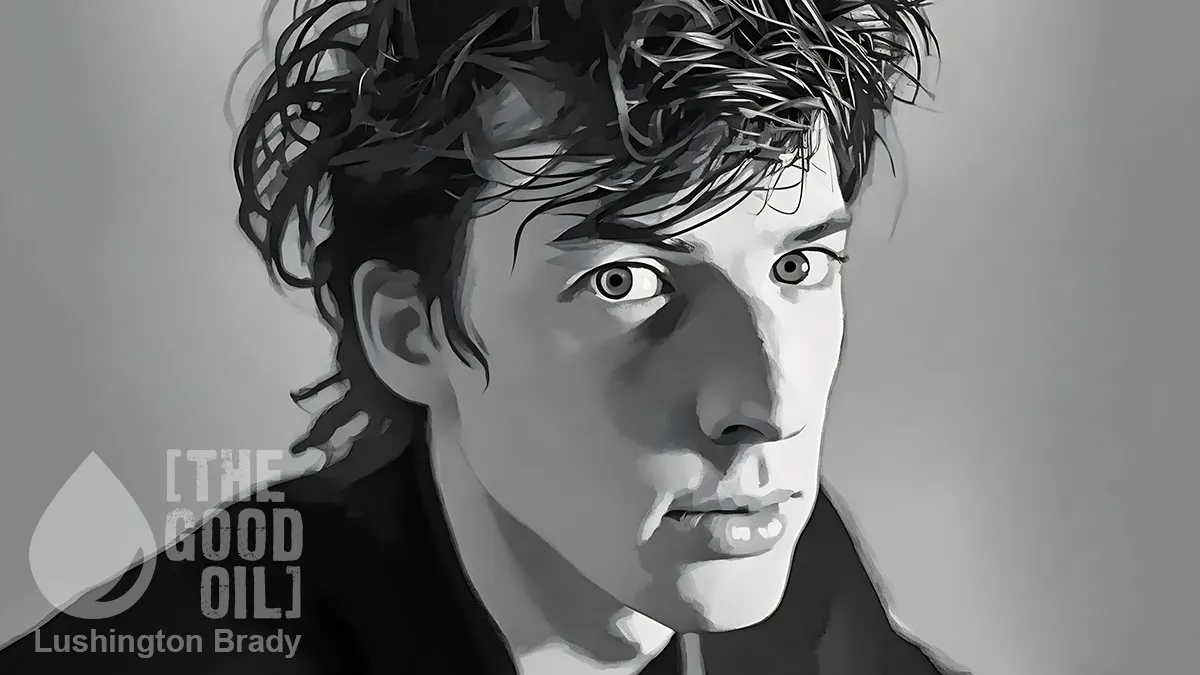
Francis John Tovey, better known by his stage name Fad Gadget, stands as a pivotal yet underappreciated figure in the evolution of electronic music. Although little-known today, Tovey is widely acknowledged as a key influence by such giants of ’80s pop as Depeche Mode and Culture Club. Later acts in the US, such as Skinny Puppy and Nine Inch Nails, also drew on Tovey’s pioneering work.
Frank Tovey was born in London’s East End in 1956, the son of a Billingsgate Fish Market porter. Although creative from an early age, his first experiences with music were not promising, mostly due to childhood coordination issues. “I just couldn’t play as well as many other others could play and I couldn’t sing as well as I’d like to either – I just didn’t have much confidence in my ability,” he later said.
Faced with such struggles with traditional instruments, Tovey turned, like musical pioneer Brian Eno, to unorthodox methods of manipulating sound by using tape recorders. He began creating sound collages by tampering with his old Grundig tape recorder, disconnecting the erase head and installing a manual switch to layer and retain sounds.
In the heady atmosphere of the Punk Explosion, DIY was the word and Tovey had the hands-on skills to do it. After graduating from Leeds Polytechnic (also alma mater of Soft Cell’s Dave Ball), he used the income from odd jobs to build a rudimentary home studio in the cupboard of his small London house. Along with his home-made Grundig machine, he eventually added a Crumar Compac electric piano, a Korg Minipops drum machine and a Korg synthesizer.
With this primitive setup, he recorded a demo tape, “Back to Nature”. The demo became the basis of the first Fad Gadget single when it caught the ear of Daniel Miller. Miller, who had a similar background in electronic music, was in the process of setting up his Mute Records independent label. Fad Gadget was the label’s first signing, in a roster that would eventually include Depeche Mode, Moby, Erasure, Einstürzende Neubauten, Goldfrapp, Grinderman, Nick Cave and the Bad Seeds and Yazoo.
In 1980, he released his debut album, Fireside Favourites. Recorded entirely solo, with tracks like “Coitus Interruptus” and “State of the Nation”, the album blended pulsating synth lines with industrial noise and critiqued societal norms with unflinching lyrics. Tovey’s live shows were just as confronting, even dangerous. He drew on his pre-musical studies in mime and visual arts to stage eccentric, theatrical performances, where he would cover himself in tar and feathers, swing microphones like whips, leap into crowds or smear shaving cream on his body. Echoing the self-endangering style of Iggy Pop, his live performances often resulted in self-inflicted injuries, like pulling out his own hair.
For Tovey, this wasn’t mere gimmickry, it was the physical embodiment of his lyrical critique of dehumanisation in a tech-driven world. He highlighted his disdain for passive performances in an interview: “I don’t think there’s anyone worth going to see any more. Nobody does anything on stage, everyone just...” This uncompromising ethic set him well apart from his more accessible contemporaries.
Thus, even though signing to Mute put him at the epicentre of an electropunk revolution that spawned many pop successes, Fad Gadget resisted pop compromise, preferring to carve out a niche that fused synthesizers, tape loops, and found objects like electric drills and razors. Other contemporary acts like SPK were using similar ‘industrial’ sounds and Depeche Mode adopted a smoother version of the style for their chart-topping Construction Time Again album. The hit single from the album, “People Are People”, sampled Fad Gadget’s “Collapsing New People”.
Clearly, some people were taking notice. A single from his next album Incontinent, “Make Room”/“Lady Shave”, became an underground hit, with its b-side’s quirky electro-funk influencing club scenes. Under the Flag followed in 1982, then the final Fad Gadget album, Gag, in 1984, recorded in Berlin. Working in Germany led to collaborations with Einstürzende Neubauten, who’d also been pursuing a similar aesthetic of integrating musical instruments with industrial sounds and metallic percussion. The single “Collapsing New People” is a nod to the English meaning of Einstürzende Neubauten: “Collapsing New Buildings”.
Following Incontinent, Tovey shed the Fad Gadget moniker, releasing Easy Listening for the Hard of Hearing, also in 1984. An experimental (even by Tovey’s own standards) collaboration with Boyd Rice, emphasised noise over melody. He later experimented with electronic takes on folk and acoustic protest music with albums like Tyranny and the Hired Hand, covering labour anthems such as “Sixteen Tons”, and touring with Irish folk-rock band the Pyros.
In 1993, he retired from music for a time, but returned in 2001, supporting Depeche Mode on tour and performing at festivals, while working on new material.
Tovey’s influence on popular electronic music can be gauged by the praise of his more famous contemporaries. Dave Gahan of Depeche Mode states that, “[Fad Gadget] definitely affected Depeche Mode in a big way and I’m sure you know hundreds of other bands.” Vince Clarke, formerly of Depeche Mode and later Erasure, also praised Tovey’s integration of synthesizers and tape loops as inspirational. Clarke cited Fad Gadget alongside early electronic pioneers as key influences, noting how tracks like “Back to Nature” embodied “genuine punk rock” in electronic form.
Even Boy George hailed him as “the king of electro – the unsung hero”, crediting Tovey’s dark humor and performative flair for influencing Culture Club’s theatrical pop.
Tragically, Tovey died of a heart attack on 3 April, 2002, at age 45, stemming from childhood heart issues.
Posthumously, his legacy has grown and documentaries like Fad Gadget by Frank Tovey (2006) and rankings of Gag among top post-punk albums highlight his enduring impact.

![[The Good Oil] Stuff Up of the Day](/content/images/size/w1304/format/webp/2024/09/Stuff-up-image-1.webp)


