Table of Contents
At the turn of the last century, Australia was a world-leading powerhouse in cinema. From the first feature-length film to the first dedicated movie studio, Australia was at the forefront of this astonishing new medium.
Then a combination of greed and government cackhandedness killed it: first, the formation of a distribution cabal that effectively shut out local production in favour of American imports, followed by a ban on the popular ‘Bushranger’ genre (Australia’s answer the American mainstay, the Western). Local production all but vanished for the next half-century, reaching a nadir in the 1960s.
From 1968–1971, a series of government initiatives ushered in a renaissance, spurring the ‘New Wave’ of Australian cinema. The introduction of the ‘R’ adult rating in 1971 birthed the New Wave’s disreputable sibling, the ‘Ozploitation’ genre: low-budget horror, comedy, sexploitation and action films (sometimes, all of them at once).
Today, the Ozploitation genre is celebrated by cinema fans such as Quentin Tarantino. Films such as Stone, Mad Max, Don’s Party, The Adventures of Barry McKenzie, Roadgames and more are recognised as bona fide classics. Early Ozploitation directors like George Miller and Bruce Beresford went on to become Academy Award-winning film makers.
But some genuinely great Ozploitation films remain obscure and under-recognised. This week in Diving into Obscurity, I’m looking at two of the best and yet least known: Long Weekend (1978) and Next of Kin (1982).
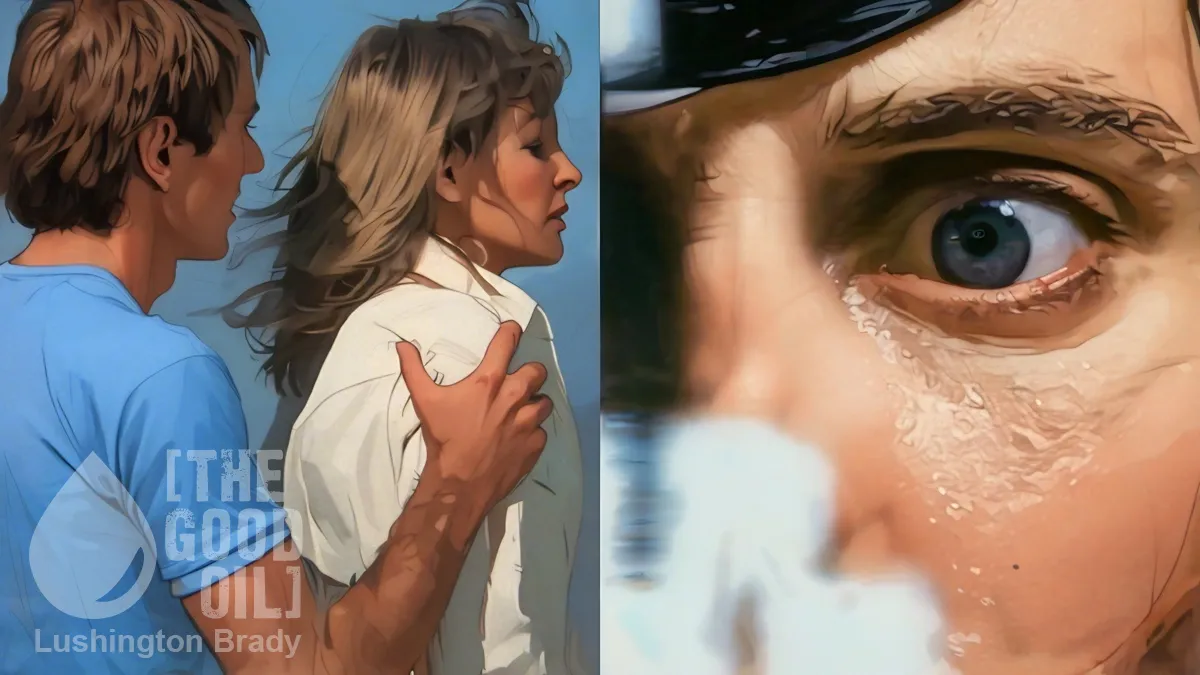
Directed by Colin Eggleston, Long Weekend is a truly unsettling and atmospheric thriller. The plot follows Peter (John Hargreaves) and Marcia (Briony Behets), an urban middle-class couple spiralling toward divorce, who set off for a long weekend camping trip at a remote beach, hoping to reconnect. But their contempt for each other – even the decision to take the family dog is a cause of pointless bickering – quickly surfaces.
That contempt is reflected in their attitude to the natural environment: they toss cigarette butts out the car window, carelessly run down kangaroos, and leave a trail of rubbish everywhere they go. Even when they set up camp at the idyllic beach, Peter hacks down a tree for no other reason than he feels like it and aimlessly fires bullets into the surrounding bush.
It seems their hostility to nature is returned. Food spoils for no apparent reason, ants overrun the camp, sharks lurk in the surf and spiderwebs practically attack them. Even a dead sea creature on the sand seems imbued with menace.
But, unlike a John Wyndham or Michael Crichton nature-on-the-rampage thriller, the film remains terrifyingly ambiguous. It is never made clear whether nature is consciously punishing the couple or if their paranoia is merely a projection of their guilt and internal decay.
The film was scripted by the legendary Everett De Roche, who wrote some of Ozploitation’s best-known thrillers, such as Patrick and Roadgames. Long Weekend may well be his best. He sidesteps overt horror tropes in favor of psychological tension and uses minimal dialogue to great effect. The lack of talkiness allows the film’s subtle and dread-filled cinematography and sound design to come to the fore. Cinematographer Vincent Monton captures the Australian landscape, not as picturesque but as oppressive and unknowable. The bush feels alive – watching. The beach is isolated and surreal, bathed in unnatural stillness. The sound design uses amplified, distorted animal calls to enhance the surreal, ominous atmosphere.
Eschewing over-the-top sex, gore and violence (though all three horror tropes are present), Long Weekend is a a horror film without a monster: a cerebral, existential experience.
Next of Kin (1982) is likewise a chilling and atmospheric gem that deserves far more recognition than it gets – and certainly far more than the miserly $228,251 it garnered at the box office. Unfortunately, New Zealand-born director Tony Williams only made one other feature, Solo (also released in 1978), and a handful of highly regarded documentaries.
Next of Kin has more recently earned high praise from the likes of YouTube critical channel Red Letter Media and Ozploitation aficionado Tarantino, who compared it positively to The Shining. The Philadelphia Mausoleum of Contemporary Art calls it “Australia’s answer to Suspiria”. It also seems that then-starting-out Hollywood superstar director James Cameron was taking notes. Just as The Terminator shamelessly lifted key shots from Mad Max, one of the most famous scenes in Cameron’s breakthrough movie is almost certainly lifted from Next of Kin’s startling climax (I’m not giving it away, but you’ll recognise it as soon as you see it).
Set in a sprawling, isolated retirement home inherited by a young woman named Linda (Jacki Kerin), the film follows her descent into paranoia as she reads her dead mother’s diary and unsettling happenings begin to pile up. John Jarratt, latterly famous as another horror icon, Wolf Creek, as ‘Mick Taylor’, also stars as Linda’s hometown love interest.
Like Long Weekend, Next of Kin is a slow burn: chilling and atmospheric, rather than relying on jump scares and gore. Depending on your preference, the film is either ‘boring’ or a restrained art-horror classic of psychological dread. Also like Long Weekend, sound design (including a haunting score by Tangerine Dream’s Klaus Schulze) and cinematography add a surreal and hypnotic quality to the film’s dream-like pacing.
Except... the slow-burn almost completely turns around in the film’s final act, which makes the mayhem of the last 15 minutes even more shocking.
Next of Kin, like Long Weekend, stands apart from its Ozploitation peers, even as it shares their DNA: made independently, on a modest budget and aimed (unsuccessfully, sadly) at both domestic and international markets. Its themes of isolation, madness and inherited trauma resonate, like Long Weekend’s outsider paranoia, with the uniquely Australian theme of fear of the unknowable and hostile landscape, which puts both more alongside Peter Weir’s The Last Wave (1977) than Nicolas Roeg’s gentler and beautiful Walkabout (1971).
The two serve as a reminder that Ozploitation was capable of far more than trashy fun. Like it’s more ‘arty’ New Wave sibling, it could turn out subtle haunting gems that are well worth watching.