
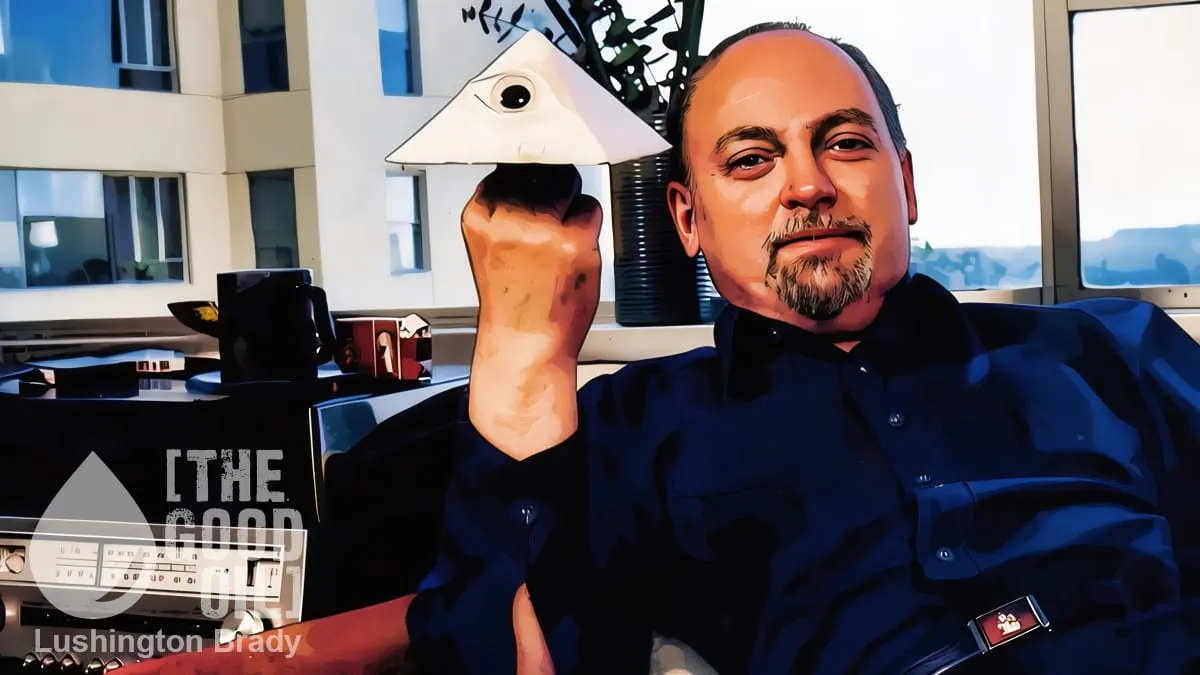
Last week, I chronicled the brief and gloriously anarchic career of the JAMs/KLF/Timelords. I also briefly outlined one of their chief inspirations: the sprawling, satirical science fiction acid trip of the Illuminatus! trilogy. While it is unrecorded if they ever formally met, the Scots music duo at least once shared a space with Illuminatus! co-author Robert Anton Wilson: Wilson had an uncredited role as a nude extra in the stage production of Illuminatus! The KLF’s Bill Drummond was a set designer for the show and Jimmy Cauty an audience member.
Had he known of the bizarre almost-encounter, Robert Anton Wilson would almost have certainly laughed it off as ‘just one of them coincidences’, while at the same time hinting that it was ‘one of them coincidences’. Mock profundity and hiding deep reflections behind a veil of satire was Wilson’s thing.
Robert Anton Wilson never met a sacred cow he didn’t want to tip, preferably while laughing and waving a copy of the Principia Discordia. His collaboration with Robert Shea on the Illuminatus! trilogy and his solo Schrödinger’s Cat trilogy remain among the sharpest, funniest and most subversive takedowns of dogma ever committed to paper. In an age when the World Economic Forum and its pet, The Science™, demand blind obedience and every ideology insists it alone possesses the One True Map of Reality, Wilson’s work reads like a field manual for intellectual self-defence. It is equal parts satire, philosophy, psychedelic romp and deliberate provocation. And it still stings as much as it swings.
Born Robert Edward Wilson in Brooklyn in 1932, he contracted polio as a child. His parents embraced the controversial Sister Kenny Method – hot packs, muscle re-education and rejection of the iron-lung orthodoxy – at a time when the The Science™ branded it quackery. It worked well enough for Wilson to walk, albeit at times with a cane and lifelong occasional bouts of spasms. The experience left him with a healthy contempt for medical priesthoods that put institutional ego before patient outcomes.
Later, as a 24-year-old in New York, he watched trucks dump six tons of Wilhelm Reich’s books into the Gansevoort Incinerator for burning by the US government. “I thought only Nazis did that,” he recalled. While Reich was undoubtedly a kook, book-burning struck Wilson as immeasurably worse than some whacky psychological theories.
(Kate Bush later put the government’s brutal pursuit of Reich into song and music video, with her achingly beautiful “Cloudbusting”, based on Reich’s son Peter’s memoirs, with the book briefly seen in the video.)
The episode crystallised the young Wilson’s lifelong allergy to authority, especially the kind that cloaks censorship in the robes of science or public safety.
Formally, Wilson’s academic credentials were modest but tellingly eclectic. He studied electrical engineering and mathematics at Brooklyn Polytechnic and English education at NYU without completing degrees. He later earned an MA and PhD in psychology from Paideia University, an institution that was accredited when he graduated but later lost that status. Far more formative was his day job: associate editor at Playboy from 1965 to 1971, a job, he said, which gave him not only a better salary than any other he’d had, but complete creative freedom.
More importantly, as part of the Playboy gig, he and Robert Shea waded through the conspiracy-laden mailbag of the Playboy Forum. Those letters – every paranoid fantasy from Illuminati bankers to Bavarian death cults – became raw material for Illuminatus!
Wilson’s literary heroes included James Joyce, whose linguistic pyrotechnics and rejection of linear narrative he emulated with glee. His friendship with Timothy Leary was equally influential. The two collaborated on projects exploring Leary’s eight-circuit model of consciousness, turning psychedelic insight into a practical (if tongue-in-cheek) toolkit for hacking your own brain. Wilson described himself as an ‘agnostic mystic’ – open to wonder but allergic to certainty. As he quoted, from Aleister Crowley’s Book of Lies: “I slept with faith and found a corpse in my arms on awakening; I drank and danced all night with doubt and found her a virgin in the morning.”
All statements are true in some sense, false in some sense, meaningless in some sense – Robert Anton Wilson.
But at the heart of his worldview sits Discordianism, the parody religion he helped popularise. Founded in the early 1960s by Greg Hill and Kerry Thornley via 1963’s Principia Discordia, it venerates Eris, Greek goddess of chaos and discord. Order and disorder are illusions imposed by the human nervous system: both are equally ‘true’ and equally absurd. The sacred practice is “Operation Mindfuck”, flooding the zone with surreal nonsense until straight-line thinkers crack and start questioning everything. Wilson and Shea turned this ethos into high art. “All statements are true in some sense, false in some sense, meaningless in some sense,” Wilson liked to say. It is the perfect antidote to every totalitarian certainty, whether religious, political or scientific.
Illuminatus! (1975), co-written with Shea, is the trilogy that made Wilson’s name. On the surface it is a drug-soaked, sex-drenched, conspiracy-laden postmodern romp. Beneath the surface it is a devastating satire of conspiracy thinking itself. The plot pits the secret rulers of the world, the Illuminati, a five-thousand-year-old (or, possibly older than humanity itself) cabal of control freaks, against the Discordians, the Justified Ancients of Mummu, agents of glorious chaos.
Along the way we meet every paranoid fantasy and trippy archetype the 1970s could muster: the Kennedy assassination as false-flag theatre, the Illuminati as both bankers and anarchists, the sinking of Atlantis, the 23 enigma, and enough tentacles to satisfy any H P Lovecraft fan. There’s talking dolphins who sing in nonsensical rhyming couplets, an anarcho-libertarian Captain Nemo with a golden submarine, a still-living John Dillinger and a bewildered hippy hero who got dragged from his cell in Mad Dog, Texas, to get blown on a beach by a gun-toting feminist, and then cajoled into copulating with a gigantic golden apple atop a 33-step pyramid in the basement of a Long Island billionaire’s mansion.
None of this even begins to touch on the glorious weirdness of Illuminatus! The genius is that Wilson and Shea treat all the conspiracy theories with equal deadpan seriousness and equal mockery. The book doesn’t debunk conspiracies so much as explode the very idea that any single narrative can explain the universe. It is the literary equivalent of a whoopee cushion at a conspiracy theorists’ convention.
The Schrödinger’s Cat trilogy (1979–81) is the sequel that never quite was and is, if anything, even weirder and funnier.
Recurring characters from Illuminatus!, from “New York’s bitchiest literary critic” to a mafia don nicknamed “Banana Nose”, pop up in new guises, genders and realities. Where the earlier work skewered political paranoia, the Cat books turn the same gleeful scalpel on quantum mechanics, the philosophy of science and the conceit of bands of two-legged primates.
For the unitiated, the title comes from a famous thought experiment from physicist Erwin Schrödinger. Like Albert Einstein, Schrödinger was deeply unsatisfied with quantum physics. To demonstrate its absurdity, he posited a thought experiment consisting of a cat locked in an opaque box. Also in the box is a mechanism by which a poison gas will be released by a completely random and unpredictable process. Once sealed in the box, Schrödinger said, the cat is literally both alive and dead at the same time: it’s only when the box is opened and an observer looks in that the cat is definitively either alive or dead. According to quantum mechanics, the answer is: yes, to both.
Each volume illustrates a different interpretation of the titular thought experiment. Book 1: The Universe Next Door embraces the Many Worlds interpretation: every possibility branches into its own parallel universe. Book 1: The Trick Top Hat explores non-locality and quantum entanglement. Book 1: The Homing Pigeons dives into observer-created reality, where consciousness collapses the wave function. Wilson’s treatment is playful, bawdy and deliberately absurd. Quantum mechanics becomes a metaphor for the multiplicity of selves and realities each of us inhabits. Certainty is the real enemy and laughter the only sane response.
Wilson called this approach Quantum Psychology. Outlined most clearly in his 1990 book of the same name, it rejects Aristotelian ‘is’ logic in favour of probabilistic, observer-dependent thinking. He advocated E-Prime – English without the verb ‘to be’ – to break the habit of mistaking models for reality. “The map is not the territory,” he repeated, borrowing from Alfred Korzybski. We live in ‘reality tunnels’ shaped by genetics, imprinting, conditioning and learning. The goal is model agnosticism: holding multiple maps lightly, ready to discard any that stop working. It is psychology for people who have taken the red pill, the blue pill and the whole damn pharmacy.
Wilson’s influence on popular culture is outsized and subterranean. Illuminatus! popularised the modern Illuminati mythos that still fuels everything from Dan Brown thrillers to QAnon fever dreams, usually without crediting the satire. Discordian ideas seeped into hacker culture, chaos magick and the early internet. The KLF built their entire aesthetic on Wilson and Shea: sampling everything, staging elaborate Mindfucks and culminating in the ritual burning of a million pounds sterling as pure Erisian art. Wilson’s fingerprints are on Alan Moore’s comics, X-Files episodes, and the general 21st-century suspicion that official narratives are usually self-serving nonsense.
Critics have sometimes dismissed Wilson as a lightweight crank, a stoner philosopher peddling relativism. There is some justice to the charge. His enthusiasm for every fringe idea occasionally veers into credulity; his prose can be self-indulgently Joycean. But, like Julian Jaynes’s The Origin of Consciousness in the Breakdown of the Bicameral Mind, it is possible for a book to be both “wonderfully bonkers” (to quote Daniel Dennett) and usefully thought-provoking.
The charge of relativism misses the point. Wilson was never saying “nothing is true, everything is permitted” in the nihilistic sense. He was saying everything is a model. Some models are more useful than others. The test is pragmatic, not metaphysical. In an era when governments, corporations and activists all demand you swallow their One True Reality whole, Wilson’s cheerful scepticism is more necessary than ever.
The Illuminatus! and Schrödinger’s Cat trilogies are not perfect. They are messy, sometimes dated in their 1970s counter-cultural obsessions (but sometimes surprisingly prescient, such as with President Lousewart Furbish V’s ‘Revolution of Lowered Expectations’, virtually a mission statement for Just Stop Oil and their ilk), and occasionally exhausting. But they are also liberating. Wilson reminds us that the emperors of certainty – scientific, political, religious – have no clothes. He arms the reader with laughter, curiosity and the courage to say ‘maybe’ when everyone else screams ‘must’, and drink and dance all night with Doubt. In the end, his greatest gift is not any particular theory but the attitude: stay playful, question everything, and never let the bastards convince you their map is the territory.
For anyone tired of being told what to think by experts, ideologues or algorithms, Wilson remains essential reading. Operation Mindfuck continues. The only question is whether you’re still playing along with the conspiracy – or finally laughing at it.





![[The Good Oil] Stuff Up of the Day](https://storage.ghost.io/c/31/f4/31f4e20a-0315-499e-83ff-139e8eab53bf/content/images/size/w1304/format/webp/2024/09/Stuff-up-image-1.webp)

