Charlton Allen
Charlton Allen is an attorney and former public servant who writes on policy, history, and religion. He is the nominee of President Donald J Trump to serve as General Counsel of the Federal Labor Relations Authority. The views expressed are solely his own and do not necessarily reflect those of the president or his administration.
History does not long entrust the care of freedom to the weak or the timid. – Dwight D Eisenhower
The history of war is crowded with acts of courage. Yet now and then, one story survives because later generations recognize something enduring in it.
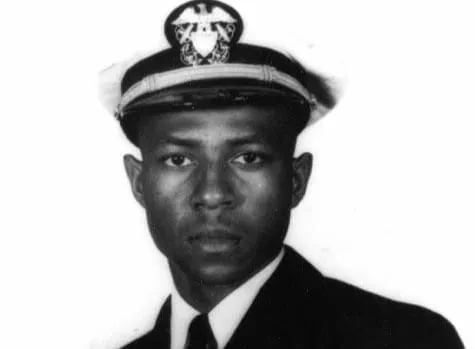
Ensign Jesse L Brown’s story endures for exactly that reason.
He was born in 1926 – 100 years ago this October – in the hard soil of rural Mississippi, the grandson of sharecroppers, in a part of America where opportunity for black citizens was then constrained by law, custom, and fear.
The world into which Brown was born offered little encouragement to ambition, and even less to dreams that crossed the hardened racial boundaries of the era.
Yet from an early age, he became captivated by flight. He clipped photographs of airplanes from magazines. He studied pilots with the intensity of a boy already imagining a horizon beyond the fields around him.
Growing up in Depression-era Mississippi, Jesse Brown set his sights on something few black Americans of his generation could realistically imagine – becoming a naval aviator.
His friends later described him as serious, disciplined, and intensely focused. He spent long hours studying, worked deliberately on his speech and handwriting, and understood early in life that mistakes likely to be overlooked in others might not be overlooked in him.
Brown eventually attended Ohio State University before entering the navy’s flight training program. The environment he entered remained overwhelmingly white, and not everyone there welcomed him. But naval aviation had a way of stripping away illusion. A pilot either knew how to fly or he did not. Brown did.
In 1948, Jesse Brown earned his Wings of Gold, becoming the first African American naval aviator in the history of the United States Navy.
Brown’s achievement drew national attention. But he approached naval aviation not as a symbol or celebrity, but as a professional.
Fellow pilots respected him because he could fly.
And fly he did.
Brown mastered the powerful and unforgiving Vought F4U Corsair, one of the most formidable fighter aircraft of the second world war and Korean War era. The Corsair was fast, difficult, and dangerous in inexperienced hands. Brown handled it with skill and calm precision.
But history was already moving toward another war.
In 1950, communist forces crossed the 38th parallel into South Korea, beginning the Korean War. American forces soon found themselves fighting in some of the harshest conditions modern warfare had ever produced. Nowhere was the suffering greater than around the Battle of Chosin Reservoir, where United Nations troops battled encirclement, snow, mountainous terrain, and temperatures that plunged far below zero.
It was there, on December 4, 1950, that Jesse Brown’s final flight began.
Brown and Lt (jg) Thomas J Hudner, Jr flew that day with a navy squadron providing close air support over the frozen mountains of North Korea to embattled marines near Chosin Reservoir.
Enemy ground fire struck Brown’s Corsair during the mission, damaging the aircraft and forcing him into a crash-landing high in the snow-covered mountains of North Korea. Hudner watched helplessly as Brown’s crippled fighter slammed into the mountainside. Smoke rose from the wreckage. Brown survived the impact but was trapped inside the twisted cockpit, gravely injured and unable to escape.
Had the story ended with Jesse Brown’s death in the frozen mountains of Korea, it would still rank among the great American stories of courage and sacrifice – a young black aviator, born into segregation and inequality, giving his life for a nation still imperfectly living up to its founding creed.
But history had one more measure of character to reveal.
Another pilot – a member of Ensign Brown’s squadron – circled overhead.
What followed revealed a level of loyalty few who witnessed it would ever forget – nor should we.
Knowing enemy troops could arrive at any moment, Lt Hudner made a decision almost unthinkable for a naval aviator: he deliberately crashed his own Corsair into the frozen mountainside in an attempt to save his friend.
Snow covered the mountainside so deeply that rescuers struggled to move across the terrain. The cold was brutal even by Korean War standards.
Hudner climbed through the wreckage with little more than gloves and determination, trying desperately to reach Brown through twisted metal, smoke, and spreading fire. A rescue helicopter eventually arrived, and the men worked frantically with axes in an effort to free him. They could not.
Brown and Hudner were flying together barely two years after Harry S Truman ordered the desegregation of the United States military. The policy itself remained controversial, unevenly enforced, and deeply resented in parts of the country.
Much of the nation Jesse Brown served still denied black Americans equal access to schools, voting booths, neighborhoods, universities, gas stations, hotels, restaurants, and even water fountains. Black Americans traveling across large swaths of the country often did so with a copy of The Negro Motorist Green Book and a prayer.
Jesse Brown flew and fought for the United States at a time when segregation still shaped daily life across much of the country. His service came before the victories of the civil rights movement – before the confrontation at Little Rock Central High School and before many black Americans in large parts of the South could vote freely, attend equal schools, or expect equal treatment under the law.
And yet there they were together in the skies above Korea – one black, one white, flying as brothers in the same squadron of the same Navy, entrusted with the same mission beneath the same flag.
History had moved quickly. But not quickly enough.
It was there, high above the frozen mountains of Korea, that a better America revealed itself.
Jesse Brown was willing to make the ultimate sacrifice because he believed in the idea of America – not as it was, but as it might someday become: a nation finally capable of realizing the full truth set forth at its founding, that all are created equal and equal before the law.
And Hudner was willing to sacrifice his own life to save Brown – not because of the color of Jesse Brown’s skin, but because of the content of his character. In that desperate act of loyalty and brotherhood was an insight into the America that Martin Luther King Jr would later dream might fully emerge.
Ensign Jesse L Brown died there in the snow at the age of 24.
Years later, Hudner would still struggle to speak about him without emotion. He had not been able to bring Jesse Brown home. Even six decades later, the burden remained with him. In 2013, he traveled to Pyongyang in the hope that Brown might finally be brought home at last.
Hudner had refused to leave Ensign Brown alone behind enemy lines.
That, too, is part of the measure of an American hero.
Memorial Day is not merely about remembering the dead. It is about remembering what they chose to live for.
Jesse Brown’s life reminds us that patriotism – at its best – is not the denial of national shortcomings. It is the belief that a nation remains capable of courage, decency, and renewal.
Even in its imperfections, America remained worthy of the faith Jesse Brown placed in it.
Jesse Brown believed in America long before America fully believed in him.
And then he gave his life for it.
This article was originally published by RealClearDefense and made available via RealClearWire.