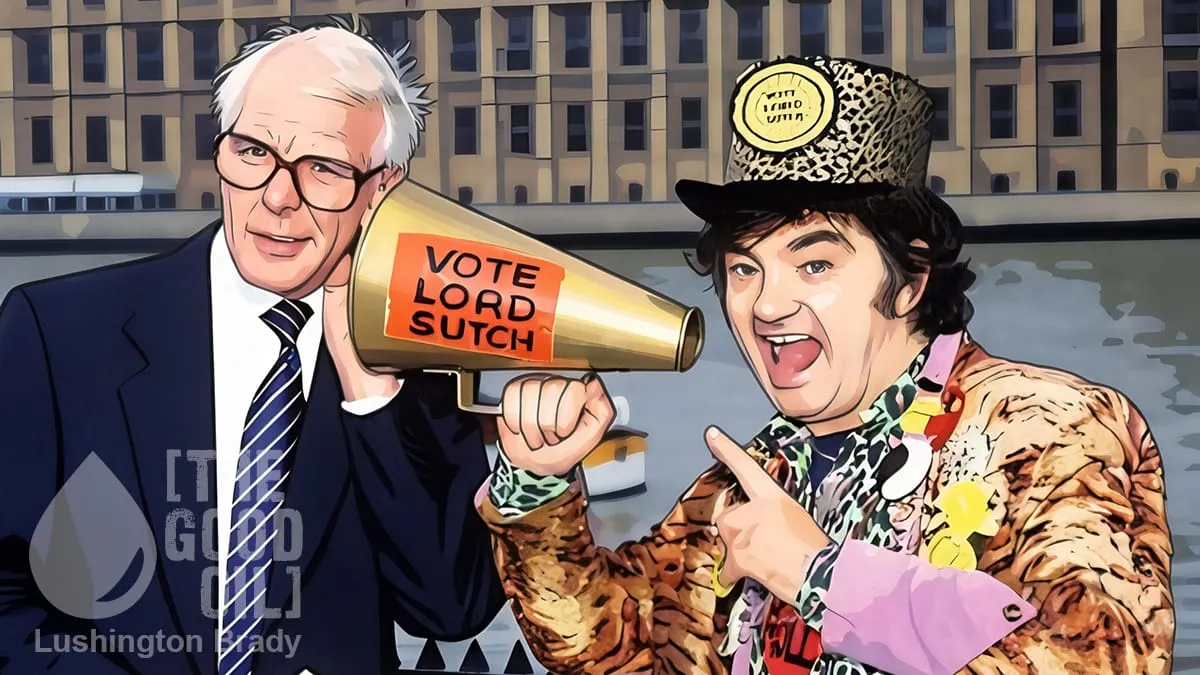
David Edward Sutch, better known as Screaming Lord Sutch, or just Lord Sutch, was one of the most colourful and eccentric figures to emerge from the British rock scene of the 1960s. Born on 10 November 1940 in Hampstead, London, and dying by suicide on 16 June 1999 at age 58, Sutch carved a dual legacy as a pioneering horror-themed rock performer and the founder/leader of the satirical Official Monster Raving Loony Party (OMRLP). In fact, he holds the Guinness record for contesting the most UK parliamentary elections: 39 between 1963 and 1997. Almost all as a novelty or protest candidate.
Sutch’s flamboyant stage persona, complete with top hat, tails, coffin entrances, and Jack the Ripper theatrics, placed him at the forefront of what became known as shock rock or horror rock. While never achieving massive commercial success in music, his influence rippled through later theatrical rock acts.
Politically, he embodied a long British tradition of mocking the establishment through absurd candidacies and policies, turning elections into performance art. His story bridges 1950s–60s novelty horror, British rock eccentricity and the enduring appeal of satirical politics.
Sutch did not emerge in a vacuum, though. He drew directly from American pioneers of theatrical, macabre performance blended with rock and roll or novelty music, such as Screamin’ Jay Hawkins.
Born Jalacy J Hawkins in 1929, Screamin’ Jay Hawkins is widely regarded as the godfather of shock rock. His 1956 hit “I Put a Spell on You” was transformed from a ballad into a raw, guttural scream-fest during a drunken recording session. It sold over a million copies despite radio bans for its suggestive content, or for being “too cannibalistic”.
Hawkins’ stage act was pure theatrical horror-comedy: he emerged from a coffin in a shower of flash-bangs, wielded props like “Henry”, a smoking skull on a stick, rubber snakes and leopard-skin outfits, blending voodoo imagery (long before Malcolm John Rebennack Jr, aka Dr John the Night Tripper) with comic menace in the style of a “black Vincent Price”.
Hawkins influenced countless artists, including Alice Cooper, Tom Waits, the Cramps, Black Sabbath, Led Zeppelin, Marilyn Manson and Rob Zombie. His coffin entrance and over-the-top persona directly inspired Sutch, who duly adopted the “Screaming” prefix and replicated the dramatic entrance.
Across the Atlantic at the same time, on television “Ghoulardi” (Ernie Anderson) hosted Cleveland’s Shock Theater from 1963 to 1966, presenting old horror films with anarchic, subversive humour. Dressed in a lab coat, fright wig, and fake beard, Ghoulardi dropped weird images over the footage, made strange noises, and delivered catchphrases like “Stay sick” (later paid homage as the title of a Cramps album), “Turn blue”, and “Hey, group!”
Ghoulardi’s irreverent style influenced the counterculture of Cleveland and Akron. Local musicians in bands like Devo, Pere Ubu, The Dead Boys, and The Cramps cited him as a formative influence on their weird, punkish sensibilities. Ghoulardi represented the comic-horror TV tradition that paralleled musical novelty acts. (On the other side of the globe, “Deadly Earnest” was a similar fixture on late-night Australian TV in the 60s and early 70s.)
The 1960s monster craze also produced pure novelty hits like Bobby “Boris” Pickett’s 1962 “Monster Mash”. With its Boris Karloff-inspired narration and dance-party theme featuring Dracula, the Wolfman and other creatures, the song topped charts and captured the era’s playful fascination with horror B-movies and TV. It exemplified the light-hearted, danceable side of monster culture that Sutch would amplify with rock energy and British wit.
These figures – Hawkins’ visceral shock, Ghoulardi’s anarchic hosting and “Monster Mash”s singalong fun – created a template of horror as entertainment and satire. Sutch synthesised them into a uniquely British rock context.
Sutch began performing in the late 1950s and early 1960s amid Britain’s skiffle and rock ’n’ roll explosion. Inspired by Hawkins, he adopted the stage name “Screaming Lord Sutch, 3rd Earl of Harrow” (a self-bestowed title with no actual peerage connection, though he later legally changed his name). Sutch fronted the Savages, delivering high-energy sets blending rock, R&B and horror theatrics.
His signature stage show involved emerging dramatically from a black coffin (once getting trapped inside, later parodied by Slade), and dressed as Jack the Ripper with props, including knives, daggers, skulls and artificial corpses. He performed in top hat and tails or flamboyant capes, combining menace with camp comedy.
Early recordings came via eccentric producer Joe Meek (known for sci-fi and horror-tinged sounds like “Telstar”). The 1963 single “Jack the Ripper” became his best-known track, a proto-psychedelic stomper with eerie atmosphere.
Sutch had a knack for attracting top-tier session musicians, even if commercial breakthroughs eluded him. His 1970 album Lord Sutch and Heavy Friends (also known as Smoke and Fire) featured Jimmy Page, John Bonham, Jeff Beck, Noel Redding and Nicky Hopkins. Despite the star power, it was critically panned and voted the worst album of all time in a 1998 BBC poll – yet it remains a cult curio for its raw energy and guest spots. A 1972 live album, Hands of Jack the Ripper, captured performances with Ritchie Blackmore and others (recorded without full consent according to some accounts).
Other singles included proto-psychedelic tracks like “The Cheat” and novelty covers. Sutch also dabbled in pirate radio, occupying Shivering Sands Army Fort in 1964 with manager Reginald Calvert to launch Radio Sutch (featuring music and readings from Lady Chatterley’s Lover). The station was sold and renamed Radio City, while Calvert was later killed in a dispute (his shooter acquitted on self-defence grounds).
By the late 1960s and 1970s, Sutch’s musical output continued with albums like Rock & Horror (1982) and live releases, but his focus increasingly shifted toward politics and publicity stunts. He toured extensively and maintained a loyal following for his outrageous live shows, which anticipated the theatricality of glam and shock rock. His vocal style was more about energy and character than technical prowess, but the spectacle carried the act.
Sutch’s political career began in 1963 as a publicity vehicle for his music. He stood as the National Teenage Party candidate in the Stratford by-election (garnering 208 votes) and later in other seats, advocating for lowering the voting age. In 1983, at the Bermondsey by-election, he founded the Official Monster Raving Loony Party (OMRLP), a name inspired by a Monty Python skit, formalising his satirical persona.
The OMRLP’s deliberately absurd policies satirised the British political establishment: requiring all MPs to wear clown costumes, nationalising “hot air”, turning the UK into a tax haven, or painting invasive grey squirrels red to boost native red squirrel numbers. The party positioned itself as a protest option for voters disillusioned with mainstream parties, especially in safe seats. Sutch’s flamboyant campaigns – top hat, outrageous Union Jack outfits, and media-friendly stunts – generated publicity far beyond his typical low vote tallies. He often finished last but occasionally outperformed minor parties (e.g., beating the SDP’s David Owen in one by-election, contributing to that party’s collapse).
This fit a long British tradition of mock-comic or eccentric political candidacies. Earlier examples included independent jokers and satirical figures: the party’s spirit echoed Monty Python’s Flying Circus’ “Silly Party” sketch and The Goodies’ loony candidates. Especially thanks to the British tradition of all candidates ascending the podium while the vote count is read, the OMRLP provided comic relief and a safety valve for protest votes while highlighting the absurdity of politics. Some of its ideas (like commercial radio or aspects of youth enfranchisement) eventually entered mainstream debate.
Sutch led the party until his death and it continues today under leaders like Howling Laud Hope, fielding novelty candidates with policies that blend whimsy and pointed critique. Memorably, he visited Australia in the early 1990s, pestering PM Paul Keating on campaign stops over the latter’s calls for Australia to reject the monarchy.
Sutch’s record of 39 elections underscores his persistence and the party’s role as a perennial sideshow that occasionally influenced the main event through publicity.
Sutch’s most enduring cultural impact lies in his pioneering of shock rock theatricality. His coffin entrances, horror props and camp menace directly prefigured the 1970s shock rock explosion, most notably Alice Cooper. While Cooper drew from multiple sources (including Hawkins), several accounts position Sutch as a key British influence on Cooper’s macabre stagecraft and persona.
This lineage later extended into gothic rock and horror punk. Theatrical performance, dark humour and outsider aesthetics in bands like the Damned, with singer Dave Vanian (also trading on his actual day job as a gravedigger) similarly wearing frock coats and other Victorian stylings, early goth acts and horror-punk scenes owe something to Sutch’s template of rock as spectacle and subversion. His work with Joe Meek added a layer of eerie, otherworldly production that resonated with later darkwave and gothic sounds. Sutch embodied the eccentric, anti-establishment spirit that gothic rock often celebrated: flamboyant rebellion against conformity.
Beyond music, the OMRLP cemented his status as a symbol of British satirical eccentricity, much like the Goons or Monty Python. His life story – rock dreamer turned political jester, battling personal demons (bipolar disorder) – adds tragic depth. Posthumous releases and documentaries keep his music alive, while the party he founded persists as a quirky fixture of UK elections.
In sum, Screaming Lord Sutch was more than a novelty act. He was a bridge between 1950s–60s horror novelty and the theatrical rock that followed, a tireless promoter of his own myth, and a reminder that politics and entertainment often blur in the most entertaining ways. His coffin may have been a prop, but his legend continues to rise from it.