
Table of Contents
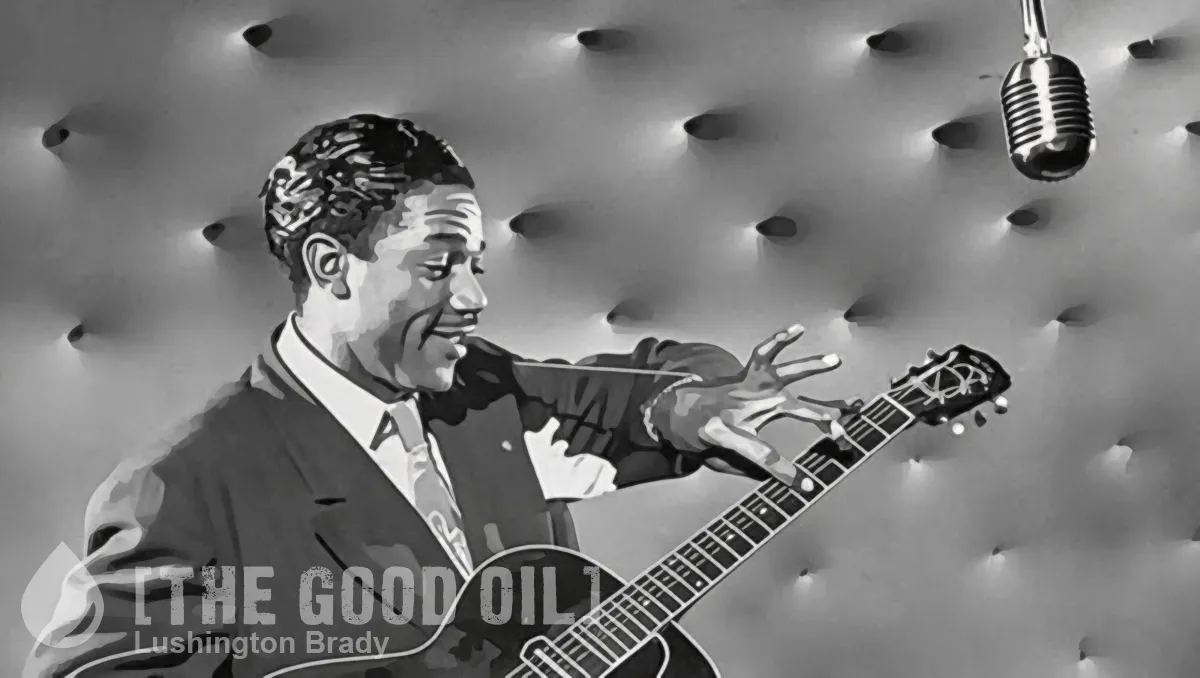
“Slim Gaillard is a tall, thin Negro with big sad eyes who’s always saying, ‘Right-orooni’ and ‘How ’bout a little bourbonorooni’… Slim goes mad and grabs the bongos and plays tremendous rapid Cubana beats and yells crazy things in Spanish, in Arabic, in Peruvian dialect, in Egyptian, in every language he knows, and he knows innumerable languages… To Slim Gaillard the whole world was just one big orooni” – Jack Kerouac, “On The Road”
If you hear the phrase ‘orooni’ attached as a suffix, you’ll almost certainly think of The Simpsons’ Ned Flanders. While not his most common catch-diddly-atch-phrase, ‘orooni’ was so associated with Springfield’s resident good neighbour that when he proposes a neighbourhood watch, everyone waits with bated breath until he adds, neigbourhood watch… OROONI!
In fact, the phrase predates The Simpsons by a good 40 years, as Jack Kerouac’s brief salute to jazz musician Slim Gaillard shows. But who was Slim Gaillard? Where many of his contemporaries are still famous names, or even if not, nearly everyone knows their music. Gaillard’s music is today almost forgotten, despite him being one of the most remarkable musicians and singers of his era.
Possibly that’s because much of his work is, rightly or wrongly, assigned to the ‘novelty’ or comedy genre. But, like Spike Jones or Tiny Tim, while Gaillard might seem like a novelty act with songs like “Cement Mixer (Put-ti, Put-ti)” or “Potato Chips”, behind the seeming nonsense lay an incredible depth of musicianship.
In fact, Slim Gaillard was in many ways the quintessence of early 20th century American popular music. Few figures in 20th-century popular culture embody both the delirious joy and deep hybridity of American music as perfectly. A multi-instrumentalist, vocalist, songwriter, comedian, polyglot and self-invented myth, Gaillard forged a career that spanned jazz, novelty music, Hollywood and European bohemia.
Yet his greatest legacy may be the way he fused linguistic play, global influences and musical virtuosity into a style that defied genre boundaries: anticipating later developments in postmodern comedy, world music and nightlife culture. To trace Slim Gaillard’s story is to follow a zig-zagging line through mid-century entertainment: from the swing era to bebop, from live radio to beat-era cabarets and always with a sly grin and a winking invitation to join his surreal world.
While often dismissed as a novelty performer, Gaillard was a genuine musical pioneer whose work illuminates the porous boundaries between jazz and comedy, Black performance and mass entertainment, and American vernaculars and global cosmopolitanism.
Gaillard’s early life is famously hazy. Born Bulee Gaillard – almost certainly in 1911 – his precise birthplace is debated. He variously claimed Detroit, Cuba and Santa Clara in the Canal Zone and often embellished his youth with stories of shipwrecks, stowaway journeys and worldwide wandering. While such tall tales complicate biographical accuracy, they also reflect a deep truth about Gaillard: he was a master fabulist and attuned to the power of self-creation.
What is reliably documented is that by the early 1930s he was in Detroit, working as a bootblack and budding musician. His early facility with languages, real or improvised, was already forming. “He knows innumerable languages,” as Kerouac noted. He absorbed Arabic from Middle Eastern immigrants, Spanish from Latino communities and a streetwise blend of jive and African American vernacular English. These linguistic threads later knitted together into “Vout-O-Reenee”, the private slang that became his artistic signature.
Detroit in the Depression was a musical crossroads and Gaillard soaked up everything he heard: blues, swing, pop, Latin rhythms and the thriving Black vaudeville tradition. He learned guitar, piano, vibraphone, bass and drums, performing wherever he could. The ingredients of his later persona – comic timing, instrumental dexterity and a chameleon’s cultural adaptability – were already present.
Gaillard’s career ignited when he met bassist Slam Stewart in 1936. Stewart’s signature humming-along-with-the-bowed-bass technique blended eerily well with Gaillard’s unpredictable vocal style. Together, as Slim & Slam, the duo became one of the most distinctive acts of the swing era.
Their breakthrough was “Flat Foot Floogie (with a Floy Floy)” (1938), a deliriously nonsensical number that became a national hit. The song’s nonsense syllables – already a hallmark of Gaillard’s approach – fit perfectly into the era’s appetite for light relief amidst economic and political anxiety. Other hits followed: “Tutti Frutti”, “Laughin’ in Rhythm”, “Cement Mixer (Put-ti, Put-ti)”.
In these recordings, Gaillard’s artistry is unmistakable. While the lyrics appear comedic and chaotic, his rhythmic precision is laser-sharp. He could stretch or compress a phrase with the elasticity of a seasoned jazz soloist. His guitar and piano playing is deceptively sophisticated: swinging hard while seeming casual. And his command of timing – sudden pauses, muttered asides, unexpected scats – gives the music an improvisatory, almost Dadaist, energy.
Slim & Slam were not merely entertainers but experimenters. Their blend of humour and jazz anticipated the playful edge of later bebop musicians like Dizzy Gillespie, who adored Gaillard. Indeed, Gaillard’s improvisational daring – linguistic, rhythmic, comedic – set the stage for the bebop revolution’s blurring of musical boundaries.
Like many performers of his era, Gaillard served in the US military through WWII. The war interrupted his collaboration with Slam Stewart, but he continued performing and recording. His comic masterpiece “Cement Mixer (Put-ti, Put-ti)” became a sensation in 1945, its mechanical-sounding refrain perfectly capturing his knack for turning mundane noises into musical texture. Like contemporary Spike Jones, Gaillard’s comedic music no doubt served as a much-needed corrective to the grim reality of the war.
What makes “Cement Mixer” remarkable is that beneath the absurdity lies genuine innovation. Gaillard uses the syllables “put-ti put-ti” much like a percussionist, creating a syncopated motif that drives the song. This technique presages later experiments in vocal percussion, from doo-wop basslines to early beatboxing. Gaillard was playing with the boundary between language and sound, a theme that runs throughout his work.
At a time when jazz was gravitating toward instrumental virtuosity and intellectual exploration, Gaillard offered a different form of intelligence – one rooted in playfulness, surrealism and cultural collage. He was not merely a novelty act: he was engaged in a kind of musical theater in miniature, where everyday language became a site of transformation.
Perhaps Gaillard’s most enduring creation is Vout-O-Reenee, his self-invented slang that functions as both linguistic experiment and cultural satire. Part jive talk, part nonsense, part multilingual bricolage, it appears in dozens of songs, from “Tutti Frutti” to the legendary “Groove Juice Symphony”. The world truly was “just one big orooni”.
This puts Gaillard squarely in the long line of African-American culture’s veneration of the ‘man of words’, inherited from non-literate African culture’s respect for linguistic versatility, which winds all the way from the ante bellum plantations, through scat, to jive talk, to early rap and hiphop.
Like scatting, Vout also allowed Gaillard to use words themselves as music, free from semantic constraints. He could shape vowels and consonants for rhythmic and melodic effect, treating the voice as pure instrument. Like the ‘sound poems’ of Dada, the European art movement that appeared in Gaillard’s youth, to Kerouac’s Beat prose-poetry, then avant-garde poetry and performance art, Vout blurred the line between meaning and nonsense.
Finally, Vout was just fun. Audiences never knew what he might say, creating a sense of joyful unpredictability.
Gaillard even published a dictionary, Slim Gaillard’s Vout-O-Reenee Dictionary, which straddles parody and earnestness. It is both a joke and a legitimate attempt to codify a private world. This impulse toward world-building anticipates later performers like Sun Ra, George Clinton, and hip-hop artists who construct entire cosmologies around their stage personas.
But Gaillard was much more than a musical comedy novelty or even clever wordsmith. The fact that he performed alongside the undisputed musical genii of his time shows that his status among fellow musicians was beyond dispute. Charlie Parker, by all accounts, admired Gaillard deeply, not only for his musicianship but for his comedic genius.
If any moment demonstrates the respect in which Slim Gaillard the musician was held by other musicians, it’s the famous 1946 session at Billy Berg’s club in Hollywood with Parker and Dizzy Gillespie. The recordings, including an extended version of “Slim’s Jam”, show Gaillard holding his own alongside the architects of bebop. Gaillard’s piano playing on these sessions surprises listeners accustomed to his vocal antics. It swings hard, uses angular rhythms and engages with Parker and Gillespie’s bop vocabulary without imitation. His comping is responsive and inventive and his solos show a musician fully conversant with contemporary jazz.
In this light, Gaillard is not an anomaly in the bebop story but a parallel innovator whose work intersected meaningfully with the movement.
The late 1940s and early 1950s brought Gaillard into Hollywood films and national radio, where he became a fixture on variety shows. His appearances in movies such as Hellzapoppin’ (1941), St Louis Blues (1958) and Roots of Heaven (1958) reveal his physical comedy: long limbs, expressive hands and a dancer’s feel for timing.
A striking aspect of Gaillard’s Hollywood work is his portrayal of global characters. He frequently spoke in fluent (or seemingly fluent) Spanish, Arabic, French or Yiddish during performances. Unlike the, at times cringeworthy (with hindsight), parodies of Jerry Lewis, Gaillard’s multilingualism was partly real, partly theatrical, but always affectionate. Gaillard could improvise Yiddish lines with the fluency of a Lower East Side comic and could switch to Arabic-inflected patter without missing a beat.
This chameleon quality made him appealing to diverse audiences but also coded Gaillard as a kind of cosmopolitan Black performer – an alternative to the stereotypes Hollywood usually imposed. While he was sometimes cast in caricatured roles, Gaillard’s performances resist confinement through sheer idiosyncrasy.
By the late 1950s, Gaillard’s American profile dimmed as musical fashions shifted. But, just as they did with Jerry Lewis, European audiences kept Gaillard’s career humming. He was rediscovered as an elder statesman of hipness. The postwar European fascination with jazz, absurdism and Black American culture made Gaillard’s sensibility newly relevant.
During the 1960s and 1970s, he performed in clubs, festivals and cabarets across the continent, sometimes recording with local musicians. Remarkably, he adapted smoothly to changing tastes, whether performing straight jazz standards, comedic sets or his signature Vout routines.
Still, as Kerouac’s paean in On The Road shows, in America the Beats still adored Slim Gaillard. Kerouac saluted Gaillard a “madman”, “angel” and “genius”: all high praise in the Beat vernacular, which should hardly be surprising as Gaillard’s playful language, improvisational ethos and globe-trotting mythos all resonate with Beat aesthetics. He was a proto-Beat long before the movement had a name.
Gaillard continued performing sporadically into the 1980s and made several warmly received late recordings. He appeared in the 1989 film Absolute Beginners and remained an admired figure among musicians who understood his deeper contributions. Contemporary performers – from Tom Waits to Harry Nilsson, from Cab Calloway imitators to slam poets – echo Gaillard’s blend of music and verbal play. He anticipated the modern understanding that the boundaries between genres, languages and identities are permeable.
Slim Gaillard’s significance lies not only in what he did but in how he did it. It ain’t what you do, after all: It’s the way that you do it.
Gaillard’s conflation of language and rhythm predates modern vocal experimentation. He turned speech into percussion, comedy into melody and multilingual code-switching into an art form. By merging comedy, theater and swing, Gaillard helped establish a jazz-cabaret hybrid later explored by artists like Jon Hendricks and Mose Allison. More importantly for later American popular culture, Gaillard rejected narrow definitions of Blackness imposed by the entertainment industry, presenting himself instead as a worldly, multilingual, culturally omnivorous figure.
Slim Gaillard was more than a novelty musician – he was a cultural shape-shifter, a joyful absurdist and a fearless innovator. His work invites us into a parallel world where language is elastic, humor and virtuosity are inseparable, and music is a playground of global influences. Gaillard stands as a reminder that artistry need not be solemn to be profound. Beneath every “put-ti, put-ti”, every Vout concoction, every multilingual detour, lies a deep understanding of jazz, rhythm and performance. Gaillard’s genius resides in the marriage of creativity and play – an improvisational worldview that feels remarkably modern.
Slim Gaillard’s legacy is not a curious footnote but a beacon. He showed how the world could be remixed, reinvented and sung anew. His music remains, above all, an invitation to delight – to laugh, swing and join him in the irresistible rhythms of Vout-O-Reenee.
And we could all do with a good belly-laugh, these days.



![[The Good Oil] Stuff Up of the Day](/content/images/size/w1304/format/webp/2024/09/Stuff-up-image-1.webp)


