The art school band has been a staple of rock from at least the days when a bunch of middle-class Cambridge boys met up at university in posh Kensington, dropped acid and ended up calling themselves the Furious Abdads, before settling on the Pink Floyd, later dropping ‘the’ altogether. As one critic has noted, to recreate the circumstances that led to Radiohead, you’d have to spend at least a quarter of a million pounds: the collective fees for four boys at toffy Abingdon School, where the band members met.
Even in the Antipodes, the pattern held: the members of the Boys Next Door, later to become the Birthday Party, which morphed into the Nick Cave and the Bad Seeds, met at exclusive Caulfield Grammar School in Melbourne. Still, while the Boys Next Door were, in the words of bassist Tracy Pew, “a bunch of snivelling little poofs”, as the Birthday Party they morphed into a rock’n’roll beast who instilled a real fear into the Brits when they relocated to London for a time. Poverty and heroin will do that to you: the slumming became all too real and roughened off those bourgeois edges.
The Australasian pair who founded one of the most threatening purveyors of what became known as Industrial music followed a similar path, only much quicker. Their experience of life at the bottom didn’t begin as an affectation, but a career choice. They didn’t slum it at the bottom, they clawed there way up from it. SPK were born, not in an art school, but an asylum.
Graeme Revell graduated 7A from Auckland Grammar, classically trained on piano and French horn, but ditched a Masters in Political Economy to move to Sydney in 1978 and work as an orderly at Rozelle Mental Asylum. Where he met Neil Hill, a nurse who occasionally checked himself in as a patient. Revell calls Hill “an interesting character but very self-destructive… quite obsessive. He used to shave his body every day and often go to the beach, take several Serapax (sleeping pills) and arrive home completely burned. I would then give him pain-killing injections.”
Hill had already begun a solo project he called SoliPsiK. They were introduced, blended “Neil’s more English punk-influenced side and my German electronic influences”, shared a house, and a manifesto: the German Marxist group Sozialistisches Patientenkollektiv, which argued that mental illness was capitalism’s wound and that therapy might as well be violence.
The ideology was bollocks, but the acronym stuck. Over the next decade, it came to stand for pretty much anything the pair felt like at the time. SPK could also mean Surgical Penis Klinik, System Planning Korporation, Seppuku, or SoliPsiK. Whatever best served the week’s outrage. The early slogan, on 1979’s “Slogun” single (featuring guitar work by Danny Rumour, later of the Cruel Sea), was not subtle: Kill, Kill, Kill for inner peace. Therapy through violence.
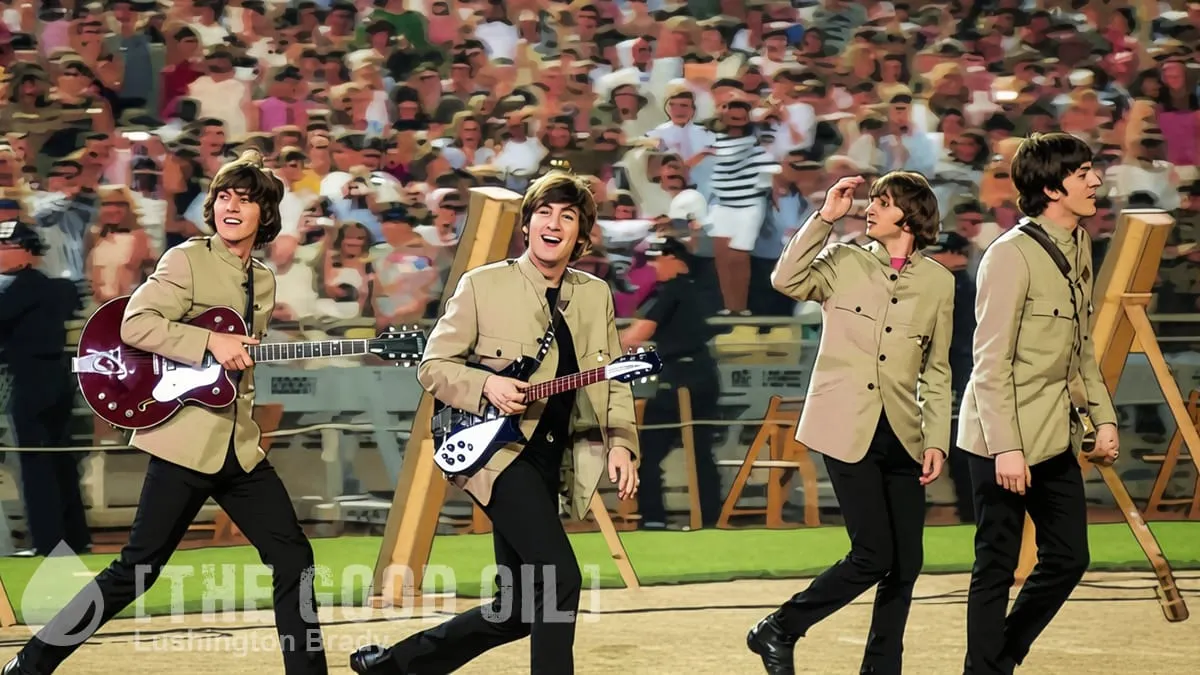
Of course, no band in history has ever emerged from a vacuum. Even the Beatles owed as much to Elvis or the Everly Brothers as they did to their own native musical genius. SPK likewise didn’t invent industrial music ex nihilo. Nor alone.
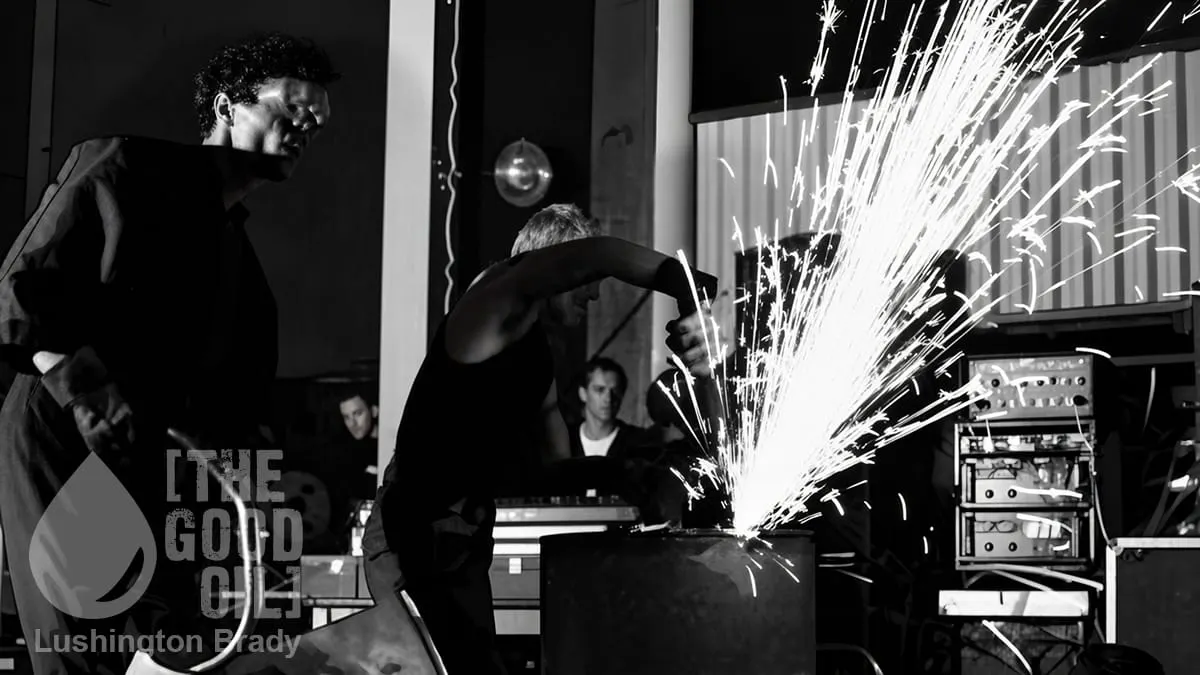
Throbbing Gristle and Cabaret Voltaire had already declared the factory a concert hall. Kraftwerk, Can, Neu!, Faust and John Cage had shown that machines and chance could be instruments. At the same time SPK were bashing, hammering and angle-grinding away on stage and in the studio, bands like Einstürzende Neubauten and Test Dept were exploring the same closed-down factories and finding interesting sounds when hammers and I-beams intersected.
What SPK added was an aesthetic informed by the darker reaches of hospital backrooms. Autopsy slides. Surgical footage run backwards. Animal carcasses. Flamethrowers. Oil drums beaten until they became rhythm. Dominic Guerin, who joined as Tone Generator, specialised in the visuals: medical abnormalities projected large enough that looking away was the only remaining courtesy. Revell later admitted a flamethrower once set an audience member on fire. That is the documented version. Industrial folklore likes to upgrade it to a murdered fan left on the floor while the crowd assumed the corpse was another prop. But the record is already grotesque enough without the extra corpse. When your stage language is evisceration, the audience stops being able to tell the difference. That was the point.
The first records sound like the century’s worst paperwork set to voltage. Information Overload Unit (1981) was cut in a Vauxhall squat during the Brixton riots. Leichenschrei (“the scream of the corpse”) followed in 1982. Neighbours called the police during the home sessions because of the screaming. The music is not songs so much as systems failing: tape hiss, metal, drum machines used as blunt objects and voices that have forgotten they were ever meant to sing.
Live, they belonged to the same percussive-noise family as Einstürzende Neubauten in West Berlin and Test Dept in the scrapyards of Deptford: men hitting found metal until it confessed. Neubauten made shopping carts and angle grinders into an orchestra. Test Dept welded empty barrels to the miners’ strike. SPK brought the operating theatre. Three cities, one idea: that the true instrument of the late 20th century was whatever industry had discarded.
Even the pop factory noticed. Depeche Mode, Mute labelmates of Neubauten, went to Hansa in West Berlin and started throwing pots down stairs. “People Are People” (1984) is a disco single with a pile-driver for a heart; “Master and Servant” made the factory floor sound like a fetish. Martin Gore has spent 40 years apologising for the obviousness of the lyrics. He does not need to apologise for the sound. That clang – sampled steel, kitchen percussion, the suggestion that pleasure and work and punishment share a beat – is industrial music sneaking into the Top Ten while the originators were still setting people on fire. Nine Inch Nails would finish the job. When Trent Reznor listed the old gods in 1992 he named Throbbing Gristle, Test Dept and SPK as the thing industrial used to be before it became Ministry, Front 242 and him. He sanded the edges, wrote choruses and took the factory to arenas. SPK remained in the ward.
Then the ward emptied. In the first week of February 1984, Neil Hill killed himself. He was 28. Two days later his wife Margaret died of anorexia. Revell kept the name and changed the music. Sinan Leong, who had auditioned for a side project called Dance Macabre and later married Revell, became the voice. Machine Age Voodoo (1984) was SPK’s attempt to grab their share of those sweet royalties Depeche Mode made by pop-fying industrial.
While the purists still treat the album as a near war crime, it briefly propelled SPK into the charts, with a softened version of what had already been a minor club hit, “Metal Dance” (1983). Machine Age Voodoo pushed the oil drums and angle grinders to the background, overlaid by tribal percussion and Fairlight gloss: something you could almost dance to without wanting to leave the building.
Zamia Lehmanni: Songs of Byzantine Flowers (1986) and Gold and Poison (1988) went further toward ritual pop and near-classical atmosphere, exploring territory that would a few years later be colonised to great success by the likes of Enigma and Deep Forest.
“Breathless” sounded like a band that had decided the scream of the corpse could also be a single. The faithful called it a sell-out. Revell called it a way out. The Fairlight he extracted from the pop interlude became the tool that let him write film music before anyone asked him to.
Australian director Phillip Noyce was the first to ask. Dead Calm (1989), Nicole Kidman and Sam Neill on a yacht with a psychopathic Billy Zane, needed a score that did not sound like anyone else’s idea of tension. Revell offered “In Flagrante Delicto”, an SPK piece, as the theme. It won him an AFI award and a Hollywood career. The Crow (1994), directed by another Aussie (of Egyptian extraction), Alex Proyas, is the one that stuck to the culture with its funereal strings and the shadow of Brandon Lee’s death. Then The Craft, From Dusk Till Dawn (he pitched it as a “mariachi surf opera”), The Saint, Tomb Raider, Daredevil, Freddy vs. Jason, Sin City, the Riddick films, Blow, Pineapple Express, stretches of Gotham and CSI: Miami. Eight BMI awards. The man who once projected autopsies now scores vampire strippers and comic-book lawyers. The industrial joke writes itself: the noise that was supposed to be unassimilable became the furniture of multiplex dread. Reznor would later take the same road, with more pontificating: Revell got there first and said less.
The pattern is the same as fellow industrial pioneers Skinny Puppy’s, only the hemisphere changed. Depeche Mode took the clang to the charts. Nine Inch Nails took the self-loathing to MTV. Revell took the dread to the pictures and got paid at last.
SPK never became a household name. They did not need to. Every time a film wants the sound of a mind coming apart in a clean room, it is walking a path first cut in a Sydney psychiatric ward by a nurse and a patient who thought violence might be therapy, and then discovered the market preferred the violence scored, mixed and under the credits.
Although SPK dissolved in 1988, in the past year Revell has reactivated the name with his son Robert, two European shows and a planned 2026 entity called SPKtR. Revell is also exploring his interest in AI, a field he was already writing about with some knowledge and prescience as far back as 1983. Perhaps not so much Leichenschrei as ‘I have a synthesizer and I must scream’.