It may seem strange today, but back in the late ’70s and early ’80s, punk and metal were mutually exclusive scenes. They weren’t just genres, they were tribes, with all that that implies. Punks and metalheads hated each other. Punk was punk, and metal was metal, and ne’er the twain would meet.
At least, not until a small cadre of ‘crossover’ bands in the early began to blur not just musical styles – the punks slowed down, the metalheads sped up – but attitudes, especially of the mutually hostile kind.
On the punk side, as musicianship evolved beyond the famous ‘this is a chord – now, go form a band’ ethos, bands like Black Flag expanded songs beyond two minutes of full speed and even to incorporate – gasp! – solos, weathering the jeers of, as Henry Rollins remembered, What is this? “Freebird”? In Australia, pioneering hardcore punks Depression termed their style Ultra Hard Core Mega Heavy Punk Metal Thrash (later used as the title of a live album). In the metal trenches, D R I (Dirty Rotten Imbeciles), Metallica, Slayer and Megadeth began to speed up, until they were thrashing as fast as the punks.
In the nomansland in between, Suicidal Tendencies, Corrosion of Conformity, and Anthrax defied classification as either punk or metal. It was the latter who delivered one of the most audacious and divisive albums of the time, Speak English or Die, released under the deliberately cartoonish moniker of “Stormtroopers of Death” (or just S O D to fans).
It’s hard to overstate what an absolute bombshell this album was. From its title to the lyrical content (“Fuck the Middle East, there’s too many problems… we’ll kill ’em all and have a ball and end their fuckin’ crisis!”), it was guaranteed to send a punk scene already ossifying into a stultifying wokeism (anti-war, anti-racism, anti-drugs, militant vegetarianism, you name it) clutching their leather jackets and fainting en masse.
But, musically, it was punk-metal par excellence, and so damn good that even the most right-on lefty punks couldn’t ignore it. A typical review went along the lines of, ‘this album shreds, but the lyrics are so racist and sexist that it just spoils it for me’.
Because, like all leftists, the hardcore punks just couldn’t grasp the very idea of a joke.
This is the story of a cartoon that became a band and released one of the greatest thrash-metal albums of all time.
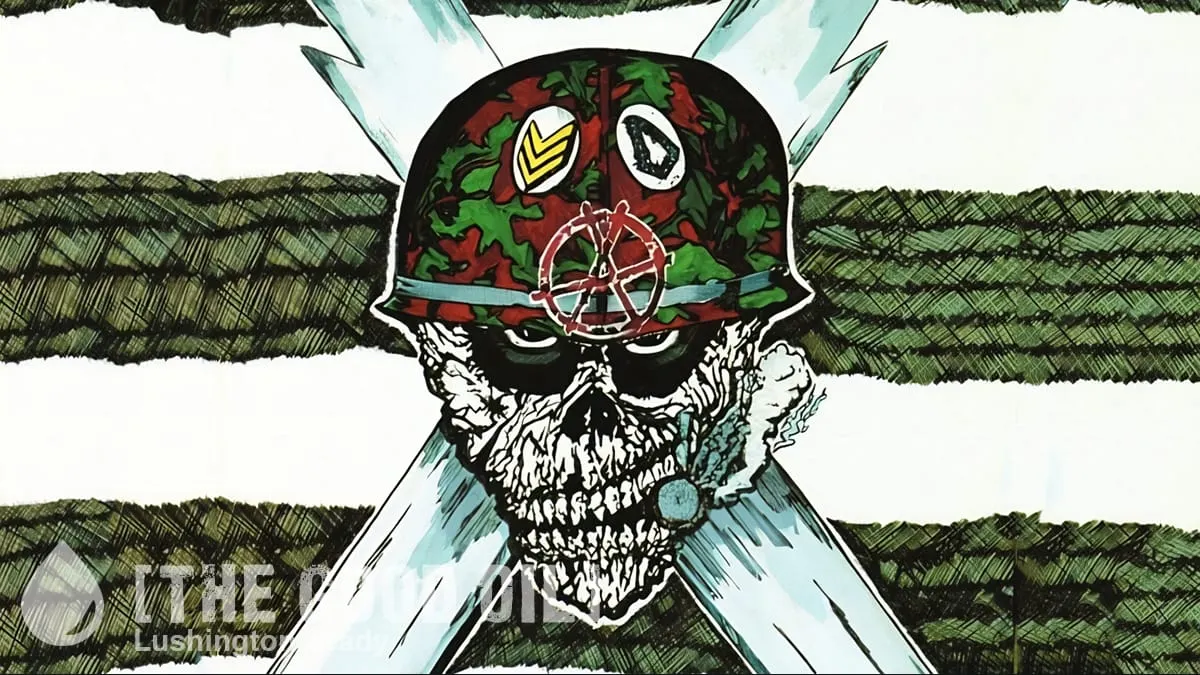
In 1985, while Anthrax were recording Spreading the Disease, members Scott Ian, Charlie Benante and recently departed bassist Dan Lilker found themselves with time to kill and far too much energy. On the road, Ian had been filling in the long hours in the van doodling a comic-book character called Sargent D: an over-the-top, cartoonish military figure who spouted deliberately absurd, satirical slogans. Unable to get the comic published, he simply started writing songs about the bastard instead.
They jammed the riffs in the studio downtime. The songs were short, hyper-aggressive hardcore pieces that matched the character’s unhinged energy. All they needed was a vocalist. Enter Billy Milano, a local New York roadie and singer for hardcore outfit the Psychos. Stormtroopers of Death was born. Briefly they called themselves Crab Society North and knocked out a 63-song demo of tracks lasting 10 to 15 seconds. This was not a band with a marketing plan, but four blokes having the time of their lives with the filter permanently switched off, while condensing thrash-metal down to hilarious bare-bones.
Leveraging Anthrax’s deal with the Megaforce label (which first released Metallica, as well as the Black Crowes and Ministry), they booked studio time and did the unthinkable. They wrote, recorded and mixed their entire debut studio album in three days.
The result was Speak English or Die. Short, chaotic, funny and brutally heavy (case in point: “The Ballad of Jimi Hendrix”, all of six seconds of a mutated “Purple Haze” riff, with one line: “He’s dead!”), it smashed the raw aggression of hardcore punk into the precision of thrash metal. Nobody had welded the two worlds together quite like this before.
The controversy was immediate and delicious. Lyrics delivered from Sargent D’s cartoon mouth targeted immigrants, foreign cultures and women with maximum provocation. Major labels refused European distribution. Canadian stores blacklisted it. Only Roadrunner’s Cees Wessels had the stones to put it out independently. The band’s defence never wavered: It’s satire. It’s Sargent D talking, not Scott Ian. The character hates everyone equally. Dan Lilker put it more bluntly: the goal was to be obnoxious and provocative. Full stop. They even later recorded “We All Bleed Red” to rub the genuine bigots’ noses in it.
Leftist critics, of course, could not see the joke. Effective satire, they insisted, must only punch upward. When the targets were the sacred cows of the day, they simply heard the slur and fainted on cue. Scott Ian has since admitted the internet of today would tear the record apart. Billy Milano’s later political outbursts with
M O D only complicated the nostalgia for some.
Yet the musical legacy is unarguable. Speak English or Die essentially invented crossover thrash as a codified genre. Everything that followed – D R I, Cryptic Slaughter, Corrosion of Conformity – built on the blueprint. The mid-tempo palm-muted breakdown that opens “March of the S O D” became the template for groove metal, metalcore and deathcore. Pantera and Hatebreed still live off that formula. The ultra-short blast-beat tracks helped spark grindcore; Napalm Death have cited S O D as a direct influence.
Not everybody failed to get the joke, by the way. Western Sydney thrash hooligans the Spunkbubbles (their lead singer was “V D Brothel Brain”) titled their own album Speak Lebanese or Die.
MTV’s Headbangers Ball used “March of the S O D” as its theme and “Chromatic Death” as a commercial bumper. Millions of kids who never owned the banned album still heard those riffs every weekend. More importantly, the project supercharged Anthrax itself. Ian and Benante returned to the main band harder, faster and meaner. Among the Living, the record many still rate as Anthrax’s masterpiece, is the direct result of that three-day pressure valve.
“United Forces” became an anthem for the very scene unity S O D forced into existence. Punks and metalheads finally dropped the tribal warfare and shared the same sweaty pit. Three days, one ridiculous cartoon character and a genre that did not exist before them. That is Stormtroopers of Death: proof that the best art is usually the stuff that makes the humourless clutch their pearls.