As I’ve written several times, unlike Australia’s, Japan’s leadership isn’t sitting in the glare of China’s belligerent headlights like stunned possums. Not only is Japan building its own long-range defence missiles (unlike the Australian government, who are content to wait nearly a decade for even a handful of missiles from America), it’s determinedly making sure its industrial base is maintained for its defence (unlike the Australian government who have wilfully dismantled almost all of our heavy industry).
But defence isn’t just about boots and hardware: in the 21st century, electronic communications, especially the internet, are absolutely critical. Japan’s on that one, too: the country is directly connected to 20 or 30 undersea fibre-optic cables, to guarantee its internet infrastructure. Not content to rest on its communications laurels, the Japanese government has budgeted ¥10 billion ($69.6 million) to shoring up its submarine cable infrastructure. Measures include diversification of submarine cable routes and landing stations in Japan.
Japan therefore has many layers of multiple redundancy. Cutting just one or two cables by accident won’t cut Japan’s communications.
How many cables does Australia have? Just 16. As Tasmania has discovered multiple times, cables can be easily cut by accident, crippling communications.
Imagine, though, if a malignant actor was to cut even more, deliberately?
An anonymous actor sent a warning shot over our bows this week – and the legacy media and the government have run almost completely silent. In a rare show, the ABC was the only major media outlet to cover the alarming event.
Two subsea cables off the coast of Perth, vital for international communications, suffered a fault over the weekend, and the company that owns them urgently wants to know what happened.
The chief executive of the cable company Subco, Bevan Slattery, wrote on LinkedIn yesterday that two separate cables in the Submarine Cable Protection Zone off Perth had both experienced faults “straight after each other and in close proximity to each other”.
His post further said that it was a concerning development and called for the Australian Federal Police to investigate urgently.
This begs the question: were the government even aware of it? Or was it a repeat of the jaw-dropping moment when it took a commercial airline pilot to notice that an entire Chinese fleet was firing live missiles and torpedoes off Australia’s east coast?
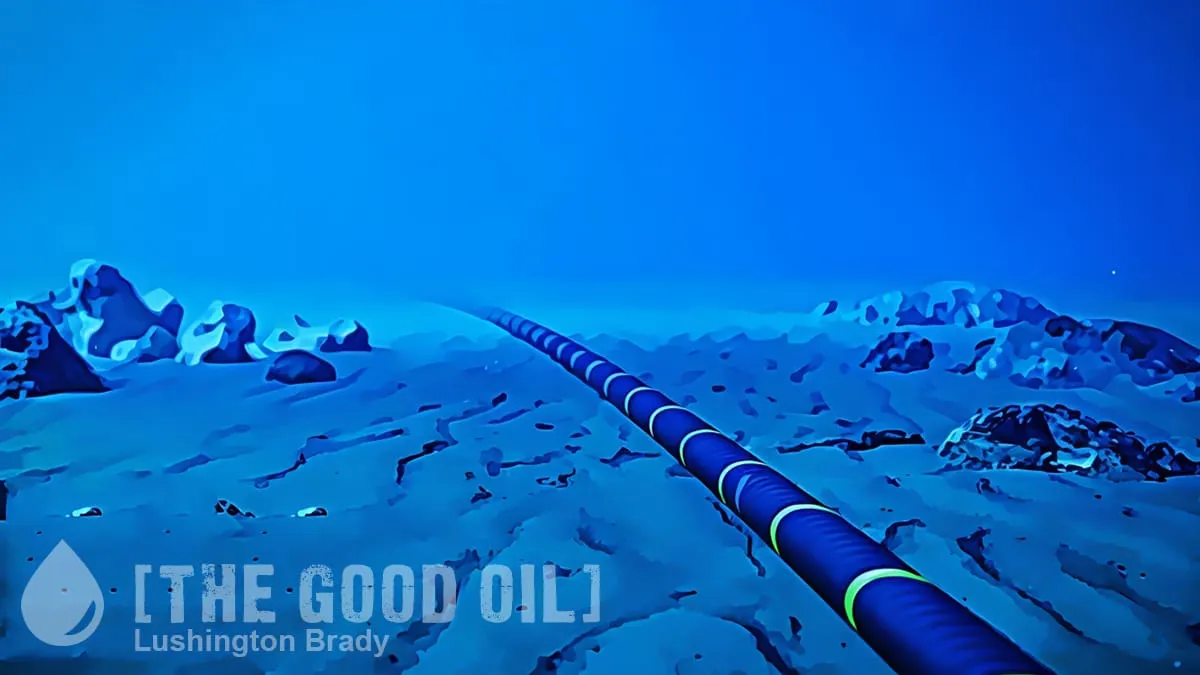
Australia’s entire digital life rides on those 16 cables. They carry 99 per cent of our international communications. Every cloud service, every Google search, every banking transaction, every government login depends on thin garden-hose-sized lines lying on the ocean floor. They are trivially easy to sever. A ship’s anchor can do it by accident. A determined adversary can do it on purpose.
David Brewster, senior research fellow at the National Security College at the Australian National University [… said] “We’ve seen numerous incidents in Europe and around Taiwan over the last, say, three or four years of cables being cut,” he said.
“It’s difficult to be absolutely certain of the reasons in some of these cases, but in a great number of cases, it’s fairly obvious that they were done by state actors, Russia and China."
The Perth zone extends 60 nautical miles offshore and one nautical mile either side of the cables. That is supposed to be protected space. Two faults occurring almost simultaneously inside it is not random fishing-boat clumsiness. It is a data point in war-planning. The apparently deliberate cable-cutting comes just weeks after China fired a long-range missile capable of menacing the entire Pacific. The test, purely coincidentally no doubt, took place just hours after Australia and Fiji signed a mutual-defence pact.
Brewster’s prescription is straightforward: lay more cables. Redundancy is the only practical defence once the lines are already on the seabed. Australia has nowhere near enough. Ownership is another quiet vulnerability. Most of the cables are privately owned, increasingly by large American tech companies. Canberra has limited leverage over how they are operated or repaired. And no single government agency actually owns the problem. Responsibility is scattered across departments, so when a cable goes dark the first question is often “who do we even call?”
Japan, faced with the same geography and a far more immediate neighbour, has treated the issue as the strategic priority it is. Multiple landing stations, diversified routes and deliberate investment in resilience. Australia, by contrast, discovers the risk only after the faults appear, then largely pretends nothing happened.
The government that cannot maintain a steel industry or produce its own long-range missiles is equally content to leave the nation’s digital jugular exposed. Sixteen cables. Two of them already nicked in the same protected zone on the same weekend. The warning has been delivered. Whether anyone in power is listening, or even aware, is another matter entirely.