Table of Contents
Here’s one that’ll set internet midwits and ‘IFL Science’ bros foaming at the mouth: the Great Library of Alexandria never existed. And even if it did, its loss wasn’t much of a loss at all.
Okay, I’m being deliberately provocative, there – but not by much. Because, firstly, there’s no hard evidence that it actually existed. In fact, there’s less reliable evidence for the existence of the Great Library than there is for Jesus. Yet, the types who sneer that there was no such real person as Yeshua ben Yosef in first century Israel, are adamant that the Great Library was real.
Secondly, even though the Great Library probably did exist, what evidence there is contradicts the conventional wisdom both about the size of its collection and its importance to the sum of human knowledge.
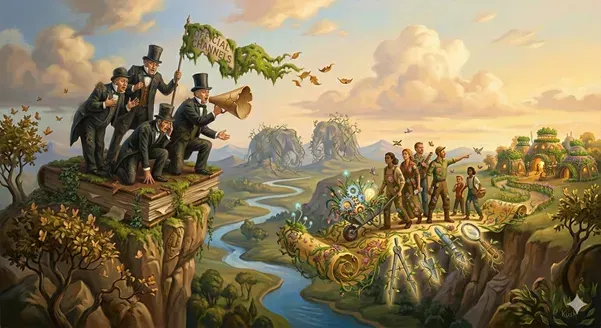
Rather, as Esoterica’s Dr Justin Sledge notes, what people believe about the Great Library says a lot more about them than it does about the library. In that respect, the Great Library is a palimpsest: a parchment scraped over and re-written, again and again, according to the prejudices of whoever is doing the current re-writing. Especially whom they blame for its destruction.
First, the evidence for the Great Library’s existence.
Almost non-existent. Almost. There is not a shred of hard physical evidence. Despite centuries of excavation, not a single physical trace of such a library structure in Alexandria has ever been found. Still large areas of Alexandria’s ancient shoreline is today underwater and larger areas remain unexcavated.
So, we are left to rely on secondhand and thirdhand reports, often written centuries later. Y’know, just like Jesus. Except that, in the case of the Great Library, these reports are notoriously vague and unreliable, including some outright forgeries. Indeed, the common modern concept of the Great Library is largely a Renaissance-era legend.
Here’s what seems certain: a centre of Hellenic learning, the Museion, was almost certainly built by the Ptolemy dynasty (the Greek rulers of Egypt that ended with Cleopatra) in Alexandria. Even no trace of even that remains – it is likely that it included a campus with a library of some sort.
But that library could not possibly have been the ‘Great Library’ of legend, which supposedly housed 400,000 to 700,00 scrolls. As Sledge demonstrates, scrolls are not exactly the most compact form of information storage. A single scroll can contain about 10,000 words. Even a single modern 300-page paperback book would require dozens of scrolls. These scrolls take up a much larger footprint than modern books.
A Great Library housing even 400,000 scrolls would have to be vast. Its footprint would be several acres at least. Far bigger than any known public building of the time.
Not only that, but, unless it contained many, many copies of the same works, such a collection would represent a corpus of books and writers far, far, in excess of what we know and can estimate actually existed in the Classical world. Not just those which have survived to today, but those which scholars can guess at from references in other texts. It would mean that some 90 per cent of ancient authors remain totally unknown to us. A modern city library, or a modest university research centre, contains orders of magnitude more books than likely ever existed in the Classical world.
That such a vast body of literature might have existed is a tantalising fantasy, but just that – a fantasy.
Another problem with the claim of such a vast collection is the fact that papyrus is just not a very durable medium. In particular, it’s massively vulnerable to humidity – and humidity is something Alexandria has in spades. Those papyrus scrolls that have survived to today were all found in the dry, desert interior of Egypt, or in dry, temperature-stable environments like the caves at Qumran, where the Dead Sea Scrolls were found. As well, the simple act of rolling and unrolling scrolls inflicts rapid and inevitable damage.
In hot, damp Alexandria, where students and scholars would have been constantly unrolling them for study, papyrus scrolls would have rapidly fallen apart. Sledge estimates that, within 50–100 years, most scrolls would have been destroyed beyond use. So, with a collection numbering over half a million scrolls, an entire army of scribes would have had to be constantly at work just copying and recopying scrolls before they fell to pieces. And we thought keeping the Sydney Harbour Bridge painted was a never-ending job.
More likely the upper limit of the Great Library’s holdings is around 40,000 scrolls. Still impressive, but clearly less than a tenth of what internet bros would have us believe.
But was the Great Library the vast repository of knowledge its fanbois believe? Almost certainly not.
Because what such a fantasy ignores is that the primary purpose of the Museion, and the Great Library that supposedly accompanied it, was not the disinterested pursuit of knowledge, but propaganda.
Remember, the Ptolemies were Greek colonisers ruling a subject population who were, obviously, not Greek. They were, in Greek parlance, barbarians. The Hellenistic worldview, after all, was one of Greeks – and a whole lot of barbarians who could only wish they were Greek. The primary purpose of the Great Library was Hellenisation: spreading Greek knowledge and culture: the only culture, the Ptolemies would have though, worth spreading.
So, the Great Library collection would have been heavy on Hellenism – and not much else.
In that respect, the destruction of such a collection would have indeed represented to the Hellenes of Alexandria the destruction of the world’s entire body of knowledge. Because Hellenic knowledge was the only knowledge worth anything.
This touches on the other notable thing about the Great Library: what we believe about its destruction says more about our own prejudices than anything else. To the Hellenic Greeks, the obvious culprit was those militaristic barbarian upstarts, the Romans. For mediaeval Christians, with Islam knocking on the Gates of Vienna, Muslim conquerors were an equally obvious culprit. For modern porch atheists, ignorant, violent Christians were just as obviously to blame.
The boring truth is that the Great Library was almost certainly an interesting place, but not the great lost repository of ancient wisdom we’d like to believe.