Summarised by Centrist
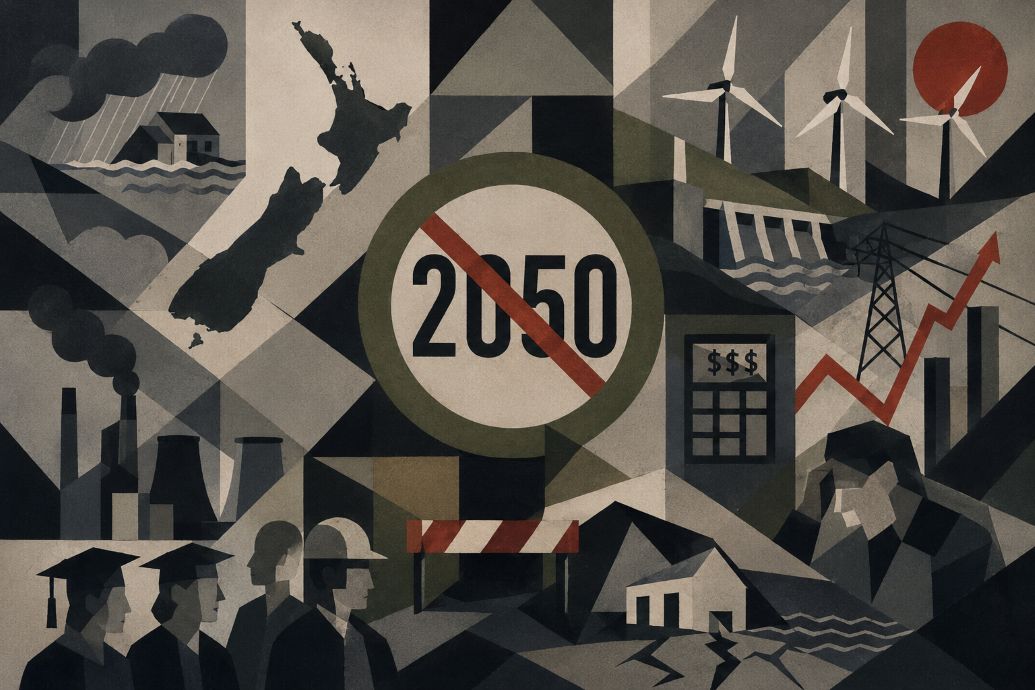
New Zealand academics and engineers, including John Raine, Michael Kelly and Bryan Leyland, say the country should abandon its Net Zero 2050 target.
They argue the policy is built on “alarmist rhetoric”, unrealistic assumptions, and impossible engineering demands.
“Climate change alarmism has become a quasi-religion,” they write, claiming many scientists have “moved to a rigid belief state rather than continuing to question the science and constantly check the latest evidence.”
Referring to the IPCC’s recent move away from the most extreme modelling scenarios, the authors write: “The new framework has eliminated the most extreme emissions scenarios that have dominated climate research over much of the past several decades.”
They argue those worst-case projections became “the foundation for much government policy and thousands… of academic research papers”.
They further note that “Nothing NZ does to reduce GHG emissions can possibly have any measurable effect on global temperatures,” the authors state.
They assert that “This alone makes Net Zero 2050 unnecessary for this country.”
They cite estimates that the transition could cost more than $550 billion, and warn Net Zero would require “not less than 40,000 engineers” with “no possibility” that universities could close the gap.
They also link high-renewables policies to “cripplingly high consumer electricity prices and de-industrialisation”.
Rather, they argue “Adaptation must be NZ’s central priority.”
“A continued focus on mitigation will crowd out investment in flood protection, coastal defence, water security, urban heat resilience, and health system preparedness,” they write.