We’ve all had our bad days. But, occasionally in Earth’s history, everyone has a bad day. One such day took place 66 million years ago. That was the day what had for a week or so been a bright new, apparently motionless, star in the sky suddenly showed just how fast it really was moving – straight at the Earth.
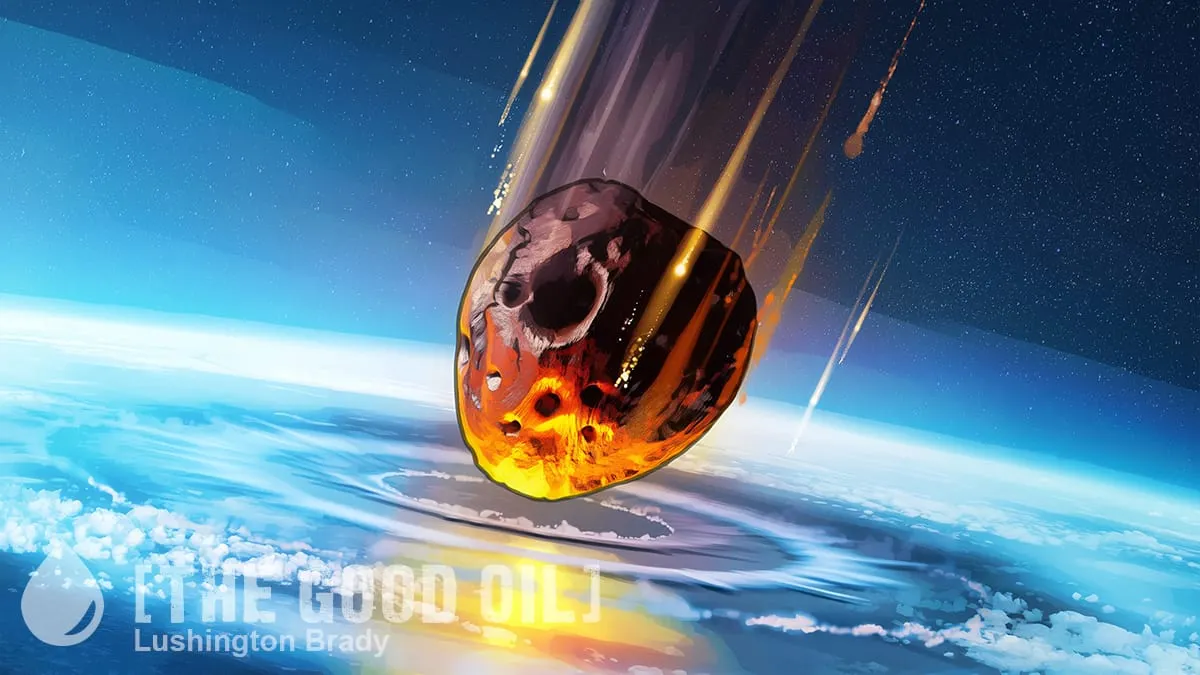
That was the day of what is now called the Chicxulub impact: a massive, 10–15km diameter asteroid slamming into the Earth at 20 km/sec (roughly 72,000 km/hr). That’s fast enough to travel from Invercargill to Cape Reinga in just over one-and-a-half minutes, which is an apt comparison, given the unusual direction of the asteroid’s orbit intersecting Earth: moving south to north (in other words, at right angles to the Ecliptic, the band in which most objects orbit the Sun) at the “deadliest possible” angle.
What would it have been like to witness? It would have all started so innocently.
T-minus one day
All is calm and the Cretaceous day proceeds as usual. In what will soon be ground zero, it is pleasantly warm, about 26°C, and wet. It often is. For about a week, the asteroid has been visible only at night. Because the giant rock is heading straight towards Earth, it looks like a motionless star. There is no dramatic tail; this is a rocky asteroid rather than a comet.
In the last 24 hours, the light becomes visible during the daytime. But it still looks like a star or planet, getting brighter in the final few hours before impact.
T equals 0: Impact.
If you’re anywhere near the Caribbean shallows, the show starts with a blinding fireball and a crackling, fizzing roar: the photo-acoustic effect of the ground flash-heating the air. Then comes the sonic boom as something the size of a small mountain slams into the planet faster than sound. You don’t get time to run. In fact, it was probably a blessing to be near the Mexican Gulf: you’d likely be almost instantly vapourised.
On the other hand, you’d have missed the (brief) opportunity to witness destruction on a scale so colossal that it simply beggars the imagination.
In seconds the kinetic energy carves a transient crater 30 km deep, deeper than the Mariana Trench, with a rim twice the height of Everest. The asteroid and target rock vaporise into a 10,000°C plasma fountain. The cavity collapses and rebounds into a central peak kilometres high before slumping again. The final wound: 180 km across and 20 km deep. This all happens within just three minutes.
Anything within a couple of thousand kilometres is incinerated by thermal radiation or shredded by supersonic winds. Even 1,500 km out you’re still facing category 5 hurricane-force blasts carrying superheated steam from the ocean strike. Wood and vegetation ignite instantly. Fires rage everywhere.
Five minutes after the impact, the winds have “eased” to those of a category 5 hurricane, flattening everything within about 1,500km of the impact. Destroying everything, that is, which has not already been burnt. Atmospheric temperatures in the region rise to over 500K (226.85°C). This would feel like being inside an oven – causing burns, heatstroke and death. Wood and plant matter ignite, creating fires everywhere.
Because the asteroid struck the sea, the atmosphere is also filled with super-heated steam, making the hurricane-force winds even deadlier.
It gets worse, believe me. Racing behind the superheated hurricanes come the megatsunamis. One hundred metres high (the Boxing Day tsunami, by comparison, was 30 metres high) and moving at incredible speed: it crossed the Pacific in less than a day, and circled the Earth within two. It dumped debris as far away as New Zealand. In North America, metre-sized chunks of rocks were hurtled hundreds of kilometres.
So if you were 2,000km to 3,000km from the epicentre and survived the first few seconds, you’d most likely die from overheating, earthquakes, hurricanes, fires, tsunami-driven floods or being hit by impact melt.
But what is happening much further away? In the first five minutes after impact, dinosaurs roaming the Cretaceous forests of what are now China or New Zealand are so far undisturbed.
But it won’t be long before that changes.
Within an hour, a belt of dust and molten droplets has girdled the globe. Skies darken from New Zealand to Denmark. The burning sky is already triggering wildfires on every continent. Within the next 24 hour, the tsunamis cross the Atlantic and Pacific, while hurricane-force winds whip soot and debris into the air. Global firestorms pump more carbon into the stratosphere. Sunlight begins to fade.
A week later, the Earth is blanketed in darkness. Solar radiation reaching the surface is now one-thousandth of normal. Surface temperatures drop at least 5°C. Acid rain (literally: battery-acid strength from vaporised sulphur and nitrogen oxides) lashes the planet. Trees lose nutrients, shellfish dissolve and shallow seas acidify. Most large dinosaurs and marine reptiles freeze or starve.
A year later, the Earth is shrouded in a veritable fimbulvinter. Average surface temperatures are 15°C lower. Inland waters freeze. The Sun hasn’t shone for a year. Over half of plant species are gone. The great reptiles are reduced to scattered, rotting skeletons.
A decade later, the worst of the dust has settled but the planet is still 5°C colder. Only burrowing mammals, small reptiles, some birds and insects cling on in refugia where enough light penetrates for plants to photosynthesise again. Life begins the long, slow rebuild, but the age of the dinosaurs is over.
The Chicxulub impact wasn’t just a bad day. It was the day the rules changed forever. The meek – or at least the small, the furry and the quick to hide – really did inherit the Earth.