Table of Contents
Canada, famous for its ice hockey and maple syrup, now tops the global chart for euthanasia deaths. The 2024 Canadian report on medical assistance in dying (MAID), which covers the second full year of data, has recently been released. The report indicated that there were 16,499 reported MAID euthanasia deaths, representing a 6.9 per cent increase from 15,427 in 2023. Since legalisation up to December 31, 2024, Canada has recorded a total of 76,475 MAID deaths.
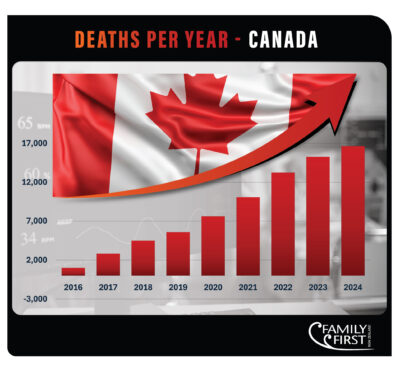
The report indicates that cancer, especially lung, colorectal, pancreatic and blood cancer, was the most frequently reported condition in nearly all age groups of people who died by MAID in 2024, except those 85 and older for whom ‘other’ conditions were the most frequently cited.
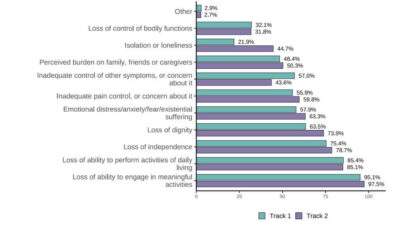
Interestingly, inadequate pain control was only the sixth most common reason for seeking MAID. The primary reasons for euthanasia deaths were related to autonomy and daily function:
- Loss of ability to engage in meaningful activities (the highest reason, over 95 per cent for both tracks).
- Loss of ability to perform activities of daily living.
- Loss of independence and loss of dignity.
In terms of MAID deaths across districts, Quebec has the highest number of euthanasia deaths at 5,998. MAID deaths remain heavily concentrated in three provinces, which accounted for nearly 85 per cent of all provisions: Quebec (36.4 per cent), Ontario (4,944 deaths, 30.0 per cent) and British Columbia (2997 deaths, 18.2 per cent).
Nearly all MAID deaths were performed by a doctor or nurse practitioner. While the law allows patients to self-administer the medication in most parts of the country (except Quebec), this option is rarely chosen. The typical (median) age of a person receiving MAID in 2024 was about 78 years old. Recipients who were near the end of their lives (track 1) had a median age of 78.0 years, while those whose death was not immediately foreseeable (track 2) were slightly younger, with a median age of 75.9 years. Overall, the average age of MAID recipients continues to rise slightly each year.
There was a notable increase in track 2 euthanasia deaths, which increased by 17 per cent, accounting for 4.4 per cent of total euthanasia deaths and up from 4.1 per cent in 2023. Track 2 euthanasia deaths refer to not immediately foreseeable deaths of people and are more likely not to have a terminal condition, to be women, younger and living with a disability.
Dissecting track 2 euthanasia deaths a little further, it appears people who die by track 2 euthanasia deaths are significantly more likely to be poor, live in institutions or poor neighborhoods, and be receiving disability support services than those who die under track 1. Of the 16,104 people who responded to questions around disabilities, roughly one-third (32.9 per cent) reported having a disability.
Alex Schadenberg, chair of the Euthanasia Prevention Coalition (EPC), suggests that MAID for non-terminal conditions mainly targets individuals with disabilities, noting a clear link between disability and track 2 deaths, as 61.5 per cent of track 2 recipients identify as disabled.
If that isn’t shocking enough, loneliness and isolation were reported as a factor in 44.7 per cent of track 2 deaths and 21.9 per cent of track 1 deaths, suggesting that over 3,800 people listed this as a primary reason. Track 2 recipients were far more likely to be receiving mental health/social support services (31.4 per cent) compared to track 1 recipients (9.4 per cent), indicating that mental health is a prevalent factor in non-terminal MAID cases.
These statistics are both disturbing and tragic, highlighting pro-life advocates’ concerns about expanding Canadian euthanasia laws to include non-terminal individuals. These vulnerable groups are often affected by factors such as lower socioeconomic status, disabilities, and insufficient social support. The recent MAID data confirms this, showing that social and systemic problems – like loneliness and inadequate disability support – are significant factors influencing requests for MAID.
The most concerning finding in the 2024 annual report is not only the total number of MAID deaths but also the speed at which this peak was reached. Despite the growth rate slowing to 6.9 per cent in 2024, this follows years of swift expansion that propelled Canada from having a recently legalized system to becoming a global leader in euthanasia deaths. This trend confirms that MAID is shifting from a last-resort service to a major – and quickly becoming a leading – cause of death in Canada.
This article was originally published by Family First New Zealand.