One of the biggest lies of the ‘renewables’ lobby is that they are ‘clean’. Leave aside that, by the UN’s own definitions, coal, oil and uranium are also technically ‘renewable’ (that is: “energy derived from natural sources that are replenished at a higher rate than they are consumed”), there’s the simple fact that solar and wind generation are very, very dirty at both ends of their lifetimes.
The other plank in the ‘Net Zero’ lunacy, batteries, are just as dirty – and far more dangerous. Just as the massive fibreglass blades of a wind turbine will lurk in landfill for centuries, leaking potentially toxic chemicals, batteries will leach very actually toxic chemicals.
That’s when they’re not spontaneously bursting into flames.
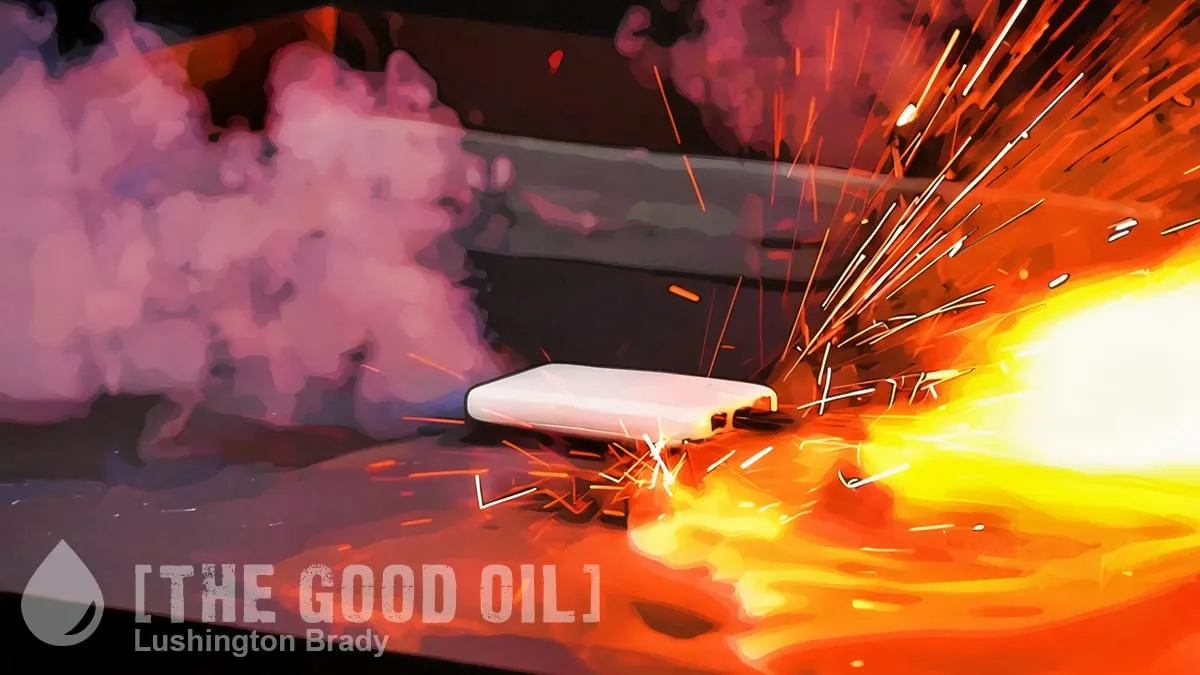
It turns out that our zealous march toward a frictionless, carbon-free Utopia has brought with it an entirely more visceral sort of combustion. While technocrats in their glass-fronted offices chant mantras about sustainability, our civic sanitation infrastructure is going up in smoke. We are witnessing a daily pageant of pyrotechnics in garbage trucks and recycling depots across the land, all courtesy of the humble lithium-ion cell tucked away in our disposable gadgetry.
There are an estimated 10,000 to 12,000 battery-related fires in Australia’s waste and recycling system every year, says ReTHiNK Waste Tasmania, a consumer education initiative between the Tasmanian government and the waste-management sector.
One might ponder how a society so obsessively concerned with carbon emissions manages to overlook the minor detail of its rubbish trucks spontaneously immolating on suburban streets. Yet, here we are. From discarded vapes and singing birthday cards to rechargeable screwdrivers and toys, these miniature electrochemical time bombs are tossed into ordinary wheelie bins with the casual abandon characteristic of the modern consumer.
As the experts in municipal conflagrations observe, the sheer density of stored energy in these little chemical cages means that safety is measured in seconds rather than minutes.
“One minute, it’ll be sitting there looking very benign. A second or two later, it’s a very intense fire, often spitting embers and pieces of battery out, which can also spread the fire into other parts of the rubbish or the recycling pile.”
The financial and operational toll on waste management companies is nothing short of staggering. Facilities that once processed our discarded cardboard and plastics are now plagued by daily blazes, rendering whole installations offline and making comprehensive industrial insurance a quaint artifact of the past. Major players in the refuse industry report that fires have graduated from rare anomalies to clockwork occurrences.
We had yesterday, we had one the day before, it’s almost a daily event and it’s always a battery. It is completely company-agnostic. Visy’s lost a site in the last five years. Re.Group has lost a recycling site in the last five years. Cleanaway has lost a site in the last five years. Most recycling facilities can’t get insurance any more because of the fires.
And yet, this fiery spectacle is merely the warm-up. If a modest accumulation of discarded vapes and rechargeable toothbrushes can reduce multimillion-dollar sorting facilities to smouldering cinders, one shudders to contemplate the apocalyptic prologue awaiting us when the colossal lithium leviathans, the massive batteries heaved out of expiring electric vehicles and domestic solar storage arrays, finally reach the terminus of their working lives and find their way into our municipal waste streams.
At present, we are struggling to manage the odd lithium cell from a cordless drill. Imagine, if you will, millions of automotive-scale batteries being unceremoniously dumped, crushed in collection trucks, or abandoned in suburban tips, each one harboring a catastrophic capacity for thermal runaway. When these industrial-sized monoliths begin to degrade, rupture, and short-circuit beneath mountains of household refuse, local municipal incinerators will look less like waste management facilities and more like rehearsals for the final judgement.
The architects of our green transition have engineered an economic and ecological ouroboros of magnificent proportions. In their haste to sanitise our conscience, they have littered our municipal arteries with high-energy explosives. Until our enlightened leaders reckon with the combustible consequences of their pet projects, we are destined to live in a perpetual state of red alert – where every rumble of the garbage truck outside the window sounds less like public service and more like an impending detonation.