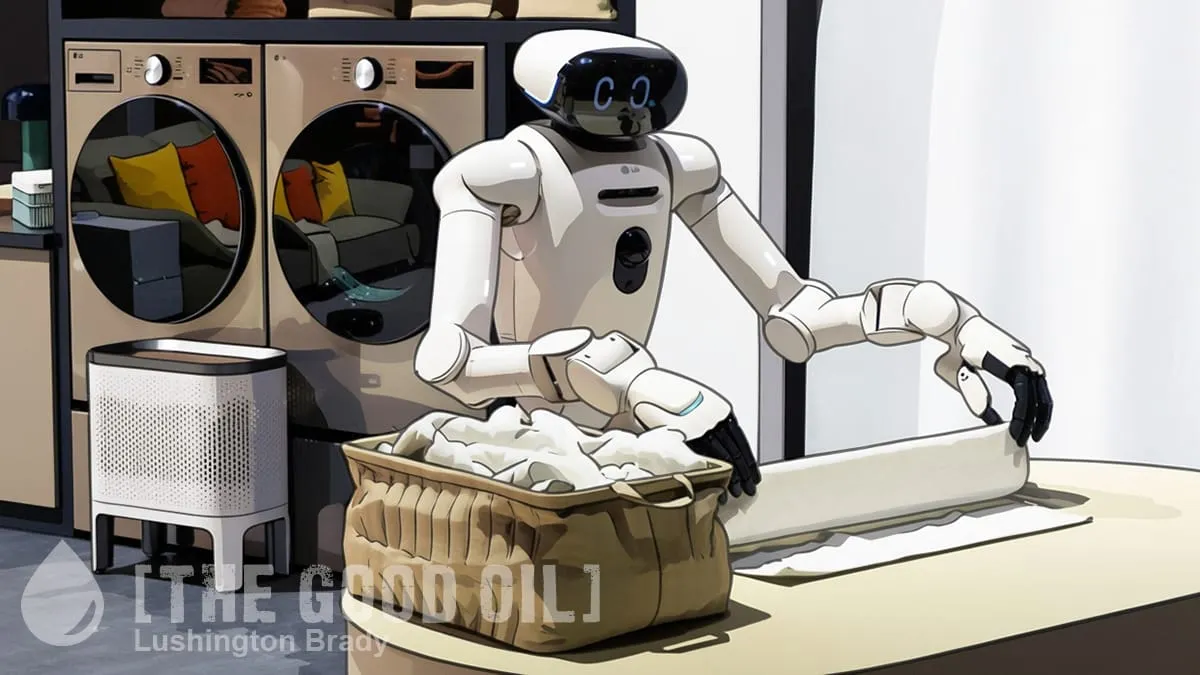
Every time some mass migration-addicted prat burbles, ‘but who will wipe your bum when you get old?’, I reply: preferably not some low-IQ Third Worlder who’d want to behead me if they thought I was Jewish. In fact, I’d rather it not be a human at all: let the robots have the unenviable job of getting every last clinker from the venerable Brady backside. Enjoy the mental picture.
Of course, sceptics scoff, ‘Do you really think we’ll have robots that sophisticated in your lifetime?’ Well… yes. And by the time I’m old enough to have regressed back to the infantile state, they’ll likely be cheaper than a Fijian fruit-picker. Look at the price trajectory of robot vacuum cleaners: already dropping to around the cost of a human-operated model.
The Chinese, bless their communist little red socks, are leading some of the biggest innovations in humanoid robotics.
Beijing has just staged the World Humanoid Robot Games 2026, which is exactly the sort of thing a regime that still prints Little Red Books would invent when it wants the future on a podium. Robots sprinted, boxed, played football and mimed factory, restaurant and disaster-rescue chores. Tiangong Ultra ran the hundred metres in 8.64 seconds, leaving Usain Bolt’s 9.58 in the dust and several sports journalists reaching for a stiff drink.
But spectacle is cheap: practicality is another matter. The question that matters for anyone who would rather not import a new underclass to change their sheets is whether the same machine can do the laundry.
It cannot. Not the whole job, not reliably and not yet. Nobody’s robot can collect the basket, sort the darks from the delicates, choose a programme, hang, fold and iron without a human hovering like a disappointed housemistress. Folding alone is still a doctoral thesis in cloth. Shirts come inside-out. Sleeves hide. Trousers elope with towels. Fabric is a coward: lift one corner and the rest of the garment slithers off to start a new life. Humans do this in a trance. Robots have to solve each slither as a separate crisis.
That is why laundry is a better exam than a running track. The hundred metres is hard on the joints and the gyroscopes, but the problem is honest. The lane does not invert itself. The finish line does not turn out to be a fitted sheet. A house is not a factory line. Toys migrate. Pets veto the experiment. Children exist – and, as the occasional inadvertent cybernetic beat-down on YouTube hilariously shows, a robot midway through its pre-programmed dance or kung-fu routine ain’t stopping for nobody’s Little Emperor.
A useful domestic humanoid cannot replay a memorised ballet; it has to notice that reality has misbehaved and improvise before the sleeve hits the dog or the One Child.
There is a second, less televised nuisance. Skills do not copy like an app. Teach a specialist laundry arm – rigid, with ceiling cameras, and grippers built for cotton – how to fold a polo and you have not thereby educated the cybernetic biped in the corner with cameras in its skull and a fear of falling over when it leans across the table. Different hands, different balance, different sensors. Therein lies the huge gulf between a specialised machine designed to do one thing and do it, well, robotically, and an all-purpose mechanical dogsbody who has to cope with everything a normal household can throw at it. Which, at Brady Towers, at least, can mean quite a lot.
Projects such as Open X-Embodiment are trying to pool more than a million real trajectories from 22 robot types so the next body does not have to invent ‘shirt’ from scratch. Some of the idea transfers: where a shoulder usually is, what a decent fold looks like. The receiving chassis still has to work out how not to drop it while remaining upright. Folding a fitted sheet, meanwhile, remains a task of such mind-boggling complexity that the Riemann hypothesis is a doddle by comparison.
China is stuffing capital and national pride into machines that look like us, and can do our routine chores, because a country that is about to get very old has done the arithmetic the West prefers to outsource to a slogan. In a country where, in most places outside the big cities (meaning the vast bulk of the country), simply being not-Chinese is something akin witchcraft, importing millions of Africans to do the dirty work is clearly off the table. Useful domestic and personal care robots are not a luxury for China, they’re a looming necessity.
A robot that beats Bolt is a circus. A robot that sorts the laundry pile, recovers from a dropped sock and does not summon a supervisor every four minutes is an immigration policy. By the time the sceptics have finished explaining why this is impossible, the unit price will be heading the same way as the robot vacuum: down, hard, toward the cost of the fruit-picker they used to cite as proof that the future necessitates importing the Third World.
Just so long as we can be sure the robots aren’t Chinese-made and ready to line us up against the wall when a centenarian Xi Jinping hits the button on the global glorious revolution.