George Orwell once wrote, “There is widespread awareness of the prevalence of antisemitic feeling and unwillingness to admit sharing it. Among educated people, antisemitism is held to be an unforgivable sin and in a quite different category from other kinds of racial prejudice. People will go to remarkable lengths to demonstrate that they are not antisemitic.” Even when, as Orwell noted of a man he knew to be an ex-Blackshirt at an intercession service on behalf of the Polish Jews, they quite obviously were.
“Above a certain intellectual level,” Orwell continued. “People are ashamed of being antisemitic and are careful to draw a distinction between ‘antisemitism’ and ‘disliking Jews’.” Just update the last part to careful to draw a distinction between ‘antisemitism’ and ‘criticising Israel’, and Orwell could have been looking in a crystal ball to 2026.
Who’d have thought, 81 years after the Third Reich was bombed into dust, antisemitism would once again be mainstream? Let alone in Australia...
Yet, here we are.
Day four of the Virginia Bell royal commission into antisemitism and social cohesion laid it bare. Former Age editor Michael Gawenda didn’t mince words. Mainstream media, including the masthead he once ran and the ABC, have actively refused to platform Jewish voices or report honestly on Jewish concerns. Journalists who support Israel’s right to exist, or even seek nuance, face a de facto bar to employment.
“My concern is that there’ll be this bar, that if you’re a journalist – Jewish or not Jewish – who supports the State of Israel, or is not an anti-Zionist, you’re unlikely to get a job,” Mr Gawenda told the antisemitism royal commission.
“I believe that if I was now a young up-and-coming journalist with the views that I’ve expressed, which are complicated and nuanced about being a Jew … I don’t think that I could ever be chosen to be an editor of the newspaper of which I was the editor.”
He said he noticed, from 2021, journalists signing their name to declarations calling for Jewish and Zionists voices not to be featured in media.
“I thought this was unethical. This is not the way we do journalism,” he said.
Sadly, it’s very, very much how the legacy media do ‘journalism’, today.
This wasn’t some post-October 7 aberration. Gawenda saw the rot setting in years earlier. Media outlets minimised antisemitism as a ‘concocted notion’, pushed by a powerful lobby to silence criticism of Israel. They failed utterly to cover the fracturing of Australian multiculturalism that became obvious the moment the black flags came out after Hamas’s massacre. Where was the serious reporting on what Jewish communities were actually experiencing? Nowhere. The royal commission exists precisely because legacy media wouldn’t do its job.
“There’s been an enormous failure of journalism in Australia,” Gawenda said. The universities were worse.
Special Envoy to Combat Antisemitism Jillian Segal described them as “completely ill prepared”. She’s being far too generous.
Special Envoy to Combat Antisemitism Jillian Segal has accused Australian universities of being “completely ill prepared” for student encampments, saying an early chance was lost nationwide to put antisemitism on a “different trajectory” […]
“(Universities) were completely ill prepared for what was happening, the encampments and the hatred. They didn’t have appropriate policies in place. They didn’t have appropriate legal advice as to actions that they could take.”
Unprepared? Or simply unwilling? Because it’s not as if the swastikas weren’t being scrawled on the sandstone walls for years before Oct 7. ‘Academics’ using lecture slides with the Star of David melded with a swastika, or screaming abuse while waving money in the faces of little old Jewish ladies. Not students, remember – academics. Students were even worse: Jewish students banned from open days and subjected to years of abuse, and student newspapers celebrating Jew-murdering Muslim terrorists on their front pages.
“The encampments and the hatred” weren’t aberrations, they were continuations. Universities had no policies, no spine and no interest in acting until the optics became toxic.
[Segal] divided modern antisemitism into four “buckets”: Islamist extremism, far right neo-Nazism, far left or “issue nominated” antisemitism, and a growing cohort of those conflating “the actions of the government of the State of Israel with the Jewish people”.
“Antisemitism is a virus. It’s an illness that has morphed and mutated over time,” she said.
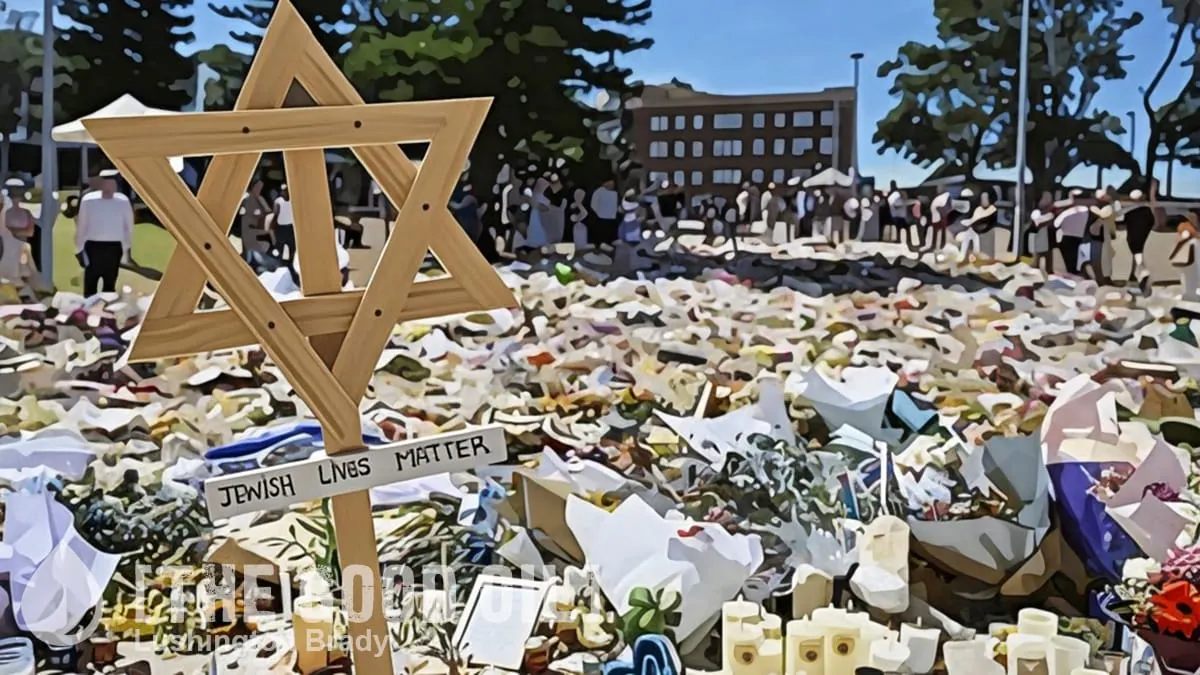
The same politicians and police – looking at you, Chris Minns and NSW Police – who are now weeping crocodile tears for the slain at Bondi are just as guilty. The October 9, 2023, Sydney Opera House rally, where crowds chanted for Jewish blood while police stood by (and worse: the only arrest made that dreadful Muslimknacht was a Jewish man, for the capital crime of carrying an Israeli flag), was a ‘critical turning point’ that authorities missed. Had it been confronted decisively, Segal argued, the trajectory might have been different. Instead, institutions that had turned a blind eye to creeping antisemitism in their ranks for years simply stopped pretending.
The pattern is clear. Pre-October 7, elite institutions – media, universities, cultural gatekeepers – treated antisemitism as a niche irritant best ignored or explained away as legitimate criticism of Israel. After October 7, with Jews slaughtered in their homes, and then being hounded in Australian streets, many simply dropped the mask.
This isn’t incompetence. It’s institutional capture. Large sections of the left, once capable of distinguishing between criticism and hatred, have embraced victimhood hierarchies that place Jews at the bottom. Multiculturalism, once sold as harmonious enrichment, fractured the moment one imported community’s ancient hatreds met another’s survival.
The royal commission is hearing what many of us already knew. The question isn’t whether Australia has an antisemitism problem. It’s whether its most powerful cultural and educational institutions even want to solve it.
In 1945, Orwell concluded, “It is not at present possible, indeed, that antisemitism should become respectable.” Eighty-one years later, that seems almost Pollyanna in its optimism.