Table of Contents
It’s ironically fitting that the Chinese Communist Party puts so much totemic stock in the country’s giant pandas. In many ways, few of them flattering, the creatures can be seen as, indeed, a metaphor for modern China.
Not least because of their apparent determination to simply go extinct. Pandas are listed as ‘vulnerable’, up from ‘endangered’, but not from any effort of their own. The creatures were never endangered, as so many other species are, by human activity. Quite the contrary: the CCP has invested extraordinary effort into keeping them alive. But the simple fact is that, not only have they backed themselves into an evolutionary tight corner with their highly restrictive diet, they just show almost no inclination to breed.
Not unlike the Chinese themselves: the country’s population is collapsing. Decades of communist rule have crushed the people’s will. After the disaster of the One Child policy, the sudden reversal has had no success. Despite throwing everything at encouraging young Chinese to breed, birth rates continue to plummet.
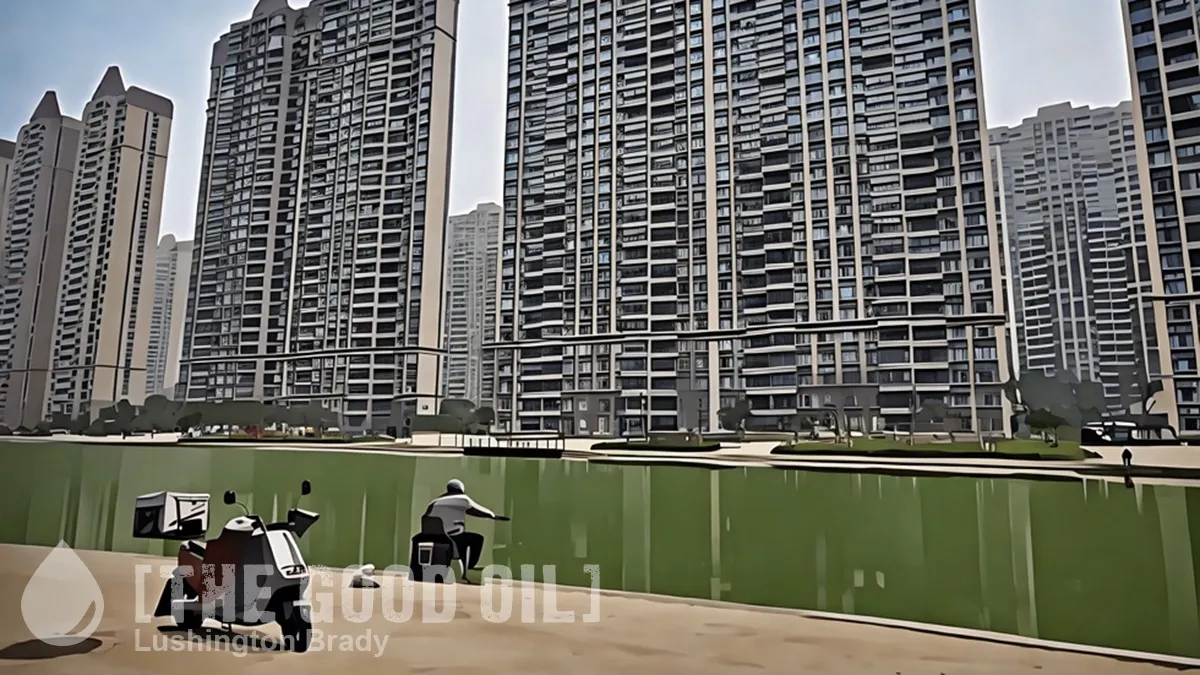
And more and more young Chinese are simply giving up on Xi’s vaunted ‘Harmonious Society’. Put simply, they’re dropping out. And the vast ‘Ghost Cities’ built to order by the CCP are helping them do it.
The “Life in Venice” housing development, a multibillion-dollar replica of the Italian city on the Chinese coast, stands silent. Many of the tens of thousands of homes are hollow husks of concrete and alabaster.
But in recent years the remote, partially abandoned complex has drawn unlikely new residents like Sasa Chen, a burned-out young Chinese woman who until recently worked a high-earning finance job in Shanghai, China’s bustling commerce hub.
In a reverse of the housing crisis in Western nations, where demand vastly outstrips supply, leading to soaring prices, there just aren’t enough Chinese to fill the empty new cities. Inevitably making them very, very cheap.
Chen pays just 1200 RMB, or $168, a month for her apartment in faux Venice in the eastern Chinese province of Jiangsu. It’s so cheap that it’s allowed Chen to retire at the tender age of 28.
Experts say Chen is part of a broader trend that has seen a growing number of young people across China migrating to small towns and cities, taking advantage of cheap real estate prices that have been plummeting since the Covid pandemic.
As I wrote recently, the ‘Cry-Cry Horse’ plush toy fad shows that Chinese are not feeling the ‘Harmonious Society’ at all. Instead, they’re burned out by ‘996 culture’: 9 a.m. to 9 p.m. from Monday to Saturday. So, they’re just dropping out and upping sticks for the cheap former Ghost Cities.
Some are redefining their dreams to focus on rest and relaxation, much like what some young adults in the West are doing under what they call FIRE: “Financial Independence, Retire Early.”
That’s much more achievable in China because the cost of living in some places can be so low compared to prices in the West.
Home prices at the massive “Life in Venice” development have more than halved since the downturn in China’s property market a few years ago, and a lunch of noodles or a rice dish costs under three dollars in the neighborhood’s restaurants.
The bargain prices have benefited young people like Chen willing to live in remote but affordable housing now available across the country. Chen describes it as the perfect life: a sea view, clean air, and cheap rent.
“I have all the time in the world, the freedom of doing whatever I want,” said Chen. “I am living the life that I want.”
This has as ominous repercussions for China’s future as its collapsing birthrate.
While there’s no available data about how many have left the Chinese workforce in recent years, figures show that from 2019 to 2024, Beijing lost 1.6 million people in their 20s and early 30s – around the total population of Philadelphia – according to China’s capital statistic office.
And this means, as the population bubble ages, that a generation of future Chinese workers will be as scarce as the giant panda.