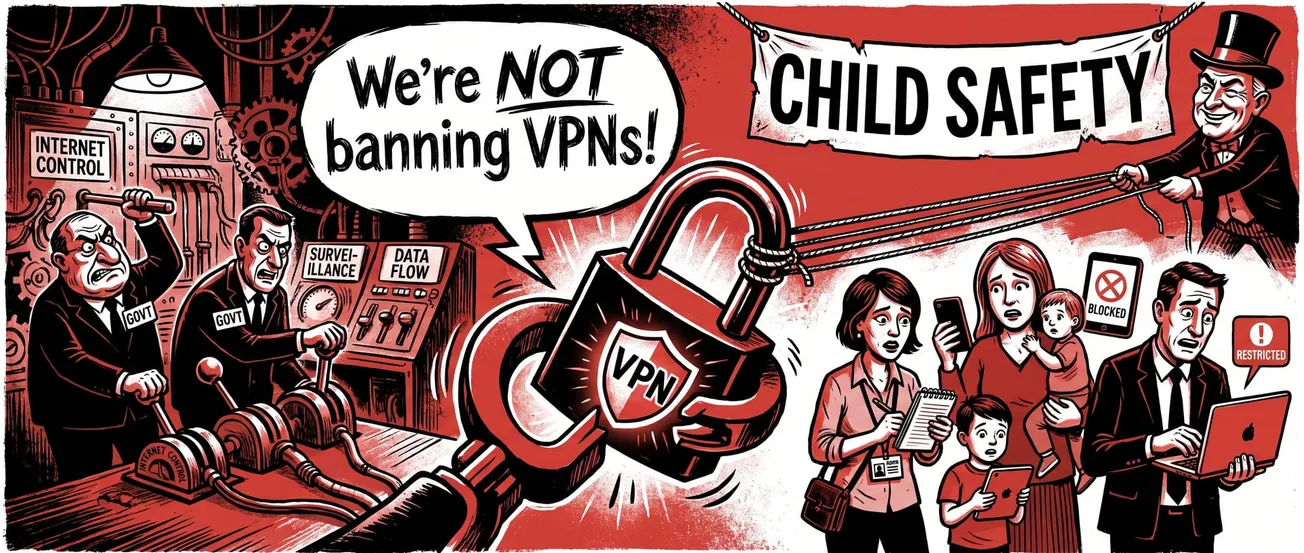
The National led government is flat out denying it is even considering a ban or restriction on VPNs. Education Minister Erica Stanford’s office insists no such thing is on the table as part of their social media harm legislation. Funny how that works when documents and sources say otherwise.
This looks like classic gaslighting. One minute reports surface about exploring a VPN ban or forcing platforms to block them; the next the government claims it was never a thing. Pull the other one.
The context is the stalled push for an under-16 social media ban, which has already proven an utter flop in Australia and the UK. Teens there are dodging the restrictions like pros, with Australian data showing about two-thirds of targeted young users still accessing banned platforms. VPNs make that easy by masking locations.
Instead of admitting the ban is unworkable, the government has been sniffing around ways to stop people bypassing it. A select committee report even flagged concerns about VPNs undermining restrictions and suggested exploring regulation. Budget 2026 threw $30 million at developing policy options for child online safety. Yet suddenly it is all “nothing to see here”.
Really? https://t.co/MGfZr2HE3D pic.twitter.com/3YU6hi0Uet
— Kitty (@IamKitty_Cat) July 7, 2026
Opposition is loud and cross party. ACT leader David Seymour warned that restricting VPNs would mean the government controlling how every New Zealander uses the internet, not just kids on social media. He compared it to Chinese-style intrusions into privacy. Green co-leader Chlöe Swarbrick called it perverse consequences and not the right approach. Labour supports age restrictions but rejects VPN bans as ineffective.
The Free Speech Union nailed it: A VPN ban would be the most significant expansion of state control over online speech and digital freedom in New Zealand history. It is not child protection; it is censorship infrastructure. VPNs protect privacy, encrypt data, secure business information and help journalists safeguard sources. Only the worst regimes ban them.
Children’s Commissioner Dr Claire Achmad pointed out that blanket bans are too blunt and could increase harm for vulnerable youth, especially in marginalised communities. Critics rightly argue that restricting access alone does not make the internet safer.
The social media ban for kids has failed overseas, yet National keeps driving hard on this. Why? Politicians always believe they are smarter than everyone else and that their version will magically work where others collapsed. It is not the government’s job to police what kids access on devices. That is parents’ responsibility.
Erica Stanford is set to introduce a new bill soon and it is unlikely to include VPN restrictions after the backlash. But the fact they were even considering it tells you everything about the mindset. They want control and when it gets pushback they pretend it was never the plan.
New Zealanders should not fall for the denial. Keep a close eye on this. Digital freedom is worth defending and handing the state more power to dictate internet access is a dangerous path. Parents, not politicians, should decide what is best for their children.