Table of Contents
Me’at min ha’or doche harbeh min ha’choshech – “A little light drives out much darkness”.
As I wrote recently, while terror is an abomination at any time, striking on the holy days of their targets is a particularly egregious terrorist enormity. The fact that the Bondi terrorists struck on the first day of Hanukkah undoubtedly strikes all Australians as a particular horror, but its full significance may not be fully understood – because many of us don’t really understand Hanukkah.
I suspect most of us have a vague idea that Hanukkah is kind of a ‘Jewish Christmas’, but that’s not really all that accurate, apart from the fact that it occurs at roughly the same time of year. That simple fact has helped promote non-Jewish awareness of Hanukkah, but undoubtedly given us a distorted idea of its significance in the Jewish calendar.
This, I also suspect, is largely due to the unobtrusiveness of Judaism in Western culture. Where certain other religions make a big show blocking entire streets to pray, sometimes ostentatiously surrounding Christian places of worship, Jews simply quietly go to Temple with little fuss. No wailing calls to prayer – not even church bells. Even the shofar (ram’s horn) is only blown to mark certain holidays, such as Rosh Hashanah and Yom Kippur.
Still, even Christmas was once a minor Christian holy day. So, the growing prominence of Hanukkah has its parallels in Christian culture.
More important is just what Hanukkah represents: which is of increasing importance in these dark days for Judaism and likely precisely why the jihadists chose to target it.
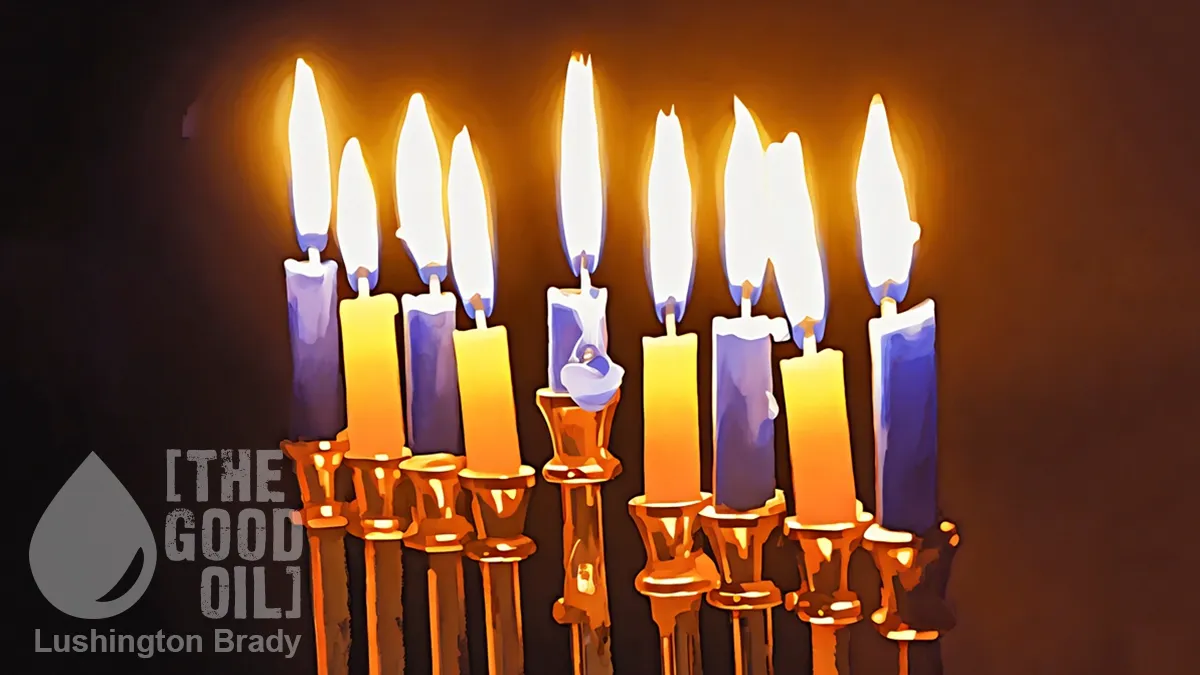
Hanukkah is literally a festival centred around the act of kindling light in public, with the familiar lighting of nine candles. That kindling of light is a kind of quiet defiance: a declaration that Jewish life will endure despite every attempt to eradicate it.
Often referred to as the Festival of Lights, it recalls a moment in history, almost 2,000 years ago, when Jews were targeted for their Jewish practices and identity.
It celebrates the brief period in which they managed to overcome attempts to suppress their faith and culture, rededicating the Jewish Temple in Jerusalem, which had been desecrated, and restoring a measure of Jewish leadership and autonomy in the land of Israel.
It’s not just that it celebrates events 2000 years ago that aligns Hanukkah with Christmas. Its timing in the yearly calendar is remarkably close:
Hanukkah takes place from the 25th of Kislev till the 2nd or 3rd day of Tevet on the Jewish calendar. This year, that falls from sunset on Sunday 14 December and continues through nightfall on Monday 22 December.
The origins of Hanukkah in fact date back to not long before the birth and death of Jesus. As they would soon under the Romans, the Jews of the second century BC were subject to the Seleucid Greek Empire. The Greeks outlawed Jewish religious practices and desecrated the Second Temple in Jerusalem.
But a small group of rebels called the Maccabees fought back against the mighty Greek empire, reclaiming Jerusalem and re-dedicating the Temple. Tradition holds that only one day’s worth of oil was found to relight the Temple’s menorah. The miracle story is that the oil somehow burned for eight days, until the rabbis could secure more.
Accordingly, Hanukkah is most famously marked by the successive lighting of the nine candles of the chanukiah: a nine-branched candelabra with eight equal branches for the eight nights, with the ninth candle, the shamash, used to light the others.
The festival begins with the lighting of a single candle on the chanukiah. A defining feature of the practice is that the number of candles increases each night, so that each night’s light builds on what came before […]
Each night begins with a blessing over the act of lighting the candles. A second blessing recalls the events Hanukkah commemorates and the deliverance remembered in Jewish tradition. On the first night only, a third blessing is added, giving thanks for living to celebrate the holiday once again. It’s a standard blessing said on the first night of every holiday, to welcome it in for the first time.
Taken together, these blessings serve as a reminder that Hanukkah is not only about what happened in the past, but about the responsibility to carry history and tradition forward […]
Across Jewish communities worldwide, Hanukkah is celebrated through nightly candle-lighting, blessings, songs, shared meals, games, gift-giving and communal gatherings.
By now, then, the symbolising both of Hanukkah itself, and the barbaric attempt to extinguish it in Australia, should be overwhelmingly evident. Hanukkah symbolises the defiance of the Jewish people in the face of repeated attempts to eradicate their shining light. Even the tradition of placing the chanukiah in a doorway or window is an act of quiet defiance, at a time when some are telling Jews not to be publicly Jewish.
Hanukkah is often understood as a reminder that even a small flame can be consequential. A common Jewish saying captures this idea: me’at min ha’or doche harbeh min ha’choshech – “a little light drives out much darkness.”
Even as we unite in grief for the victims of Bondi, let us all cling to the determination never to let the forces of darkness extinguish the light of the Jewish people – a light that has brought immeasurable gifts to not just the world, but Australia especially.