John McLean
Citizen typist patriot
Much has been made of Chris Hipkins not disclosing Labour Party policy positions in the lead-up to the November 2026 general election.
Hipkins’ ostensible reason for not (yet?) announcing policy is that he wanted to wait until after the government delivered its budget on 28 May. He hints that he may begin to announce Labour policies in June.
Hipkins pretend reason for remaining tight lipped is that he wants to fully understand New Zealand’s fiscal position before unleashing his pearls of political policy wisdom. But of course Hipkins doesn’t care one iota about New Zealand’s fiscal position. He didn’t care when Labour was last in power, and he doesn’t now. He’s of the Leftist Just-Print-&-Borrow-&-Tax-More-Money school of economic lunacy.
Media channels and journalists from all parts of the political spectrum have weighed in on Mummy’s Boy Hipkins keeping mum on policy. In one of my most viewed Substacks, I’ve previously covered the prospect of Hipkins becoming Prime Minister again:
HIPKINS, FROM POLITICAL GRAVE TO COMMIE CRADLE?John McLean 30 Jan
Jonathan Ayling, former head of the Free Speech Union in a 28 May piece for the Herald, has argued that it would be illegitimate for Labour to regain power after the next election without revealing its policy programme. Jonathan compares Hipkins’ silence to the policy void of Sir Keir Starmer’s British Labour Party before the 2024 British election, and points out that “Starmer is now fighting for his political survival.” But no lawfully elected government is illegitimate simply because it’s been tight lipped on policy.
A day earlier on 27 May, in another piece for the Herald, Jamie Ensor bravely speculated that Labour may delay longer than June before beginning to announce its policies. No kidding, Jamie.

In a 27 May piece for Scoop, Leftie Doyen Gordon Campbell heavily criticized Hipkins, opening with “Chris Hipkins is testing the patience (and allegiance) of every centre-left voter.” Gordon laments that “Unfortunately, Labour has not broken away from the economic model that has held sway in this country for the past 40 years, despite the manifest failures of that approach.” Gordon bemoans that, “Labour really isn’t a centre-left party. It’s a soft right-wing party.” Gordon dwells in a different world.
Red Radio New Zealand has purported to treat Hipkins’ silence on policy seriously, as if he’s a serious political figure worthy of being taken seriously. In doing so, RNZ has reported on criticism of Hipkins’ hush from Labour’s political opponents, ACT Leader David Seymour and National’s Finance Minister Nicola Willis.
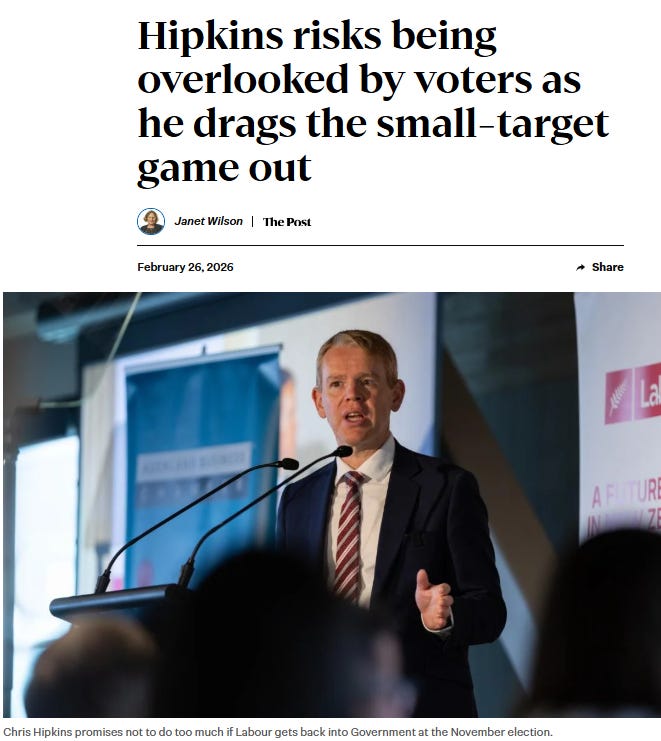
Political pundits claim that Hipkins’ cunning tactic is to make the Labour Party a “small target”: in other words, not present policies that might be amenable to criticism. And, to give Hipkins his due, Labour is New Zealand’s highest polling political party and Hipkins is probably – gulp – New Zealanders’ current preferred prime minister.
But for two very good reasons, all this journalistic noise about Hipkins’ muteness on policy is just vapid chatter.
First, no Labour Party policy promises from Hipkins can or should be taken seriously. He says whatever conveniently fits his ideologies, and never recants or repents.
Secondly, and more importantly, we know with a high degree of certainty – without Hipkins having to open his tight little lips – what Labour will do if it gets into power.
Labour will not return to power except in coalition with the Green and Māori political parties. And neither the Greens nor Te Pāti Māori will go into power with Labour without injecting their own policies into the coalition arrangements.

To give them their due, unlike Labour, the Greens have announced numerous policy positions:
- New/increased taxes (wealth, inheritance, 45 per cent marginal personal tax rate, 33 per cent corporate tax rate)
- Guaranteed minimum state funded income of $400 per week
- Free GP doctors and dentists visits
- Elimination of fossil fuels in favour of solar and wind turbine power generation
- Reinstatement of the ban on oil and gas exploration
- Revocation of all fast-track mining consents
- Cutting fertilizer use (the same cunning plan that collapsed Sri Lankan’s economy)
- Heightened commitment to the Treaty of Waitangi
- General “deindustrialization” of New Zealand
And the Māori Party has been outspoken in what they will demand if they’re part of New Zealand’s next government:
- Constitutional recognition of a separate Māori nation, reflecting the myth that Māori did not cede sovereignty to a unitary government for all New Zealanders
- Give the Treaty of Waitangi legislated constitutional supremacy
- Make the findings of the Waitangi Tribunal binding on the government, such that the tribunal will become a combined paramount New Zealand court and upper house of parliament, with the power to strike down legislation considered to be inconsistent with the Treaty of Waitangi and its amorphous “principles”, all under the auspices of a sinister, constitutional high priest, the “Te Tiriti commissioner”
- Abolish all prisons by 2040
- Ban sea drilling for oil and gas
- Give Crown and Department of Conservation land to Māori groups
- Make all personal income up to $30,000 tax-free
- Increase the top marginal tax rate to 48 per cent
- Introduce wealth taxes
- Impose new taxes on foreign-owned companies, undeveloped land and vacant houses
Importantly, Labour has not resiled from any of its actions and plans when it was last in power. In particular, Labour has committed to reinstating a separate health system for people with Māori ancestry, under a reconstituted Māori Health Authority (Te Aka Whai Ora).
It’s also reasonable to expect that Labour will finish the job it started when last in power, to merge Radio New Zealand and Television New Zealand into a massive state media propaganda machine for liberal progressive agendas. Fractious fractional-Māori Willie Jackson will consummate his Orwellian ambition.
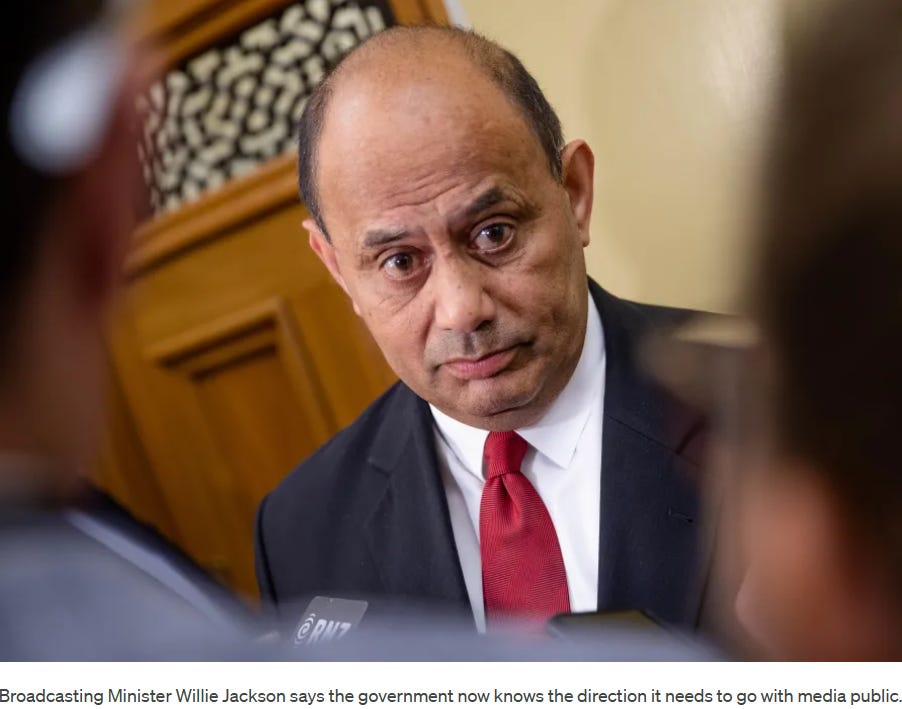
With an L/G/M coalition government, the current government’s promise to abolish the Woke Censorious Broadcasting Standards Authority will be unfulfilled. Media channels such as the Platform and Reality Check Radio that don’t fully subscribe to New Aotearoa Orthodoxy will be gone.
Therefore, for all practical purposes, we know precisely what Labour will do if it regains governmental power. It will restart the money-printing presses, fall in with its Greens/Māori Party coalition partners and forge ahead with the creation of a Neo-Marxist, Māori Dystopia. Western freedoms and civil liberties will be stripped. Two-tier policing will be reinstituted. New Zealand will collapse, Venezuela-style, into a failed State run by cultural and tribal elites. There is no ambiguity here. The future, if Labour/Greens/Māori win, is in plain sight.
And there’s a name for this distinct prospect of state sponsorship, curation and control of official ideological narratives. It’s fascism. There’s a myth that fascism is the preserve of the right. Germany’s Nazi Party was socialist.
FASCISTS!John McLean 3 November 2023
One decisive thing that will happen following a Labour/Greens/Māori government is that Justice Melanie Harland will issue her judgment upholding Māori pseudo-tribe Ngāi Tahu’s claim to almost all the fresh water in the South Island. Ngāi Tahu made its court claim in 2020, with the substantive hearing back in early 2025.
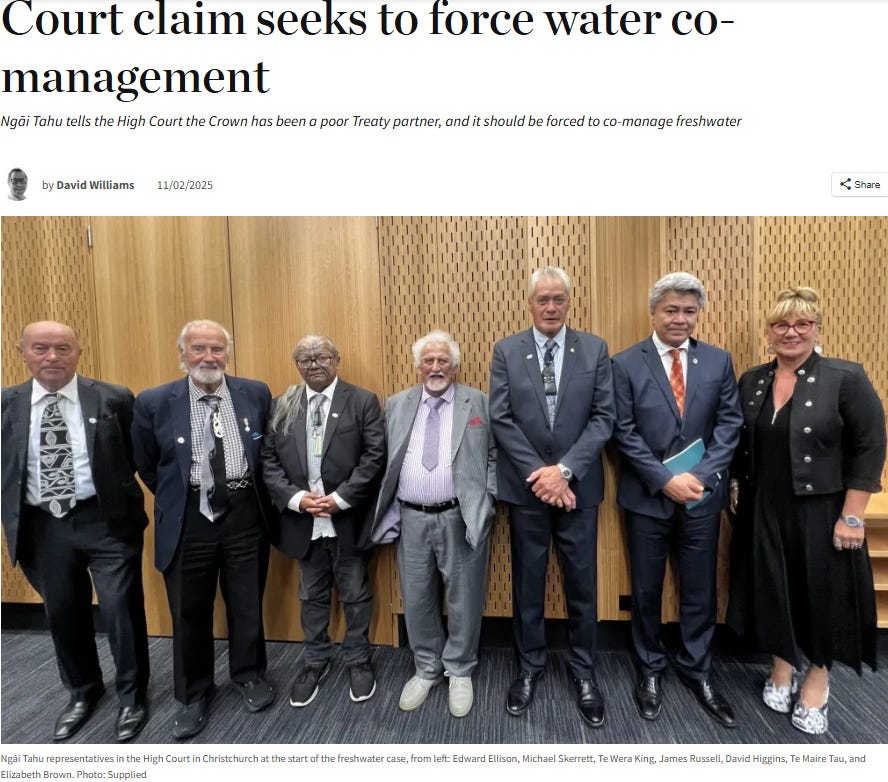
Harland has parked her judgment knowing that, if she issues it during the term of the current government, the National/ACT/NZ First coalition will pass legislation to overrule it. But the Race Identitarian Lefties are lurking and working in lockstep, poised to hand control of South Island fresh water to Ngāi Tahu. And a Labour/Greens/Māori Party coalition government would be simply delighted to let that happen.
This article was originally published on the author’s Substack.