Table of Contents
Will Jones
Dr Will Jones is Editor of the Daily Sceptic. He has a PhD in political philosophy, an MA in ethics, a BSc in mathematics and a diploma in theology. He lives in Leamington Spa with his wife and two children.
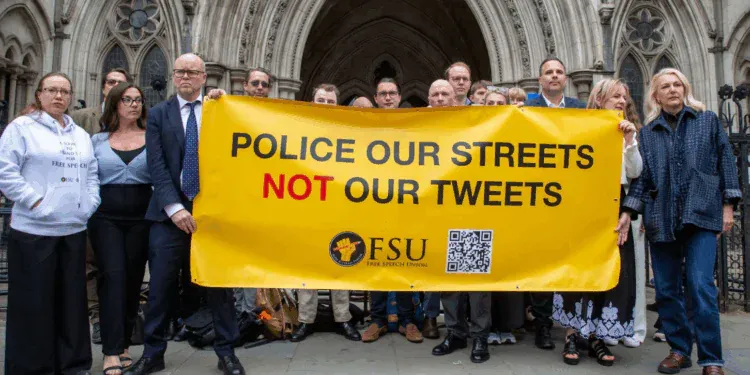
As the Metropolitan Police announce the demise of non-crime hate incidents, the Telegraph has run a feature on the Free Speech Union, crediting its years of campaigning against NCHIs and support for cancel culture victims. Here’s an excerpt.
Sir Mark’s decision may well signal a wider turning of the tide on police investigations into “hate crime”. But the force’s decision to backtrack on Linehan’s case, and others like it, got only a lukewarm welcome from Linehan himself, who said he planned to continue his legal action against the Met.
That, however, is not because he has limitless pockets – cancel culture, he says, has cost him much of his lucrative writing gigs. Instead, his lawyers come courtesy of the Free Speech Union (FSU), the British campaign group set up to defend freedom of expression – be it from armed police, an overzealous student campus or HR managers intent on enforcing diversity policies.
Set up five years ago by the former journalist, Toby Young – now Lord Young, having been nominated for a life peerage by Kemi Badenoch last December – the organisation has handled more than 4,500 cases, from members of the public arrested over tweets deemed to be politically incorrect, to office workers disciplined for querying seminars on critical race theory.
For some clients, the FSU has simply won a written apology. But for others, it has secured a £500,000 payout at industrial tribunal.
If there’s one thing most cases have in common, according to Young, it is that they shouldn’t have happened in the first place. Linehan’s arrest, in which the Met acted “like the Stasi”, being a case in point.
“I think this statement from the Met shows that they have got fed up with this stuff – they recognise that the public want them to prioritise serious crimes like burglary, car theft and mugging,” says Young, who has called for all police forces in the country to follow Scotland Yard’s lead.
“I also think that in Linehan’s case, the police realised they’d been manipulated by a trans-rights activist who understood exactly how to weaponise the police guidance on investigating hate crime incidents, and to turn the police into an enforcement wing for their own agendas.”
Young is referring to Lynsey Watson, a transgender ex-police officer who is understood to have reported Linehan to the police over his social media posts, one of which read: “If a trans-identified male is in a female-only space, he is committing a violent abusive act. Make a scene, call the cops and if all else fails, punch him in the balls.”
Linehan has always maintained that specific post was a play on the height difference between men and women. Watson, meanwhile, has a history of urging police forces to investigate complaints about gender-critical online postings.
Such cases are far from isolated, according to the FSU. In April, Ministry of Justice figures disclosed that police were making around 12,000 arrests a year nationwide for allegedly offensive posts on the internet. While most would result in a caution or no further action, that is still almost twice the 6,923 arrested per year for county-lines drug dealing – a much higher priority for the average citizen.
True, many of the arrests involve posts made while drunk, or in anger – as per that of Lucy Connolly, jailed for 31 months for urging people to “set fire” to asylum seekers’ hotels. But Young says the majority of the FSU’s 4,500 cases are brought on behalf of people whose only ‘crime’ has been to stand up for what they believe in.
“About 40 per cent of them are women who’ve been reported to the police, or reported to their employers or their university, for saying they don’t want to share toilets with non-biological women,” he says. “That, right now, is the frontline of the free speech crisis.”
Nonetheless, he speaks from bitter personal experience. The son of Labour activist, Michael Young, who helped found the Open University, Oxford-educated Young is best known for his 2001 memoir, How to Lose Friends and Alienate People, a wry account of his time in New York high society while working at the magazine Vanity Fair. While highlighting the absurdities of the US celebrity circuit, the book also documented the rather more earnest world of America’s elite Ivy League universities, where ‘political correctness’ already had a grip.
At the time, Young thought it was little more than a passing trend. But with the advent of social media, it returned in the form of ‘cancel culture’. Young himself fell victim in 2018, when the former Tory government announced him as a non-executive board member of the Office for Students. The appointment was in recognition of his work in setting up a Free School in west London, but when critics of his appointment dug for dirt in his social media history, they found a rich seam, with breezy references to “hardcore dykes”, “queer as a coot” celebrities and female MPs’ cleavages.
What might have passed for laddish, ’90s male banter was a treasure trove to the “offence archaeologists”, as Young describes them. After a chorus of “performative outrage” about his [supposed] homophobia and misogyny, he was forced to step down.
“Because I’d been a fairly provocative journalist most of my career, they found a Tutankhamun’s tomb of offensive material, and I ended up having to step down from several other positions too,” he says. “I remember I desperately wanted to reach out to an organisation that could give proper professional advice about how to cope with these cancellation storms.”
Hence the creation of the FSU, which mainly relies on supporter donations, and which now employs 28 staff, operating under the motto “Audi alteram artem” (“Dare to listen to the other side”), from its Great Portland Street office. Today, its advisory council includes the novelist Lionel Shriver, political commentator Remi Adekoya, historian Nigel Biggar, and the feminist philosopher Kathleen Stock.
Worth reading in full.
Stop Press: A review of the police’s recording of NCHIs by the College of Policing will recommend to the government that all forces should scrap the practice, the Times reports.
This article was originally published by the Daily Sceptic.