Alwyn Poole
Began teaching in 1991. TBC, HBHS, St Cuths. Founded/led Mt Hobson MS–18 years. Co-founded SAMS and MSWA. Econs degree, Masters in Edn, tchg dip, post grad dip – sport.
On a NZ blog site recently a reader responded to my criticism of the NACT education plan/progress with a frank: “What would you do?”
My credentials to suggest another pathway.
- a child of a genuinely low income and significantly problematic childhood. A solo mother, born in 1934, into a family with 11 siblings, might give you an idea of my platform. Add to that growing up in Aramoho, Wanganui.
- a survivor of a very poor high school.
- a bachelor of business studies degree (economics, accounting) from Massey at its peak.
- A teaching diploma from Christchurch College of Education.
- A master’s degree in educating high ability students.
- A post-graduate diploma in sports management.
- A teacher, head of department, sports coach at Tauranga Boys, Hamilton Boys, St Cuthberts.
- A founder and 20-year principal of Mt Hobson Middle School.
- A founder and eight-year academic adviser of South Auckland Middle School.
- A founder and seven-year academic adviser of Middle School West Auckland.
- A key researcher of the LEAVERS data of every NZ high school each year.
- A high-level rugby and athletics coach who has, for instance, contributed to the development of 18 players who have competed in rugby world cups.
- A parent of three children who are qualified at a tertiary level, with two at degree level and one at PhD – and each involved in remarkable careers.
The first point on how to improve all things education in NZ is that, so long as any government think that they are the podium of truth in this area, they will fail and all improvements will be marginal (at best).
1. New Zealand desperately needs a Crown entity for parenting.
- Non interventional and free from political influence.
- Promoting, through the broadest means, the very best developmental science/practices for children from conception to five years old.
- Bringing people such as David Eagleman and Ben Carson to NZ to widely promote best practice in parenting and development.
- A KPI of NZ becoming the world’s best nation for parenting.
The key aspect of high-quality education in NZ is high-quality parenting. Good schools clearly help but it is the parents that do the hard yards. At present the perception is that good parenting is strongly correlated with wealth and the ability to have stimulating resources in the home. We need to break this pattern/perception.
The actual practices in the crucial first five years do not need lots of money:
- good basic nutrition.
- good shelter and clothing.
- parents free of drugs and alcohol – from conception.
- MANY words being spoken every day. And positive words.
- Eating together.
- Minimalising screen time and maximizing activity and human contact.
- Parents reading to their children EVERY night.
- Music in the home.
2. The Ministry of Education needs to be completely re-structured and re-purposed.
(This section is a repeat from an earlier post… and many before that… plus the support from Oliver Hartwich who stated that the solution to the ministry was TNT.)
The influence, incompetence and sheer absorption of taxpayer funding of the Ministry of Education has to be significantly diminished.
The Ministry of Education was largely exempted from Nicola Willis’ budget reductions. Why? No explanation was given. The leadership under Hipkins, Ardern, Tinetti is still largely in place. When Hipkins became the minister, there were approx 2,700 education bureaucrats. When Labour finished it was above 4,000 and the Stanford/Seymour combination has barely reduced it. It is one of the great examples of David Graeber’s BS jobs, and all manner of studies into bureaucratic behaviour, where you employ more people and see a HUGE decline in performance.
This is a scene from inside our Misery of Education that was leaked to me.
The ministry staff don’t even like working there: “only 41 per cent would recommend the MoE as a good workplace, 26 per cent say they intend to leave within 12 months”.
Which NZ politician has the courage to walk into this institution with a bathroom sink?
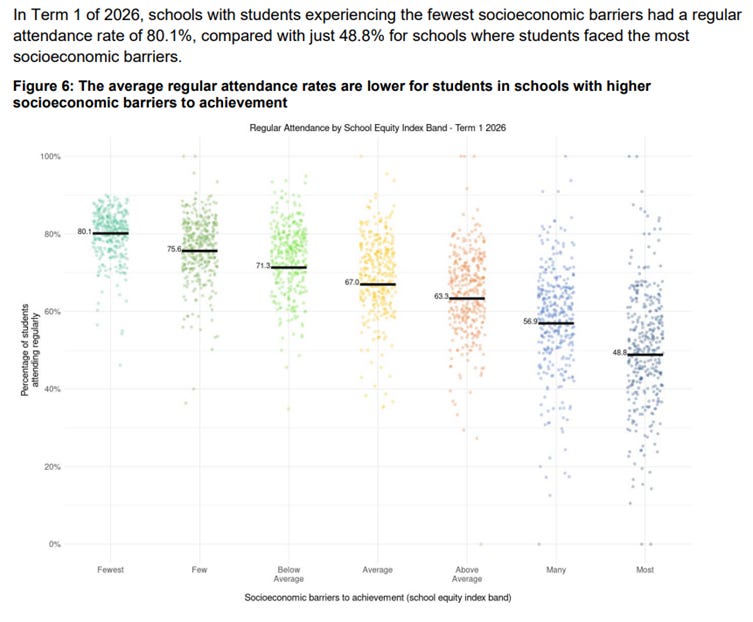
3. Attendance must be dramatically improved – especially for the lower socioeconomic levels, Māori and Pasifika.
Phonics and the one hour of math and one hour of reading a day at primary schools is a good thing but, it is of marginal value until we have HUGE emphasis and improvement on the vast majority of children attending school. I know of ministry data that clearly shows that attendance correlates with achievement/progress well ahead of any pedagogy (e.g., phonics) or type of workbooks being used.
Below is from Education Counts. It shows clearly that those who will benefit if practices, curriculum and qualifications improve… are the ones already doing well.
4. The EQI system (formerly deciles) needs a significant review.
A recently completed post grad analysis at University of Auckland showed: “EQI has a consistent negative association with achievement indicators.”
– Equity Index funding in 2024 was less than $250 million in total against direct spending of $7.9 billion. Compare that to $2.5 billion of departmental output expenditure.
– EQI funding is around three per cent of primary and secondary schools operational and teachers pay funding, yet it is one of the mechanisms we are trying to level the playing field.
The amount and differentials are simply WAY to small to make the difference that the EQI system is supposed to achieve.
5. The human aspect of education needs to be advanced. Workbooks make much less difference than the public is being told. The things that do are: school leadership, very clear and aspirational programmes to increase teacher quality and retention. Very few students remember a great facility or workbook – but they will tell you about their great teachers.
I received this connection last week from someone I taught in the 1990s:
Thank you for your teaching so long ago. Your class gave me a love for business. Whilst not academically-gifted, I always excelled in the workplace so thank you for kicking it all off.
Unions are arguing for a teacher aid in each class. That is too much – but there needs to be many more of them and there needs to be a clear training pathway.
6. A great designated character school model would be significantly better than charter schools.
The charter school policy is a bust with tiny schools and just 0.2 per cent of NZ schools attending them after nine years of effort. No state schools have converted – including none of the former charter schools who are clearly voting for the designated character model with that decision.
As I argued prior to the last election: what is needed is a fully open designated character school policy that takes care of property and does not limit attending numbers. This can also enhance the Catholic school system. Given the nature and needs of the NZ system, this is a better development pathway for new and innovative schools.
7. We should significantly enhance the private school system.
Any reading of our school leavers data shows that private and designated character schools dominate the top level.
In Australia 36 per cent of children attend private schools with a government subsidy of $14,000 per student.
In NZ 3.6 per cent of children attend private schools with a government subsidy of $1,400 per student. That amount is then lost to schools as NZ is one of only two OECD countries that charge GST/VAT on school fees. The UK being the other, as they have recently begun applying VAT to private school fees and 20,000 students, so far, have left their school of choice.
Private schools save the government a fortune for every student and the savings could be used to enhance state schools. ACT and National say that they believe in choice but have simply been pathetic in this area. As have Labour, when the children of people such as Willie Jackson and Barbara Edmonds have attended top private schools.
This is the top 35 schools from 2024 LEAVERS for UE. Can you see a pattern?
Manukau Christian School
Diocesan School for Girls
St Cuthbert’s College
Rangi Ruru Girls’ School
Iona College
Pinehurst School
Kristin School
Craighead Diocesan School
Baradene College
ACG Parnell College
Marist College
Saint Kentigern College
Woodford House
St Mary’s College (Ponsonby)
St Oran’s College
King’s College
Christchurch Adventist School
Columba College
Waikato Diocesan School For Girls
Wellington Girls’ College
Samuel Marsden Collegiate School
Queen Margaret College
Hutt International Boys’ School
St Hilda’s Collegiate
ACG Strathallan
St Matthew’s Collegiate (Masterton)
Liston College
Carmel College
Chilton Saint James School
Scots College
St Peter’s School (Cambridge)
St Peter’s College (Epsom)
Villa Maria College
St Dominic’s Catholic College (Henderson)
ACG Sunderland
St Catherine’s College (Kilbirnie)
8. The curriculum writing process under the current government has to be immediately and fully reviewed.
There is a strong sense in the sector that subject experts have been ignored and that the consultation process is farcical. This should be acknowledged and genuine engagement with the sector established. Sometimes you just need to stop and go back to the beginning.
There is also concern that almost all resource publishing contracts are going overseas.
There have been some silly claims made. None more so that Elizabeth Rata on Newstalk ZB, June 1, who told Andrew Dickens that:
“I think the move to standardise the curriculum throughout the country will mean that we don’t have pockets of children who miss out [on a good education].”
If anyone truly thinks that just changing the curriculum will solve all of our education problems then they really do need to get out more.
9. Consider mandating the Cambridge exams and upper school curriculum – with NZ aspects is subjects such as history.
We are truly in danger of creating 12 years of chaos in education in NZ. It would be much cheaper, simpler and internationally comparable – and easier to implement – to simply mandate the Cambridge exams and upper school curriculum.
10. A great deal more needs to be done for the children in the middle of these changes.
In 2024, 15.9 per cent students left our high school system with no qualifications. This was a decade high. The 2025 leavers data will show that nearly 20 per cent of students will leave our high school system (after at least 13,200 hours of taxpayer funded instruction) with no qualifications. The impact on those students – and society as a whole – will be massive and a great deal could have been done by Stanford/Seymour and co to change those outcomes. This is on their watch.
There is still the opportunity to change things for students going through the NCEA system up until 2030.
11. The government needs to fully and effectively re-engage with Māori and Pasifika re education.
There is a very powerful perception that this government is, at best, negligent of the interests of Māori. Significantly more so that the Key government – and especially in education. It was a mistake to withdraw the clause for schools to “give effect to the Treaty” from the Education Act and Minister Stanford telling Jack Tame that it was her decision – without consultation – reinforced perceptions. Over 1800 schools/ECEs have written to say that the disagree with the minister. A cabinet paper also states that the new qualifications system will, at least in the short term, negatively impact results for marginalized groups – including Māori.
These areas need to be openly faced up to and addressed. Not doing so is a part of the reason why Labour still leads National re education in the Ipsos polls.
12. Enhancing being LITERATE above functional literacy.
While there is some, very limited data, that appears to show the change to ‘structured literacy’ is having a positive impact for children, I see three significant issues.
One, is that the lack of full attendance for marginalized groups means that they have very little chance of improving – regardless of the programme.
Two, is that some children are already bored witless. This is primarily those who start school already able to read. Right through our education system we need children inspired by great books and adults passionate about literature. Functional literacy and being genuinely literate are worlds apart and we should be aiming for children and young people being the latter.
Three, is that talking of ‘the science of reading’ risks further sidelining parents. Prior to the last election I attended a literacy conference in Wellington led by Michael Johnston. There were some very good aspects. At the end I asked the panel how they saw the role of parents in the proposed changes. To a person, the panel told us that they considered parents too busy to help and that the complexity of the process would be a barrier.
With these type of interventions you get a glee club patting themselves on the back for finally seeing the light while lamenting their past signs of applying the wrong teaching/learning theories. We then jump on a new merry-go-round for the next generation.
13. School lunches, if done, need to be done well.
In a home or restaurant being presented with a disappointing meal – with clearly little thought and effort – is deeply disappointing/affronting. It clearly says that you are not welcome or valued.
Spend more money. It will still be a tiny portion of the education spend of $7.5b.
Make the meals superb. Let the children know that are valued. Give them another reason to get out of bed and go to school. Once a week, make it a shared lunch with parents.
14. Be very smart with device use and AI.
Develop a genuinely expert research group – led by someone like Sir Ian Taylor – to accurately evaluate and report on the best use of technology and AI in our schools.
We have clearly overused devices and all applications need a review – away from the tech businesses.
With AI there are two major risks. Over implementing/applying without clear research and going too slow and being left behind the world.
15. Have a strong emphasis on creativity, problem solving and entrepreneurship.
Much of the current emphasis is on the basics and, also, through the push for vocational education, providing labour for industry and tradies to service our homes.
With our appalling productivity measures NZ is desperate for a generation of exciting innovators and risk takers.
16. Much work needs to occur to generate a greater understanding of neuroscience that will allow children to be seen with fewer limits. The idea of fixed levels of abilities is long gone but many schools and teachers act as if an accurate understanding of ‘intelligence’ for a range of reasons – none of them good. Streaming children on an entry test or two is particularly stupid.
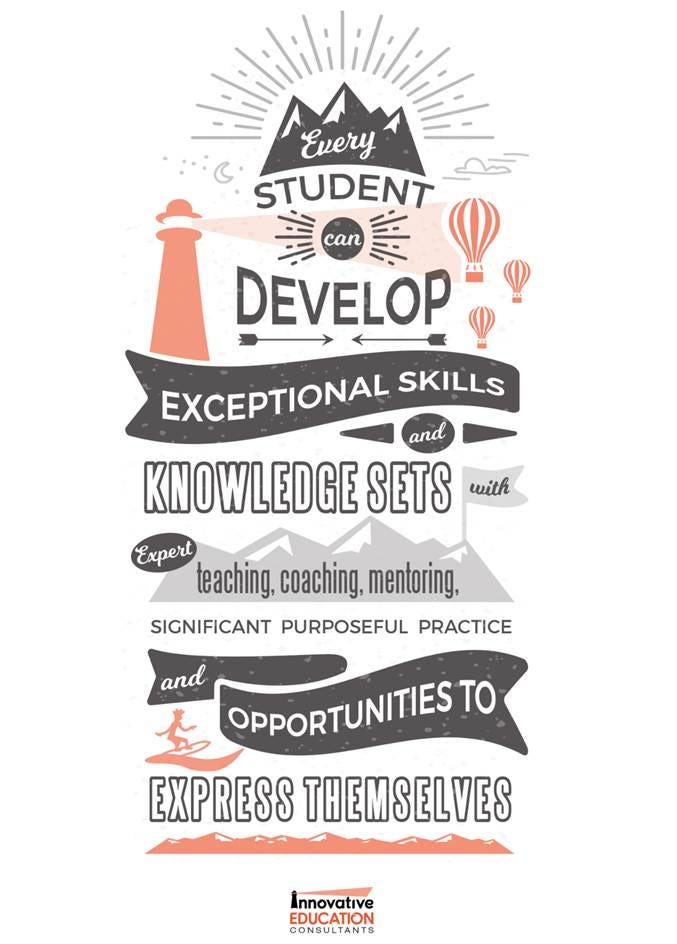
We have to return to ideals. Having a goal that by 2030 that just 80 per cent of year eights will be literate is appalling. Every teacher should teach on the basis that every children in front of them is remarkable and can do remarkable things. My teaching/learning statement is:
This article was originally published by Education – the Absolute Best Ways.