Table of Contents
There is just one big, fat problem with Morgan Spurlock’s much-valorised ‘documentary’ Super Size Me – one so obvious that even humour site Cracked.com pointed it out: no one has been able to replicate its results. This is kind of a biggie in a so-called documentary, which is, after all, supposed to be factual. Instead, as Cracked says, Super Size Me is “about as real as Borat”.
Firstly, rival documentary-makers argue that Spurlock couldn’t possibly have consumed his claimed 5,000 calories per day (Spurlock refused to disclose his food log). Secondly, healthy college students who volunteered to consume 6,000 calories per day (“inadvertently also answering the question ‘What’s the easiest way to get guinea pigs ever?’”) showed none of the health issues Spurlock reported.
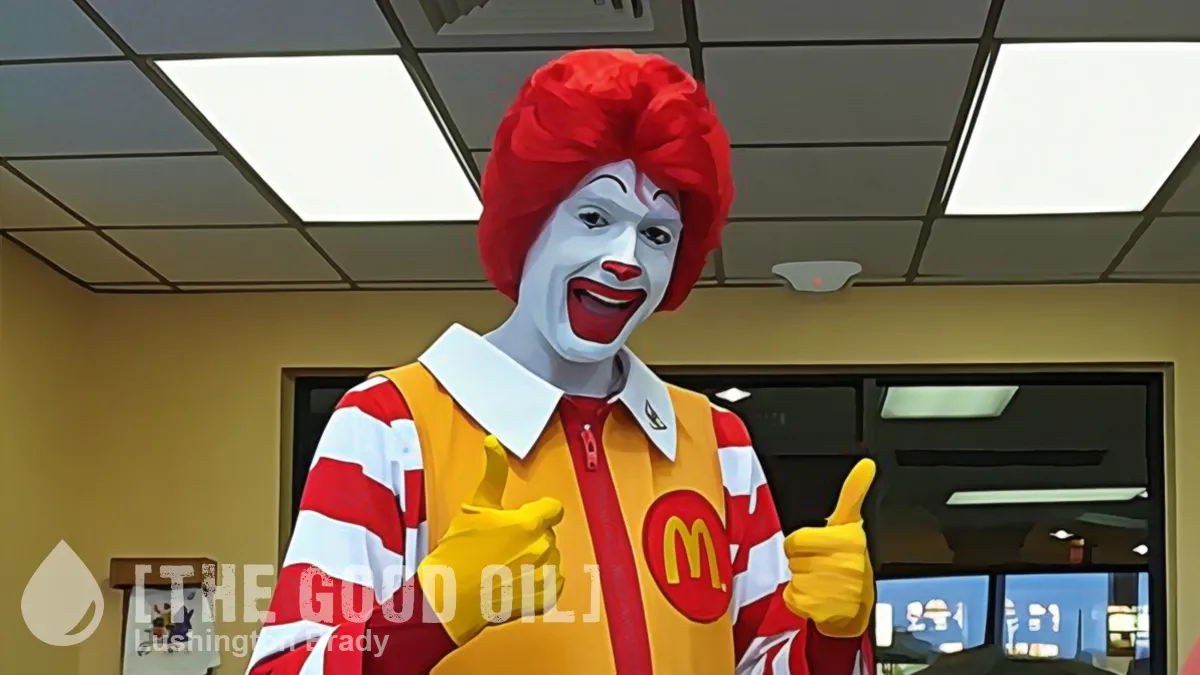
So, why isn’t Super Size Me more universally derided? Because everyone loves to hate Maccas. Many of them must be lying, of course, given the fast food chain’s stunning success. Why is it so fashionable to rubbish McDonald’s? Because doing so satisfies every elitist button, from anti-Capitalism, to food snobbery, to good old class-hatred (watch how quickly the Nimby’s screech that a McDonald’s will ‘lower the tone’ of whatever trendoid enclave they’re trying to shut the gate on.
As far as the food snobbery angle goes: the foodies are full of it. There’s a reason the sadistically jaded chef of The Menu hates foodies so much – and spares down-at-heel Margot (Anya Taylor-Joy) when she opts for an un-pretentious cheeseburger and fries. Far from the ol’ Mickey D’s being a uniquely unhealthy choice, several studies have shown that high-end dining can be even unhealthier.
Ruopeng An — a professor at the University of Illinois — studied the health data of 18,000 adults in the US across eight years. The research revealed that while those who visited restaurants ate more vitamins and potassium than those who visited fast food chains, they also consumed higher levels of harmful nutrients.
Compared to eating at home, both dining at fast food chains and higher end restaurants increased the amount of sodium people consumed per day. However, those who ate at fast food outlets saw an average increase of 300 mg, while those who dined at restaurants encountered an increase of 412 mg. Most notably, those who dined at restaurants ate on average 58 mg more cholesterol per day compared to those who ate at home. People who dined in chains only consumed an additional 10 mg.
In the end, eating food cooked at home is almost always the healthiest option. Regardless, though, McDonald’s is hardly the modern, low-class poison that sneering elitists think it is.
Not only that, Maccas is a pretty good bargain for us lower classes. As The Menu’s Chef Slowik (Ralph Fiennes) says to Margot, “I’ll make you a very good, very traditional cheeseburger… the cheap one your parents could barely afford”. Yet, at $9.95, even poor parents could afford it.
In fact, McDonald’s has probably fed more human beings than perhaps anyone other than Norman Borlaug.
McDonald’s stopped officially counting its hamburger sales after surpassing 100 billion burgers in 1994. However, based on recent estimates of roughly 75 burgers sold every second – or approximately 2.36 billion per year – the total number of burgers sold by McDonald’s is likely in the hundreds of billions, with some sources suggesting McDonald’s has already sold its trillionth burger.
There’s a reason they’ve sold so many burgers, and it has little to do with conspiracy theories about addictive additives or subliminal advertising. Simply put, Maccas is great value.
My favorite McDonald’s item is the cheeseburger. It’s been my top choice since 1973, when McDonald’s first came to my hometown. This product will provide you with 300 calories, 15 grams of protein, 31 grams of carbohydrates, 13 grams of fat, and 720 milligrams of sodium. I think it’s delicious and a great food value.

And it’s only either kept its value, or become better value, over time. Social media is full of images of ’60s and ’70s fast food ads, goggling at the idea of a KFC Dinner Box for $1.35. But if that was adjusted to today’s money, it would cost AUD19.95. Its modern equivalent, the 3 Piece Box, costs $14.45 – and includes a can of drink, which the 1970 meal didn’t. A Big Mac in 1971 cost the 2025 equivalent of $8.69. A 2025 Big Mac costs around $7.50 (depending on location).
In 1948, entry-level workers were earning around 66 cents an hour. A 19 cent cheeseburger would cost them around 17.4 minutes. Today they’re $1.99 and entry-level food service workers are earning $18.67 an hour, putting the time price at 6.4 minutes. The time price has dropped by 63 per cent: You get 2.7 cheeseburgers today for the time price of one in 1948.
Today, with over 41,800 stores in 118 countries and global sales of $130 billion, chances are, wherever you go in the world you can find the Golden Arches calling you. Approximately 93 per cent of the restaurants are owned and operated by independent franchisees, which has made many of them millionaires.
McDonald’s haters love to characterise it as the epitome of capitalism. As it happens, they’re right – but for entirely the wrong reasons. As they are about nearly anything to with capitalism.
So, enjoy your chukkas in moderation and raise a Coke Zero to capitalism and adundance.