Table of Contents
Is the end nearing for gay marriage in the United States? In what may be a repeat of its repudiation of Roe v Wade, the US Supreme Court has been asked to reconsider Obergefell v Hodges, the ruling that opened the way for gay marriage in the US.
This is far from the first time contentious Supreme Court rulings have been overturned or nullifed. Perhaps its most infamous ruling, Dred Scott v Sandford, which ruled that people of black African descent were not entitled to the rights and privileges of the Constitution, was effectively nullified by the Territorial Slavery Act of 1862. Plessy v Ferguson, which legitimised racial segregation, was eventually overturned by Brown v Board of Education.
Indeed, some 236 Supreme Court decisions have been overturned by later Supreme Court decisions.
Most recently, Roe v Wade, which was for 50 years the basis of abortion in the US, was overturned, and the responsibility for legalising abortion or not returned to individual states. The new case to be heard by the court will, if successful, do the same for gay marriage.
At heart is a key Constitutional right: the free exercise of religion.
Kim Davis, the former Kentucky county clerk who was jailed for six days in 2015 after refusing to issue marriage licenses to a gay couple on religious grounds, is appealing a $100,000 jury verdict for emotional damages plus $260,000 for attorneys fees.
In a petition for writ of certiorari filed last month, Davis argues First Amendment protection for free exercise of religion immunizes her from personal liability for the denial of marriage licenses.
More fundamentally, she claims the high court's decision in Obergefell v Hodges – extending marriage rights for same-sex couples under the 14th Amendment’s due process protections – was “egregiously wrong.”
As happened with Roe v Wade, the argument is that the previous court simply made up its ruling out of thin air. “Legal fiction,” as Davis’ lawyer, attorney Mathew Staver, writes in his petition.
Davis is uniquely qualified to challenge the earlier court ruling, given that it led directly to her being jailed for following her religious convictions. In 2015, the County Clerk for Rowan County in Kentucky, was the sole authority tasked with issuing marriage licenses on behalf of the government under state law. In that role, Davis defied a federal court order to issue marriage licenses to homosexual couples. Her argument was that Kentucky law required her to issue the licenses under her name, which would require her to violate her religious beliefs as a Christian. Davis was ultimately jailed.
“If there ever was a case of exceptional importance,” Staver wrote, “the first individual in the Republic’s history who was jailed for following her religious convictions regarding the historic definition of marriage, this should be it.”
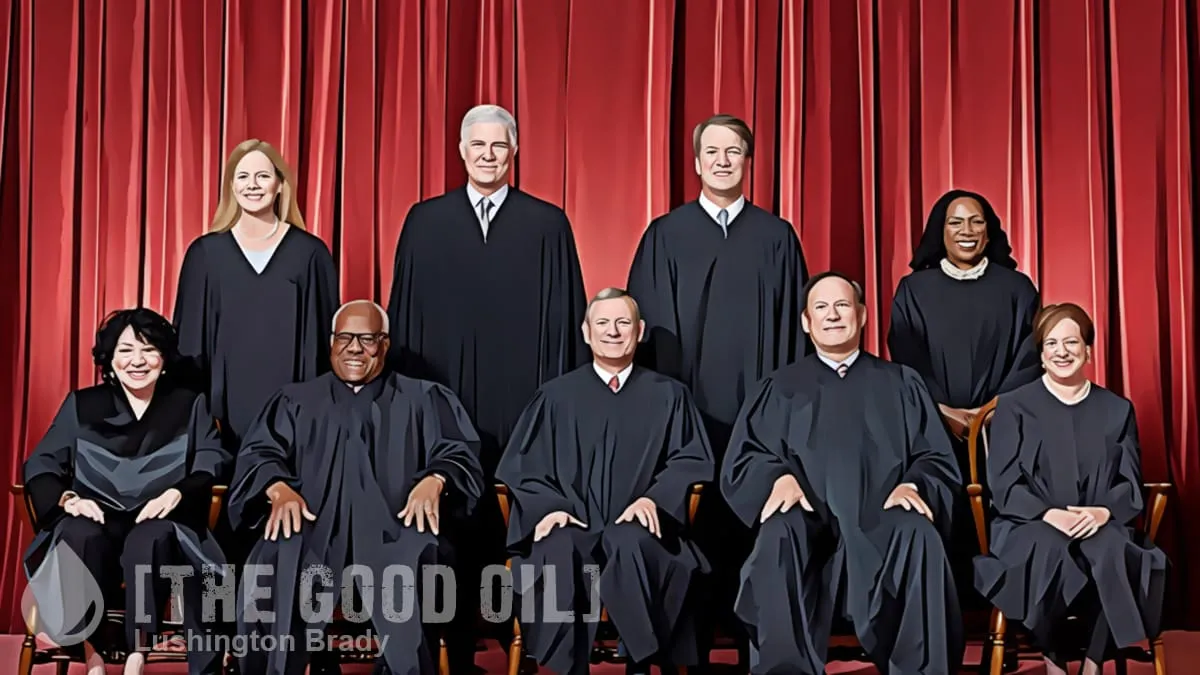
How likely is the court to reverse its earlier ruling? Lower courts, which have been subject to years of Long March white-anting by Democrats and Soros-funded groups, have refused to hear the appeal. But the current bench of the Supreme Court is a different beast. From the original on gay marriage, only two current justices (Sotomayor and Kagan) voted in the affirmative. Justices Roberts, Alito and Thomas voted no. So that’s a certain three to two ruling to overturn, for a start.
Of the justices since appointed, three (Barrett, Gorsuch and Kavanaugh) are considered conservatives. Only the motor-mouthed Ketanji Brown-Jackson is a ‘progressive’. So, does that mean a likely six to three ruling that Obergefell v Hodges will be overturned? At least one wild card is Barrett, who is more likely than the other justices to vote on virtue of ‘feelings’ rather than the Constitution. Which, while narrowing the decision to five to four, would still see it overturned.
What will happen, in that case? The responsibility for allowing gay marriage, or not, will like abortion return to the states.
At the time Obergefell was decided in 2015, 35 states had statutory or constitutional bans on same-sex marriages, according to the National Conference of State Legislatures. Only eight states had enacted laws explicitly allowing the unions.
So far in 2025, at least nine states have either introduced legislation aimed at blocking new marriage licenses for LGBTQ people or passed resolutions urging the Supreme Court to reverse Obergefell at the earliest opportunity, according to the advocacy group Lambda Legal.
In June, the Southern Baptist Convention – the nation's largest Protestant Christian denomination – overwhelmingly voted to make "overturning of laws and court rulings, including Obergefell v. Hodges, that defy God's design for marriage and family" a top priority.
At the same time, lived experience has made Americans slightly less supportive of gay marriage. While support rose from 60 to 70 per cent between 2015 and 2020, it hasn’t risen any higher since. More notably, support among Republicans has soured considerably, dropping from 55 to 41 per cent in just the last four years.
Even if the ruling is overturned, it won’t invalidate the marriages already performed. The 2022 Respect for Marriage Act requires the federal government and all states to recognise legal marriages of same-sex and interracial couples performed in any state.
But, having metaphorically and literally married in haste, a growing number of US states are ready to repent at their leisure.