
Table of Contents
Lindsay Mitchell
lindsaymitchell.blogspot.com
Lindsay Mitchell has been researching and commenting on welfare since 2001. Many of her articles have been published in mainstream media and she has appeared on radio, tv and before select committees discussing issues relating to welfare. Lindsay is also an artist who works under commission and exhibits at Wellington, New Zealand, galleries.
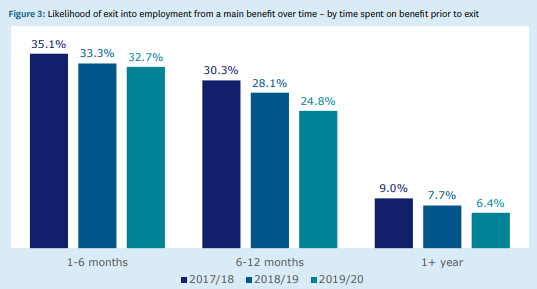
The longer people are on a benefit, the harder it is to get off it.
The following graph illustrates that. Someone who has been benefit-dependent for 1-6 months has a much higher likelihood of leaving for employment than someone with a duration of a year or more. Although the graph was released this month (September 2022) it only contains data to June 2020 unfortunately:
Two concerns.
In each of the years shown, the likelihood of leaving a benefit for employment has decreased.
Compounding that, in June 2017, 74% of all beneficiaries (203,772) had been on a benefit for more than a year. This grew to 75% in June 2022 (257,490).
For Jobseeker beneficiaries the respective percentages climbed from 57% (67,479) to 61% (104,985).
Most disturbing is this growing dependency is happening against a backdrop of employers across the board crying out for workers.
This scenario seals it. The welfare system has morphed well beyond a last-resort, safety net.