Table of Contents
Yvonne van Dongen
Veteran NZ journo incredulous gender ideology escaped the lab. Won’t rest until reality makes a comeback.
The optics were terrible.
A Pakistani Muslim woman v a gathering of Māori Christians.
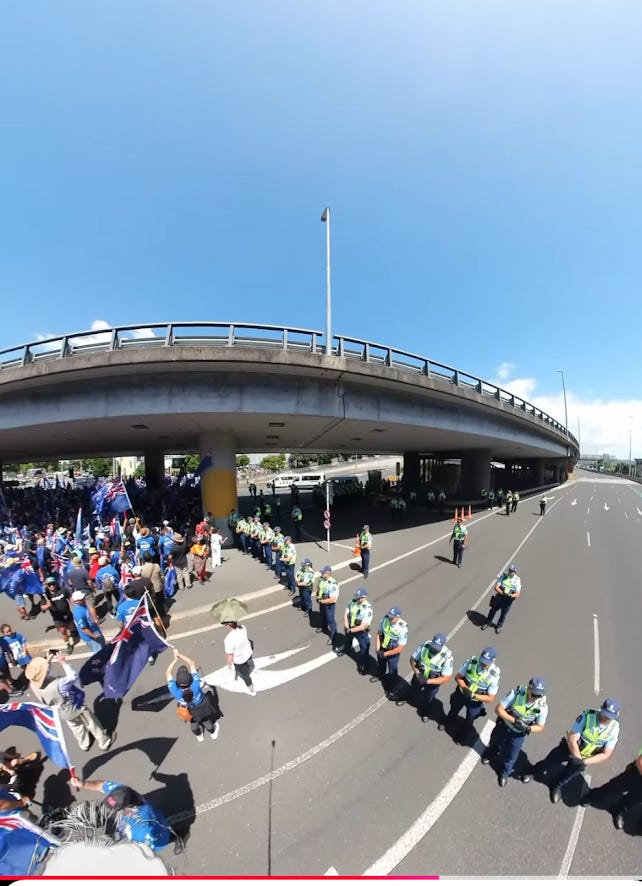
The woman was the Auckland superintendent Naila Hassan, who, the day before the march was to take place, announced a ban on the predominantly Māori Christian group crossing the Auckland Harbour Bridge on 31 January for a pro-New Zealand anti-immigration march. That is, despite the public knowing that not so long ago a Te Pāti Māori (TPM) sponsored hīkoi had crossed the bridge and that a pro-Palestine group had subsequently been given permission to cross. In the end, high winds scuppered the pro-Palestinian plans.
Hassan declared there was now “a blanket ban” on bridge marches. This decision was taken by the NZTA with the support of the police due to concerns about structural issues.
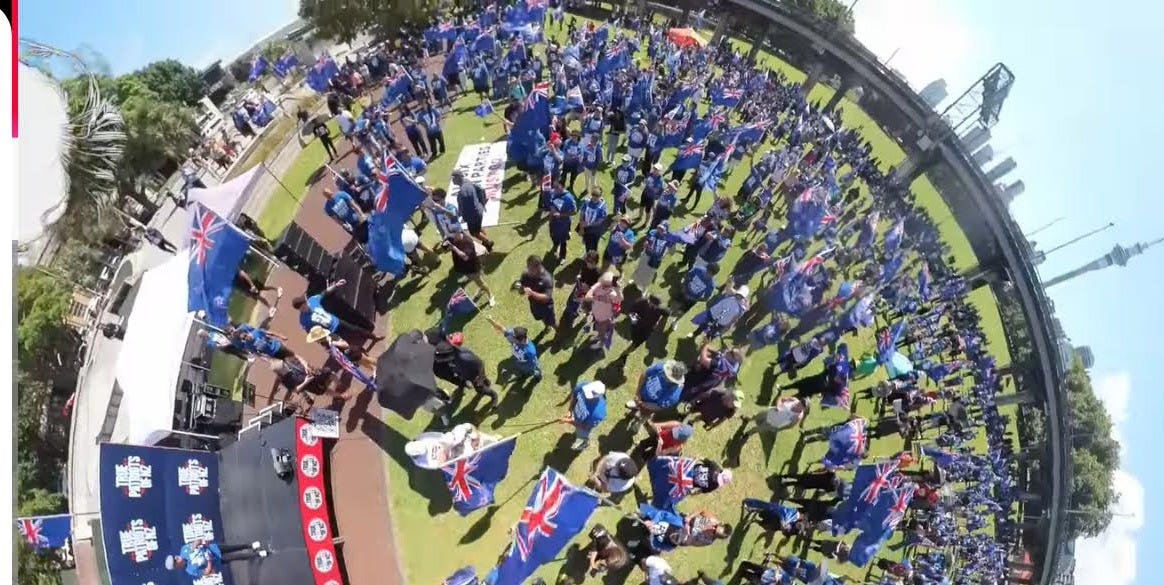
The organiser of the ‘Keep New Zealand, New Zealand’ march wasn’t having it. As far as he was concerned, her decision was emblematic of the problems facing the country. This wasn’t just police shutting his group down. This was Islam dictating to Christianity.
That organiser and spokesperson was Brian Tamaki, on behalf of the Freedom and Rights Coalition, an umbrella organisation created by Destiny Church. Destiny is a Christian church started in 1998 by the self-styled Bishop Tamaki. Membership stats are fuzzy but are likely between 2000 and 6000 people.
To say Tamaki is a polarising figure is an understatement. So many detest him – for a variety of reasons. Some condemn him for what looks like a flashy lifestyle which they suspect comes at the expense of his parishioners.
Others remember Tamaki’s anti-lockdown protests at Auckland Domain in 2021 and 2022 when he was charged with intentionally failing to comply with the Covid-19 Public Health Response Act 2020. He pleaded not guilty and was released on bail with conditions.
More protests followed. In 2022 Tamaki was arrested for allegedly breaching his bail conditions. This earned him 10 days in jail but he was eventually released with strict conditions, including a 24-hour curfew at his home. In 2024 all charges against him were dropped. Tamaki called it a vindication. Critics called it preferential treatment.
And more recently many people might even have been influenced by the two-part television investigation into the church by senior journalist John Campbell currently streaming on TVNZ+. Having watched bits of the second series until I could stand no more, I can report that Under His Command could double as a parody of John Campbell. The dramatic lighting, sonorous pontificating listing Tamaki’s sins and shadowy interviews with aggrieved former parishioners conjured up an ogre who could double as a mob boss.
None of this has silenced Tamaki. He has been a vocal critic of TPM and its president John Tamihere in recent years. His comments often frame them as corrupt, divisive, grievance-focused, and harmful to Māori and broader New Zealand society. He positions Destiny Church and his “True Patriots” movement as representing a “new breed” of healed, aspirational Māori in contrast to what he calls the “old breed” of anger and victimhood associated with TPM.
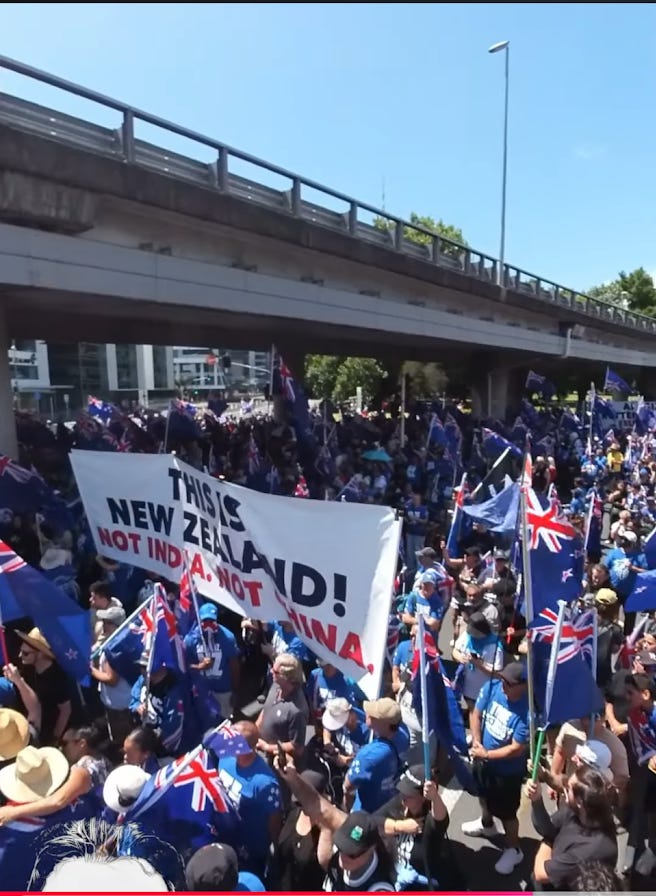
Tamaki is also openly and unfashionably against mass immigration, specifically Chinese and Indian migrants, since they constitute the bulk of the most recent tranche of new migrants. The fact is New Zealand has experienced staggering numbers in the last decade.
Ask Grok which country has the highest migration per capita in the last 10 years and it will tell you it is New Zealand.
“NZ ranks among the highest in the world for foreign-born share outside microstates or Gulf countries (where temporary workers dominate).”
Almost 30 per cent of the total population are migrants. This is more than Australia and Canada, though they are not far behind.
Tamaki is also the spokesperson for a group called True Patriots of NZ. Pamphlets given out on the rally outline the group’s aims. Below is a selection of their solutions:
Pause Mass Immigration NOW
No Assimilation. No Entry
One Flag, One Passport
Kiwis First Population Policy
Boost Kiwi Birthrates
End Multiculturalism
End Net Zero
Patriots Vote. Immigrants Don’t
Abolish the Māori Seats
Gut Bloated Bureaucracy
Some aspirations wouldn’t look out of place in an ACT manifesto, others are more NZ First. But Tamaki is opposed to all the major political parties, doubtless one reason why he has no support in government – or in any institutions that I can see. He really is Brian No Mates.
So in many respects it wasn’t surprising that it was his march that was canned, and not the hīkoi, nor the pro-Pal one. Both would have had backing from some quarters in parliament. Tamaki has none. It’s much easier to ban a group that you know has no vocal supporters the media are likely to amplify.
Hence the decision to allow the Auckland Marathon in November this year, which sees at least 17,000 runners and walkers cross the bridge, despite the “blanket ban”. That’s at least more than 12,000 people more than the Tamaki group. Which raises the obvious questions – do the structural issues raised by NZTA not apply to the Auckland Marathon? Was it really engineering woes or politics that prevented the Tamaki march from going ahead?
I decided to ask NZTA. Below is the reply.
Hi Yvonne,
The response below can be attributed to a NZTA spokesperson if required.
There is a very high threshold for acceptance of requests to access the bridge for special events. NZ Transport Agency (NZTA) declined The Freedom and Rights Coalition’s request for access because the information provided in the Coalition’s Traffic Management Plan did not meet NZTA’s strict criteria.
The Auckland Harbour Bridge is New Zealand’s most critical transport asset and is designed for a steady flow of vehicles. The bridge is not designed for use by pedestrians. Uncontrolled large groups of people walking across the Auckland Harbour Bridge generates swaying of the structure, which causes vibrations leading to large movement between the clip-ons and the central truss bridge lanes.
NZTA supports planned, structured events, such as the Auckland Marathon, on the Auckland Harbour Bridge, as runners move in a dispersed and dynamic pattern, which reduces the risk of the movement on the clip-on lanes. The event also has additional safety measures in place. Attendees are registered and controlled.
As well as the structural risks to the bridge itself, protest events pose additional risks due to the mass concentration of people and lack of attendance certainty.
There are several factors that could result in serious injury to a member of the community during a protest including:
- Unstable footing caused by increased bridge vibrations
- Increased movement between the clip-on structure and the bridge truss is a hazard, which may mean a protester could have their foot trapped and crushed.
I posted this on social media. The response was scathing.
“So. The Weasels are still great with weasel words. Noted.”
“What do you mean the Auckland Marathon can go ahead across the bridge? The top district cop said in media Friday that is it? Sorry this is double standards.”
“So why have other protest marches been allowed if this is fact based? Why did the treaty Hikoi get the all clear? “
“And why can’t Tamaki’s mob march in dispersed batches to negate the problem?”
All good questions I decided to ask NZTA.
Hi Yvonne,
Prior protests have also not met NZTA’s criteria for access and have not been granted permission. Protests such as the national Hīkoi mō te Tiriti which crossed the Bridge in November 2024, have seen NZ Police (as the lead agency overseeing response to such protests) working with NZTA to ensure the safety of protestors and officials, keep traffic and people separate, and minimise traffic disruption and damage to the bridge structure.
Observations of the bridge performance during the Hīkoi have provided more data regarding the impact pedestrians have on the bridge, which means NZTA has advised Police that it is not safe for uncontrolled crowds, such as protests to be facilitated to cross the bridge.
While planning efforts with NZ Police helps mitigate the risks, this application from the Freedom and Rights Coalition did not demonstrate sufficient crowd control to ensure individual safety, adherence to the planned route, and to prevent encroachment on lanes where attendees are exposed to live traffic.
In contrast to events such as the Auckland Marathon – where numbers can be effectively capped and movement is dispersed – uncontrolled groups such as protests typically gather in dense groups. This concentrated crowd presence significantly increases structural loading and stress on the bridge.
The same movement does not occur during the Auckland Marathon where crowd density is limited, and people run or walk at different footfall frequencies.
NZTA does not allow any unpermitted activity that does not meet NZTA’s strict criteria for access, including protest activity, across the Auckland Harbour Bridge.
Our response can be attributed to a NZTA spokesperson if required.
Mainstream media overlooked the significance of the ban for Tamaki while allowing the marathon to go ahead. But other new media groups noticed. I was interviewed on RCR about my previous Substack story, while on his podcast show Editor In Chief Duncan Garner railed against the different treatment of Tamaki as compared to other groups. He too noted the man’s unpopularity but also the hypocrisy of banning Tamaki and not previous groups that had crossed the bridge. Garner said the authorities had “walked into a boobie trap”.
To which Tamaki replied:
“Yep... I knew what I was doing all along to expose this rot.”
As I’ve already stated, Tamaki is almost universally reviled. But as Garner and others said on social media you don’t have to like him but he has a point. On X his actions were described as “a masterclass” by an observer.
In one weekend he was able to open the eyes of the public and the media to the hypocrisy – even his haters had to admit he’s right. I even saw multiple police officers nodding in agreement at the march during his speech.
Tamaki is unique in New Zealand. There’s no one like him here I can think of. But there is one person he resembles and it is a woman. Equally as reviled, equally as single-minded and equally as outspoken against immigration and multiculturalism. That woman is Pauline Hanson, leader of One Nation in Australia. She has been on the political fringes for decades, cast out from polite society as a bigot and a loony.
But the world has turned and many people are now saying perhaps she was right all along. It’s early days but Pauline Hanson and her party has experienced a dramatic surge in popularity in early 2026 Australian federal polling, following their performance at the May 2025 federal election. This places One Nation as the second-most popular party behind Labor. She’s even occasionally polled as a preferred PM option.
Brian Tamaki is not a politician but he is a public figure. Could the same happen to him? Is it possible that this is the year this hugely unpopular man might begin to be rehabilitated? Could 2026 be the inflection point for Brian Tamaki and immigration?
In his latest post on X he writes:
You are all starting to get it now…
Now my 2nd Masterclass is soon underway.
Can’t wait.
This article was originally published on the author’s Substack.