Table of Contents
Simon O’Connor
Husband, step-father, foster dad, and longtime student of philosophy and history. Also happen to be a former politician, including chairing New Zealand’s Foreign Affairs, Defense, and Trade Committee.
So the Broadcasting Standards Authority (BSA) has just granted itself more powers, notably to empower the complaining class an opportunity to harass those online sharing their views.
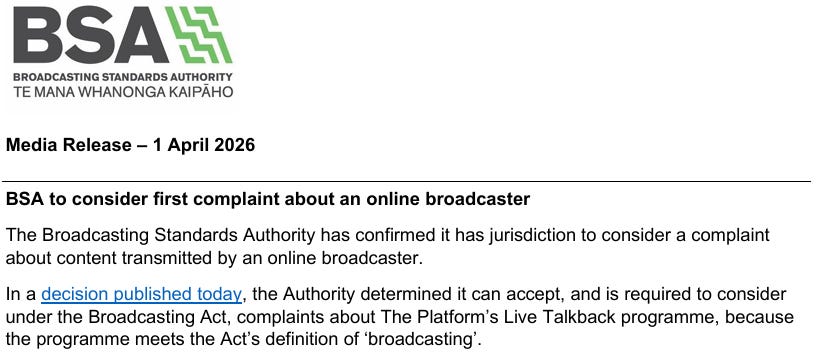
The decision is wrong on at least two counts. Firstly, this is for parliament to decide and not the BSA. I have previously argued that the BSA needed to wait for parliament and not, as it has done, acted on its own interpretation and consequently overstepped its boundary. Secondly, it appears censorious in its motivation. I’ve written before how progressives, cultural Marxists, social justice advocates (or whatever umbrella term you want to use) are desperate to control, curate, and censor what you see, hear, and ultimately think.
Control, curate, and censorSimon O’Connor 23 Feb
To be fair, the BSA’s decision is narrow at this stage. While it now claims jurisdiction over online broadcasters, it appears to only cover live content that occurs at set times. So, podcasts for example will not be captured. When I think of the media work I currently do with the likes of Family First or RCR, many of the interviews would not fall within the BSA’s newly discovered jurisdiction, but some of it will.
The fundamental problem however, is that the BSA has awarded itself these new powers to regulate online broadcasts. The funniest aspect was the BSA saying that because parliament hasn’t legislated for this situation and appears unable or unwilling, they need to step in themselves. Imagine if we all applied that reasoning to matters we feel the parliament is failing on!
I also expect to see mission creep. While the BSA has ruled out overseeing the content on the likes of Netflix, Disney+, and other overseas platforms – the reasoning that has driven them to their current decision will inevitably lead them to wanting to regulate more. Perhaps, too, local online broadcasters need to take a leaf out of Radio Hauraki’s book and broadcast from outside of the BSA’s jurisdiction.

Partly what drives my thinking and prediction is the nature of the complaint that has got us to this situation. The offence in question was the Platform’s Sean Plunket saying tikanga is “mumbo jumbo”. Whether you think tikanga is great or mumbo jumbo, no sensible person could say this is so grievous a view that a broadcasting regulator is required to arbitrate. What’s next? The BSA looking into a complaint from a voter who takes offence that an online commentator states that a policy of their preferred political party is daft?
That this nonsense was even entertained by the BSA can only be explained by ideology. That the flimsiest of reasons has been used, indicates an existing desire to find any excuse to target online media, initially the Platform. The issue itself (tikanga) also strongly hints at an entrenched view on that particular matter, otherwise it would not have been seen as the opportunity it was.
We should also appreciate that this decision does not sit in isolation. It sits within a wider ecosystem – both domestic and global – where progressive policy makers are desperate to confine speech to only their approved narratives. We should not forget the previous Labour government’s desperate, although ultimately failed, attempt to introduce hate speech laws.
In Australia, we have the likes of the eSafety Commissioner who sought to silence Chris Elston (‘Billboard Chris’) for his views on transgenderism and the World Health Organisation. Worryingly, a parliamentary committee in New Zealand has recommended New Zealand have some similar type of commissioner.
Australia is also deploying its anti-vilification laws to silence gender critical activists and medical professionals who are speaking out against sex-rejecting procedures.
In Canada, the Labour government is close to passing its own hate speech law – the Combatting Hate Act, also known as Bill C-09. As with all hate speech laws, it creates a hierarchy of citizen groups that are protected, and those who are not. This law also proposes to do away with the ‘good faith’ defence for those who hold views based from traditional and known belief systems. This could easily mean a priest or person who speaks from their religious perspective, but offends a protected group, could be criminally liable.
And as if to prove the threat is very real, Finland has just convicted Päivi Räsänen, a Finnish MP and former minister, for a pamphlet she wrote 20 years ago espousing the Christian view of marriage. The Supreme Court in Finland found her guilty under its ‘war crimes and crimes against humanity’ provisions. Not only has she been fined, but must locate all copies of this pamphlet and have them destroyed. The decision is a chilling undermining of freedom of expression, religion, and speech. The decision is also hypocritical as, in the three to two judgment, the justices say the pamphlet targets a particular group, yet in giving their ruling, they in turn are targeting Christians.
Returning to New Zealand, the government needs to step in reign the BSA back in, or better still, abolish it.
This article was originally published by On Point.