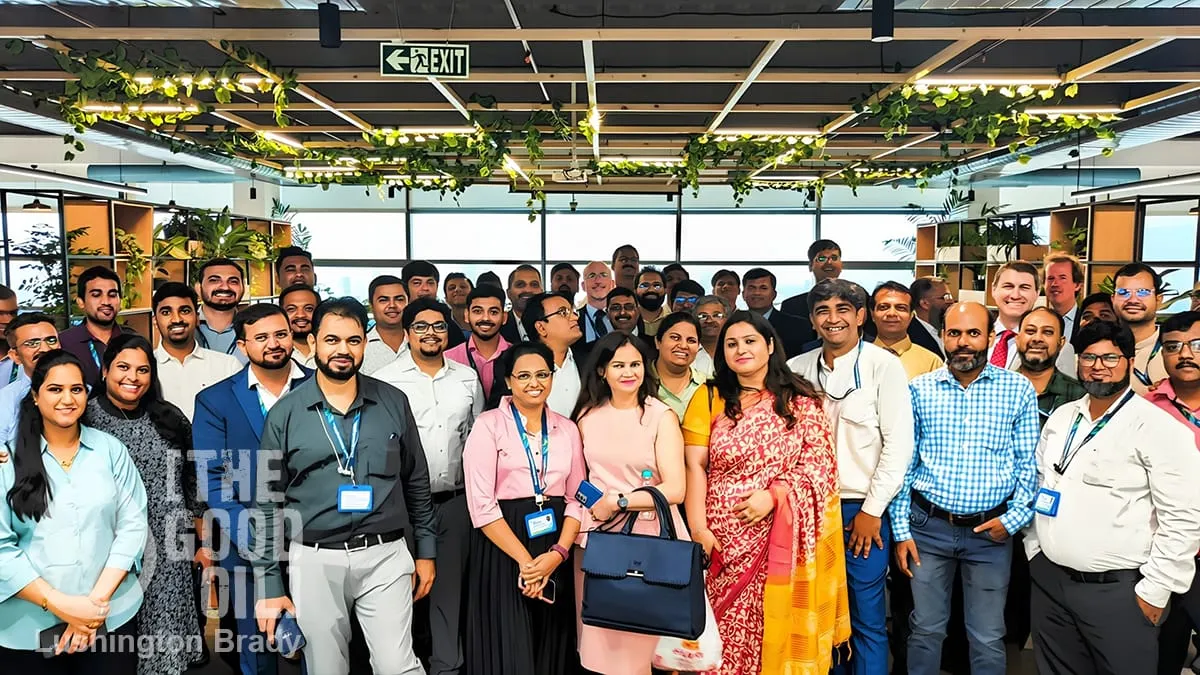
As I wrote recently, the future of the New Zealand job market is a closed ethnic shop. No, not wicked ‘white supremacists’, but the equally odious brown supremacists.
When Trade Depot advertised a warehouse job in Hamilton with “proficiency in Hindi or Punjabi” as an “essential requirement”, the reason was as obvious as it was forbidden to talk about: because all the co-workers are Indian. How did that happen? Just look at who’s in charge of hiring-and-firing: HR manager Adnan al-Khatib, business development manager Vikas Dahiya, finance officer Jignesh Patel, Operations Rushal Patel… and so it goes.
It certainly goes on in Australia. Anecdotally, supermarket workers complain that nearly all the new hires are Indian. More recently, an anonymous federal public servant blew the whistle on the butter-chicken tsunami swamping the national capital’s taxpayer-funded jobs market. In a Reddit post that was quickly deleted by mods (because of course it was) on r/AusPublicService, the Redditor complained that:
I really don’t want to sound racist but I’m currently working for a federal agency. Over the last year our team of analysts got broken into silo’s [sic] and every manager of those silos is now Indian. Since then, the only new hires have been Indian from every single silo. I really have nothing against people that are not of my ethnicity, but previously we had complete diversity in the new hires in our team, from all over the world. East Asian, European (as in someone born in Europe, not white Australian), central Asian and South American.
I know this sounds like crack pot one nation nonsense, and I’m a big believer in diversity but this really is not feeling very diverse.
Before the post was sent swiftly to the memory hole, plenty of other public servants chimed in with similar stories.
“I work in a federal government department and there is a team of seven Indian women, which is managed by an Indian woman. The odds of all these Indian women being the most suitable for the job over all other candidates is impossibly high, but nobody can say anything,” one comment read.
Another pointed out the same experience as the supermarket workers:
“I have spent many years in supermarkets and have experienced the same issue happening there. Once there is an Indian department manager they almost exclusively hire only other Indians,” said another.
“Having to do the mandatory learning every six months about how we should be inclusive to all cultures in the work force, and then you sit down to lunch with your colleagues and they all speak in Hindi so you can’t even participate in conversation is one memory from working in tech at a bank that I won’t forget,” another wrote.
Other commenters agreed on the preponderance of Indians swamping the new jobs, but denied it was because of Indian managers hiring only Indians. But is that true? If it is, why is the same pattern repeating in other Western countries?
In another Reddit post, another Redditor asserted that it very much did trace back to Indian middle-managers.
With all of the talk about DEI, I want to address the real elephant in the room. Indian managers who hire other Indians almost exclusively.
I can’t be the only one who has started to notice this trend. First generation Indian gets a management role, and they hire 30 of their kinsmen as fast as they can.
In fact, abuse of the H-1B program, almost exclusively by Indians, has prompted the US government to launch a major crackdown into immigration fraud.
The Trump administration is escalating its crackdown on immigration-related fraud, launching its first major investigation into alleged H-1B and PERM visa abuse, labor trafficking, and the displacement of American workers, Labor Department Inspector General Anthony D'Esposito told FOX Business on Wednesday.
In Canada, a woman was fired from an unnamed “multinational coffee chain” when, she says, she complained that “desi hiring managers often showed bias towards Indian immigrants”.
Also on Reddit, at r/recruitinghell, jobseekers complain about the futility of trying to get hired in the IT sector if you’re not Indian.
Everyone at the company is Indian. After the interview they choose another Indian to hire.
I recently went through a lengthy interview process and every person I talked to was Indian. They talked about a few coworkers who I didn’t meet, and they were all Indian, too. After eight interviews, then two weeks of messages that they were working on an offer, they dropped the non-surprising news that they chose to go with another Indian candidate.
As he pointed out, companies weren’t even being subtle about it, advertising openly that applicants: Should be expat & must have extensive experience in collaborating with Offshore teams during India hours.
Medical and technology sector analyst Brightwork Research argues that:
Indian discrimination against non-Indians and other out-group Indians is pervasive in the IT sector in locations where Indians have emigration.
Even other Indians see it. Indian journalist Ananya Bhattacharya reports on how heavily Indians dominate the US tech sector, under the H-1B program. Indians were the single-highest number of H1-B visa holders, capturing 72 per cent in 2015 alone. She pings the reason:
Nepotism also runs strong in India. Nearly 85 per cent of the country’s businesses are family-run, and Bollywood is dominated by just a few families. Even job-seekers with impressive resumes have to fall back on personal connections to find work.
These dynamics, she says, are playing out in the US in some of the biggest companies in the world, like Oracle. In 2022, the US Department of Labor (DOL) launched proceedings against Oracle, alleging “hiring discrimination against qualified white, Hispanic and African-American applicants in favor of Asian applicants, particularly Asian Indians”. The DOL further claimed that the company encouraged its heavily Asian workforce to recruit other Asians and its reputation for favoring Asians. The case is still making its way through the sclerotic US court system.
In 2013, Infosys paid $34 million to end an investigation into its hiring practices under the H1-B program. Of Infosys’s workforce, fully two-thirds were Indians hired on H1-B visas.
With Luxon’s trade deal inked, New Zealanders better get used to it.