Table of Contents
Ani O’Brien
Like good faith disagreements and principled people. Dislike disingenuousness and Foucault. Care especially about women’s rights, justice, and democracy.
I watched Inside the Manosphere expecting the usual Louis Theroux formula of awkward pauses, slightly ridiculous subjects exposing themselves under gentle questioning, and his usual kind of anthropological curiosity about fringe subcultures. And I got it. I knew it was going to be an uncomfortable watch, but was not shocked or surprised by what I saw. I am pretty well-versed in the horrors of the internet. The two female friends I watched it with, however, were stunned. They found it hard to grapple with the overt hatred of women these men expressed and then justified, sanitised, and excused. My partner left the room after 10 minutes to watch something more pleasant… like true crime.
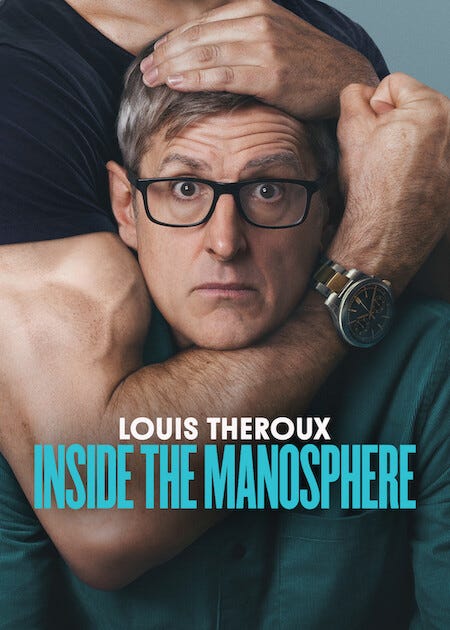
What made all of us feel most ill was the recognition that what was being presented in the documentary is not actually very fringe at all, but a growing norm in certain corners of the internet that is preying on young men via algorithms and targeting very real struggles and vulnerabilities.
I approached watching the programme with some scepticism having previously found the much-acclaimed TV series Adolescence to be (while an excellent piece of art) a misplaced and overstated narrative that was treated like a documentary by some, including the prime minister of the UK. Likewise I find the demonisation of masculinity as “toxic” to be massively problematic. Society has created a monster by denouncing relatively normal masculine traits and behaviour as just as awful as the violent excesses of masculinity. The mass feminising of boys has been a terrible self-inflicted wound.
So, when I say there are moments in the Theroux documentary that genuinely sickened me, I am not talking about men calling women “bitches” or indulging in harmless bro/lad culture. The misogyny Theroux sits back and allows his subjects to display is not coded or subtle at all. They speak about women as commodities, problems to be dealt with, and variables to be managed in a system of male optimisation. They make sport out of humiliating the young women they bring onto their podcasts and gratuitously wound them with comments about their appearance. These men make sure relationships are stripped of any emotional or moral dimension and reduce them entirely to transactions. They flatten human life into a 2D display of status, sex, and money that feels quite sociopathic.
The manosphere presents women as having intrinsic “value” while men have to build their “value”. But don’t for a moment think that is a positive thing for women. No. This value is built in to women because we are born with, in their crass terms, “tits, ass, and pussy”. In reality, that so-called intrinsic value is not actually universal to all women at all. It is only the most attractive, slim women who hold any value in the eyes of these men. Ugly, fat, or older women do not get valued at all. They are either completely disregarded or treated with derision. Men, on the other hand, they say, have to work for their value by building physical strength, and accumulating assets and material worth.
The matter of “body count” is highly prevalent in the manosphere discourse. This refers to how many people one has had sex with. Women should, they say, have a very low body count. Some advocate that men should only marry virgins. Men on the other hand are admired for having a high body count. In one extraordinary scene in which Theroux cannot help but express his incredulity, influencer Myron Gaines shows his podcast panel a clip of a guy explaining in faux-scientific terms how the DNA of past sexual partners remains in a woman and can then contribute to the DNA of a child she makes with another man later on in life. It is plainly bullshit, but there was no telling Gaines and his acolytes that.

With the exception of that last bit of bizarreness, the ideology is mostly based in a crude and simplified bastardisation of well-established anthropological knowledge of human sexual dimorphism and sexuality. Evolution has meant that women have learnt to attract males who will provide resources and protect them from external threats. And men have sought to mate with women with good genes who they can be sure will produce their offspring rather than some other fella’s. But, we are no longer mere apes. We evolved. We developed language and built societies. While some aspects of these dynamics remain, we also have come to experience relationships in far more complex ways than just the exchange of sex and resources.
In saying that, rejecting the roots of our base instincts is also foolish. In my view, human beings flourish when they have the freedom to choose how much they live according to stereotypes, but they exist for a reason. They are statistically significant behavioural presentations. Sneering at this fact has in part led us to the place where men promoting the most grotesque interpretations of masculinity can appeal to young men who are deprived of any acceptable displays of masculinity at all.
For a significant portion of the population, traditional ideas of masculinity and femininity are not oppressive relics. They are meaningful, grounding, and often deeply tied to how people understand themselves and their relationships. The problem is not that these identities exist. The problem is that the cultural space around them has been hollowed out.
On one side, you have a progressive discourse that often treats traditional roles with suspicion or disdain. On the other, you have extremist spaces that twist those roles distorting them into something rigid, hierarchical, and often hostile. What is missing is the middle spaces where people can inhabit traditional identities without being mocked or radicalised.
Very few places exist where a young man can learn what it means to be strong without being told he must dominate, how to be responsible without exerting control, or where he can aspire to leadership without subjugating. Very few places exist where a young woman can choose motherhood and “homebuilding” without being told she is either regressive or submissive.
A recent piece of research in the US showed that more Gen Z young women want to be “trad wives” than “girl bosses”. This is highly unsurprising to me on several levels. First of all, a segment of the female population will always be more inclined towards wanting to be mothers. We are not supposed to acknowledge this, but it is the truth. Secondly, the “girl boss dream” women were sold turned out to be a lemon. In fact, although the so-called trad wife versus girl boss divide is often presented as a cultural clash, in reality it is better understood as a reaction to the same underlying fatigue. The girl boss era promised women independence, success, and liberation through work, but it also normalised burnout, constant self-optimisation, and the expectation that women should excel professionally while still carrying the weight of everything else. It was empowerment to the point of on exhaustion. What we are now seeing is not a wholesale rejection of ambition but a recalibration of what a good life looks like and nearly half of Gen Z women say they would choose a more stable, traditional lifestyle over the pursuit of status and wealth.
It would be a massive mistake to allow the ambition of the manosophere to restrict women’s choices and freedoms to be conflated with recalibrations women are making about redefining power not as the ability to hustle endlessly, but as the ability to choose not to as well.
The men Theroux speaks to for his documentary speak of having different roles from their partners, but having roles in a relationship and a family is not the problem. The problem is that they ruthlessly promote a structure where the roles do not come together in an equally beneficial way. The roles they assign women restrict and control them to the benefit of the men themselves. The almost laughable “one-sided monogamy”, that the women in the doco clearly hate, is an example of this.
The idea is presented with a shrug as if it is pragmatic that men, particularly “high-status men”, are entitled to sexual variety, while women are expected to remain loyal, sexually exclusive, and compliant. It is framed not as hypocrisy but as “nature”, in a feat of selective application of evolutionary psychology. But stripped of the jargon, what is being described is, of course, an asymmetric arrangement that requires women to accept constraints that men explicitly reject for themselves.
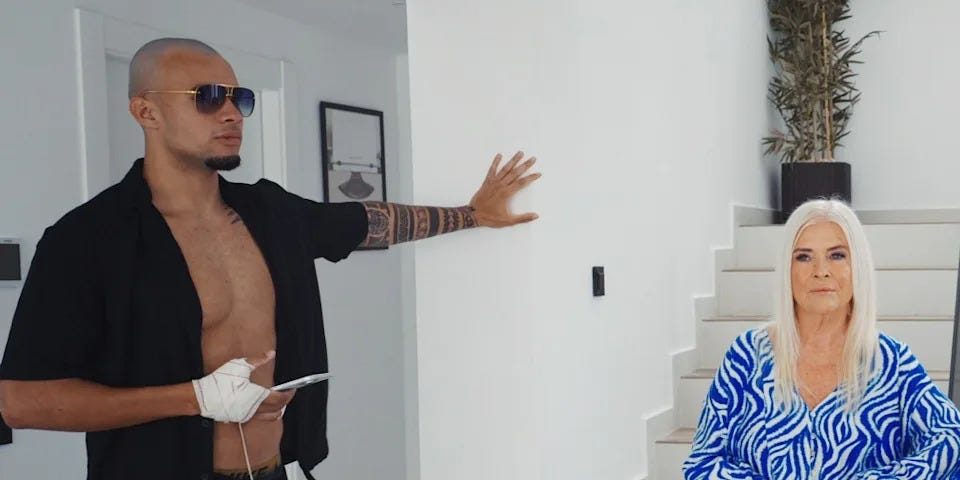
The funny part is how confidently and commercially it is packaged, sold to young men as both empowerment and realism, but when Theroux asks their girlfriend or wife about it things suddenly take a very awkward turn. Justin Waller boasts about his sexual prowess and one-sided monogamy arrangement and his wife appears to force herself to partially agree this is their arrangement for the cameras. However, after some uncomfortable needling from Theroux, it emerges that they have more of a “don’t ask, don’t tell” situation.
This kind of attitude takes the understandable desire for stability, intimacy, and commitment, and reshapes it into something transactional and hierarchical, where fidelity becomes a one-way obligation rather than a shared commitment. And in doing so, it reveals that this isn’t just about sex or relationships, but about control, entitlement, and a reassertion of power.

Perhaps the desire to control is at the heart of all this.
If we ask the question “What is actually driving this?”, we inevitably find that the manosphere did not spring out of thin air. It is not a self-sustaining phenomenon. It is a reaction, a terrible reaction, to socioeconomic-environmental conditions we all find ourselves in.
Spend any time listening, and I mean actually listening, and a truly sad pattern emerges. Many of the young men drawn into these spaces are profoundly disconnected. They are not forming relationships, building stable identities, or finding a place for themselves in the world that feels meaningful or respected. They are united less by a coherent ideology than they are by chronic loneliness, confusion, and status anxiety. That is why, I think, that alongside asking “what is wrong with these men?” we should also be asking “what is happening to them?”
Across much of the Western world, young men are struggling in ways that we rarely talk about directly. Educational outcomes are diverging along sexed lines with boys underperforming in school, less likely to pursue higher education, and more likely to disengage altogether. Economic pathways that once offered stability and identity have eroded. And, most crucially, the cultural scripts that once told men what it meant to grow up, contribute, to matter in this world, have been dismantled.
Masculinity is, as they say, “toxic”, and so without any positive masculine expression, into that vacuum steps the manosphere with confidence, defiance, certainty, a self-professed recipe for self-respect. It tells young men (rightly or wrongly) exactly what they are, exactly what has gone wrong, and exactly how to fix it.
Be strong. Be dominant. Get money. Control your environment. Control women.
It is crude, and deployed destructively, but it is a script. And for someone who feels invisible, a bad script can be more appealing than no script at all.
These disaffected young men are being sold a product to solve their inner anguish. The manosphere is not, in this sense, simply a loose collection of ideas. It is an industry that takes genuine grievances and feeds them through a narrative that is designed to produce anger and dependence. It tells them that their struggles are not complex or structural: they are the result of betrayal. The world has turned on men. Women have changed. Society has changed. You, young man, have been lied to.
Again, what makes this so effective is that it is not entirely fabricated. It is based in some truth. Dating has changed and dynamics between the sexes have shifted. I would argue it has been pretty bad for men and women. Economic insecurity is also real. But these fragments of truth are weaponised into a worldview that is totalising and adversarial. Complex realities that intertwine personal responsibility with the cruel hand of fate are collapsed into much simpler conspiracies with convenient lightning rods for blame. Ambiguity, nuance, and the messiness of human social interaction are cast aside and replaced with bad faith interpretations. The result is a feedback loop that keeps men enraged and engaged which, not coincidentally, is very good for the manosphere business.
Running alongside the rampant misogyny and chauvinism, and often intertwined with it, is a conspiratorial worldview that slides rapidly into antisemitism. The language of shadowy elites, “the matrix”, and unseen forces controlling outcomes is the kind of paranoid ridiculousness that “alpha” males of previous generations would have scoffed at. The conspiracies are rooted in the same old narratives that generations of men had to fight wars against, just dressed up in new branding. The same resentments and scapegoats, delivered with a ring light and destructively efficient algorithms.
One of the more uncomfortable developments that some of the most vocal anti-manosphere commentators determinedly avoid is the growing overlap between parts of the manosphere and Islam. There is a noticeable trend of manosphere figures converting to Islam or expressing admiration for it. Sneako, who is featured in Theroux’s documentary, has converted. As has Andrew Tate who, although not featured in the doco, kind of hovered over and around it like a bad smell.

This romancing of Islam is unlikely to be primarily theological. Rather, Islam offers these men a clear, hierarchical framework in which sex roles are defined, authority is established, and ambiguity is minimised. The parallel “Muslim manosphere” repackages familiar red-pill ideas in religious language and targets young men who are already navigating identity, marginalisation, and economic insecurity. These spaces often present themselves as promoting discipline, family values, and self-improvement, but in practice they recycle the same grievances and scapegoats found elsewhere in the manosphere. It is an established narrative and social system that promotes male supremacy. The doctrine has already been written and there are already adherents willing to die to for it.
Whether these high profile neo-Muslim influencers actually believe their own proselytising or not is up for debate. Sneako has been accused of only pretending to have relinquished his vices after converting, for example.
A convergence is taking place here where Western manosphere figures borrow the language of tradition, order, and authority of Islam, while some online Islamic influencers adopt the stylistic rhetoric that drives engagement in these spaces. What unites them is not the religious doctrine so much as a shared opposition to liberal modernity, particularly its approach to sex and sexuality. It is, in effect, a meeting point between two forms of intense dissatisfaction with the same cultural convergence. This bleak analysis highlights how these men are actually not just looking for power or status. They are looking for structure, certainty, and for a framework that tells them who they are and what is expected of them. The problem is, right now, the loudest voices offering that are megalomaniacs and advocates of stone-age religious misogyny.
As terrifying as the toxicity exposed in Inside the Manosphere is, it is only one half of what is looking more and more like an existential equation. While young men are being radicalised to devalue and subjugate women, so too young women are taught to devalue and hate men on another side of the internet. We need to grapple with how to deal with the reality that the machines are teaching young people to loathe and distrust each other.
Issac Newton’s third law of motion states that for every action, there is an equal and opposite reaction and it seems that while society is full of rational concern about the radicalisation of young men, there has been little concern about the much more substantial radicalisation of women.
The internet is not radicalising only men. It is radicalising everyone, just in different directions. Women are being drawn into their own online ecosystems that frame men as inherently dangerous, relationships as inescapably exploitative, and total alienated independence as the only rational response. The tone and vibe are different, as is the language, but the underlying dynamic is strikingly similar. Grievance is amplified and complexity is flattened. The opposite sex is othered and reviled.
While the manosphere illuminates the extreme fringe, the bulk of men have not been radicalised politically to any meaningful degree. Gallup reports that men’s political identity’s have not shifted much at all except that:
Liberal identity has increased modestly among two age groups of men.
There has been a five-point increase since 1999 in the percentage of men aged 30 to 49 identifying as liberal, from 17 per cent to 22 per cent, and a six-point increase, from 12 per cent to 18 per cent, among men aged 65 and older. At the same time, there has been essentially no long-term change among men aged 18 to 29 (up one point since 1999) or 50 to 64 (up two points).
On the other hand, there has been a clear and measurable ideological shift among young women. The intensity of the shift, and the ecosystem reinforcing it, should be subject to much more interest, but there is a strange lack of curiosity around this phenomena. Polling shows that Gen Z women are not just slightly more liberal, but the most liberal demographic cohort in the United States, with positions on issues like abortion and gender identity sitting well to the left of both men their age and the national average. This is a widening political divergence that has been accelerating for over a decade, with young women becoming steadily more left-leaning while young men remain relatively unchanged. And this divergence is increasingly being shaped through online environments where identity, morality, and politics collapse into one another.
Social media plays a decisive role in how worldviews are formed and intensified. Research shows that algorithmic systems do not simply reflect user preferences, they actively escalate them, pushing users toward more extreme content over time. A 2024 “Safer Scrolling” study conducted by University College London and the University of Kent, analysed TikTok’s recommendation algorithm and found a rapid escalation toward more extreme content within days.
For young men, this means content reinforcing their feelings of grievance and anger, demonstrating the worst examples of their scapegoats (women and Jews, for example), and encouraging defiant rejection of it all. For young women, who tend to score higher on traits like empathy, moral concern, and sensitivity to perceived injustice, this creates a different, but also potent feedback loop. Political identity becomes rooted not just in beliefs, but in emotional performance of outrage, grief, and moral signalling which is then rewarded socially and algorithmically.
The algorithm, therefore, can be seen as weaponising male desire for self-respect/respect and female desire for belonging. Both are about social status.
Within this environment, a distinct female archetype has emerged of the hyper-online activist whose politics are grounded not in coherent analysis, but in a moralised narrative of oppression and resistance. Causes are bundled together into a single ideological package of anti-Western sentiment, rejection of traditional family structures, and alignment with global “struggle” movements, regardless of their (significant) internal contradictions. What begins as sympathy for humanitarian issues can, in some cases, slide into uncritical support for regimes or movements that are themselves deeply illiberal, simply because they are positioned as opposing Western power.
American writer and political commentator Rob Henderson notes that women have long played a central role in enforcing social norms through moral judgement and social pressure, but in digital spaces, those norms are now set by highly visible activist voices, often detached from everyday constraints like family formation, long-term partnership, or economic responsibility. The result is a narrowing of acceptable identity, for example, traditional aspirations such as marriage or motherhood are reframed as backward or complicit, while political activism, particularly of a highly visible, performative kind, becomes the marker of virtue.
This is a reciprocal dynamic. As I say, a textbook case of Newton’s third law. As young women are pulled into increasingly moralised, emotionally driven forms of online activism shaped by algorithms that reward outrage, vulnerability, and absolutism, young men are being pushed in the opposite direction, into their own parallel ecosystems that prize detachment, cynicism, and resistance to those same narratives.
Men and women are no longer simply disagreeing: they are being socialised into entirely different interpretive frameworks before they even encounter each other. Each side arrives pre-loaded with assumptions about the other. Women as hysterical, performative activists and men as reactionary, disengaged or hostile. Then those assumptions are constantly reinforced by the content they consume. The same algorithmic systems that escalate emotional and ideological intensity ensure that the most extreme examples of each worldview are the most visible, creating a distorted perception of what the “other side” actually believes.
This kind of thing often gets lumped in as part of the so-called “culture wars”. I reject the dismissive framing of culture as some kind of side show we shouldn’t bother with anyway, but in this case surely it is obvious that we are headed to disaster if we don’t address this issue. This is far more than just a clash of ideas, in fact, it is more accurately described as a mutual rendering of ideas unintelligible. A scrambling of intent and meaning. The structure of online life with its algorithmic amplification, peer reinforcement, and identity-based signalling, does not produce moderation. It produces divergence and conflict.
Watching the cringeworthy house of horrors that is Inside the Manosphere revolted me at times, but it also kind of just reinforced the despair I have about the state of relations between the sexes. How have things got so bad so fast? How irreversibly have we ruined the ability of men and women to relate to each other? Young people are having far less sex than previous generations as they spend more time online growing more suspicious and hostile toward each other. The internet is to blame in large part for that. And so are we who let this happen.
Theroux’s documentary is a pretty light touch. It shows the gore, but does not get into much diagnosis nor solutions. What is needed is a reckoning around how the use of the internet and so-called social media is wrecking havoc on us all. Yes, HSTikkyTokky’s misogyny is vile and Sneako is a vile anti-semite, but their ability to infect potentially millions of young men with the lie that women and Jews are to blame for their unhappiness is enabled by the destructive algorithms and perverse incentives.
We need to be able to say, clearly and without eye-rolls, that a significant number of young men are not doing well. Their loneliness is not just an individual failure, but a social one. And we cannot expect healthy identity to be built purely on negation (what men should not be) without offering something positive in its place. We can do this while also being equally clear that misogyny, antisemitism, and the dehumanisation of others are not acceptable responses to that reality.
Likewise, we need to be able to say that a significant number of young women are not doing well. They are miserable, emotionally manipulated, and searching for meaning. We cannot stand by while positive traits like empathy are weaponised to turn young women into activists for causes that clash with their own interests. It should go without saying that the future of our entire human race rests on women being happy and healthy and free to make positive choices about their lives.
More than anything, we need to rebuild the conditions under which men and women can actually relate to each other as people rather than as adversaries. That means creating spaces, cultural, social, and physical, where relationships are not mediated entirely through performance and ideology. It means offering models of masculinity and femininity that are neither oppressive nor empty. And it means articulating, in human terms, what a good life can look like. It isn’t about liberal or conservative, left or right, it is about the fact that we cannot actually exist without each other. If we don’t reclaim the terms of engagement, others will. And as Inside the Manosphere makes clear, they won’t play fair.
This article was originally published by Thought Crimes.