Table of Contents
Yvonne van Dongen
Veteran NZ journo incredulous gender ideology escaped the lab. Won’t rest until reality makes a comeback.
Before I start this story I want to get something out of the way. It’s important that you know you can call me names such as transphobe, Islamophobe, bigot, far right, racist – anything you like really. Knock yourself out. Call me whatever you fancy – except woke. That would hurt.
But for the rest, I don’t care. Because I think it’s important that we get over this name-calling, reputational hurdle that prevents people from airing their actual opinions, so we can all have half a chance at speaking frankly and describing reality as best we see it. Also because by the time you finish this story, some of you may be cancelling your subscriptions and a few might think ‘well thank goodness’ and yet others might think ‘I always thought that about her but no one is perfect.’
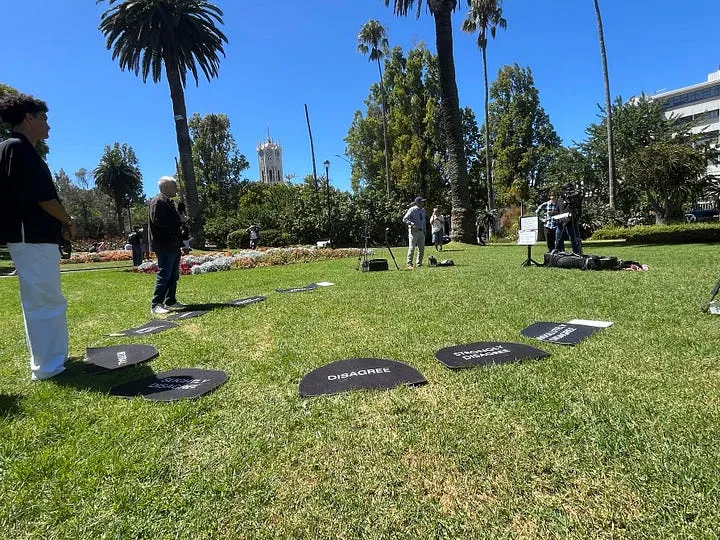
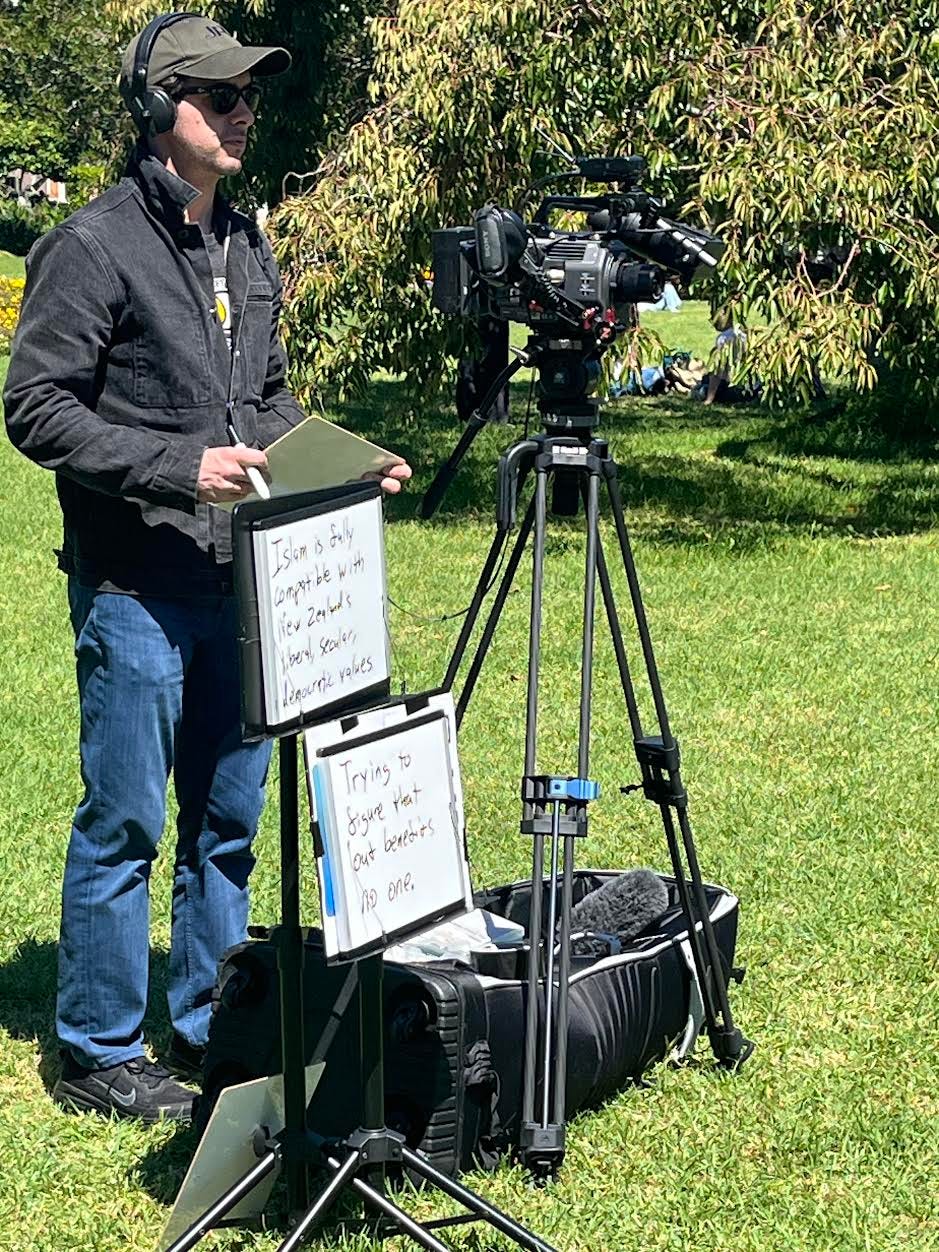
You see, last week I took part in Peter Boghossian’s Street Epistemology event in Albert Park in Auckland and I answered sensitive questions honestly. My father always said you could take me anywhere twice – once to apologise.
Boghossian is the former Portland State University professor of philosophy who is famous for taking part in the grievance studies affair in 2017 and 2018 with two other collaborators. The trio submitted bogus papers to academic journals related to gender studies and other fields in order to test peer-reviews. This prompted a reaction from his employer which resulted in him leaving the university, citing harassment and a lack of intellectual freedom.
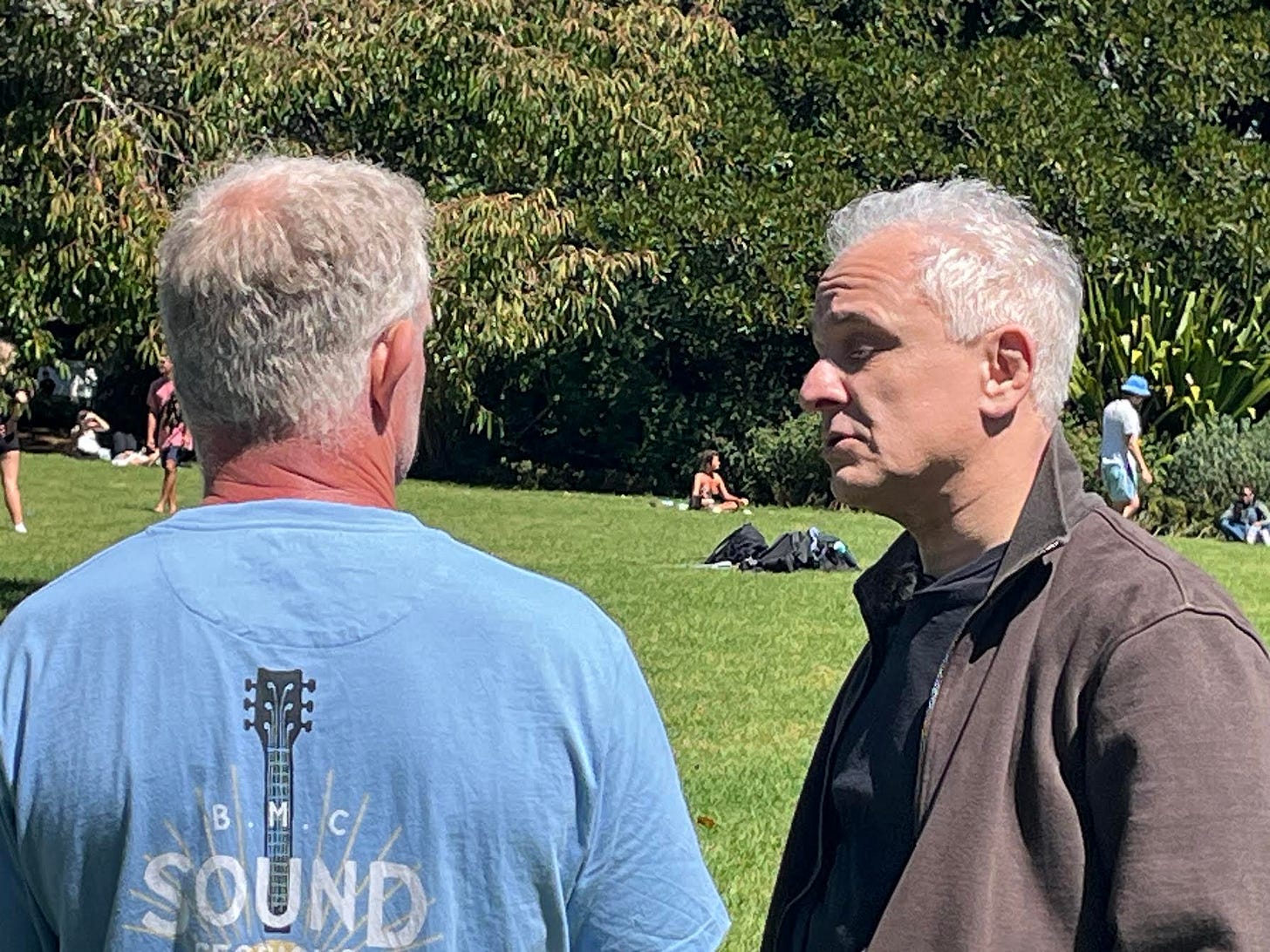
So he’s an iconoclast, to put it mildly. Since then Boghossian has devised a game that consists of asking hot-button questions of strangers, asking them to explain their responses to other strangers in the game and asking them to guess what the other person said and why. He calls it Street Epistemology and it’s taken him and his team all around the world.
Street Epistemology is a wonderful device aimed at getting people to have difficult conversations which is, in fact, the title of Boghossian’s last book – How to Have Impossible Conversations: A Very Practical Guide.
He films the conversations and people can watch themselves online at a later date. Which is why I have to out myself as an appalling person now, at least to those with particular sensibilities, because you’ll soon be able to see for yourself what a horror I am.
Boghossian was brought to New Zealand by the Free Speech Union (FSU). His work is part of their new youth initiative called Speakeasy, aimed at creating an environment conducive to free speech. In the next three months Boghossian will travel around the country, with his street epistemology kit and audio visual mates, so look out for him on this website and join in. Or run a mile. Up to you. I thought it was fun.
His first outing in Auckland was launched at the beginning of the university year and located across the road from Auckland University. This is significant since in recent years university students all over the Western world have confessed they often feel they can’t share their real opinions for fear of public censure by other students or even a downgrading of marks by lecturers. Universities everywhere have tilted enormously to the left so any expressing any dissenting views can be risky.
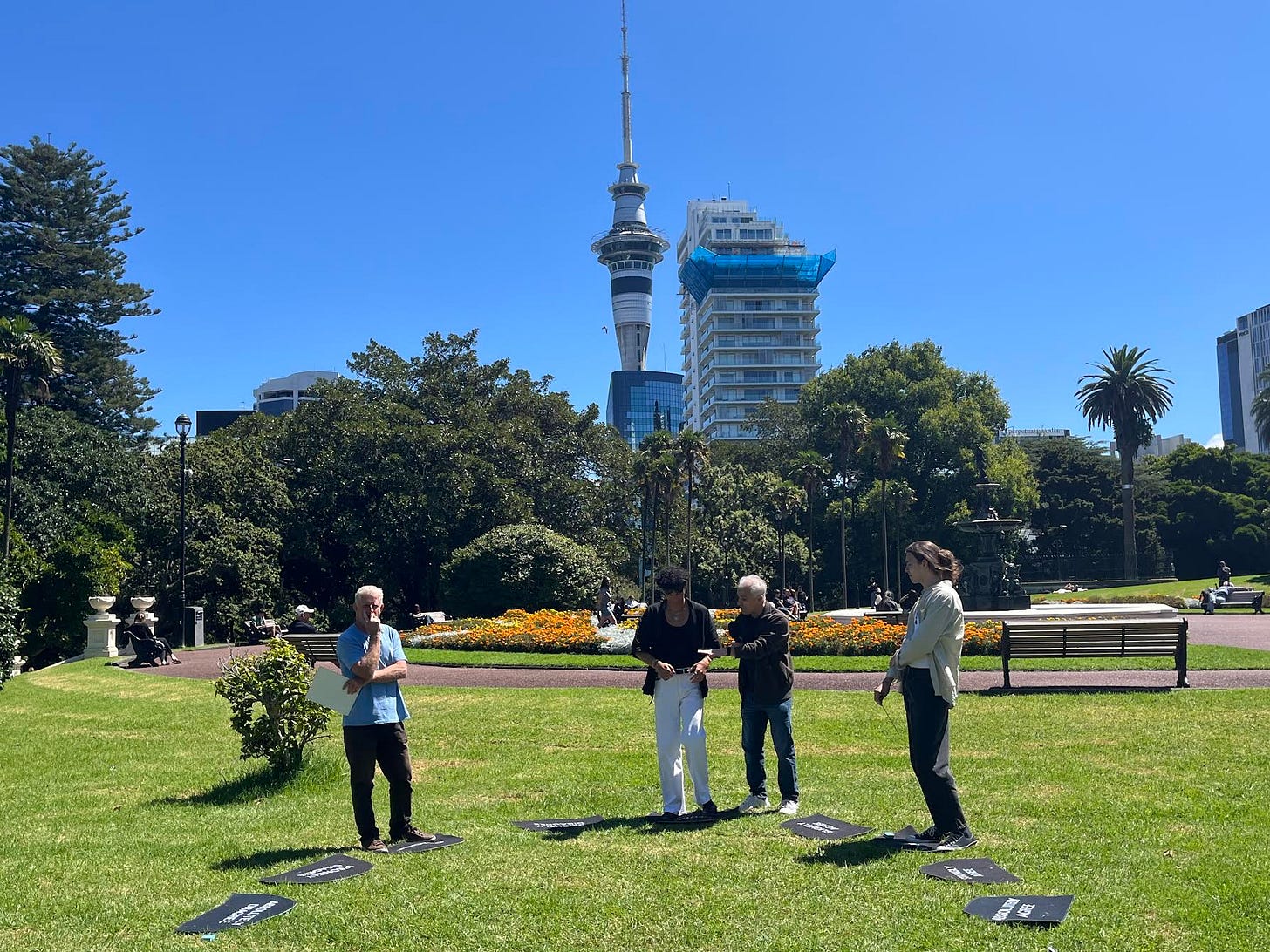
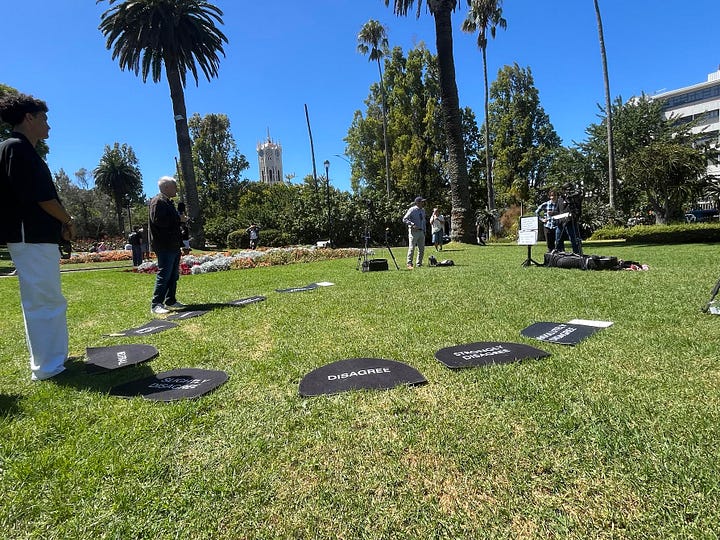
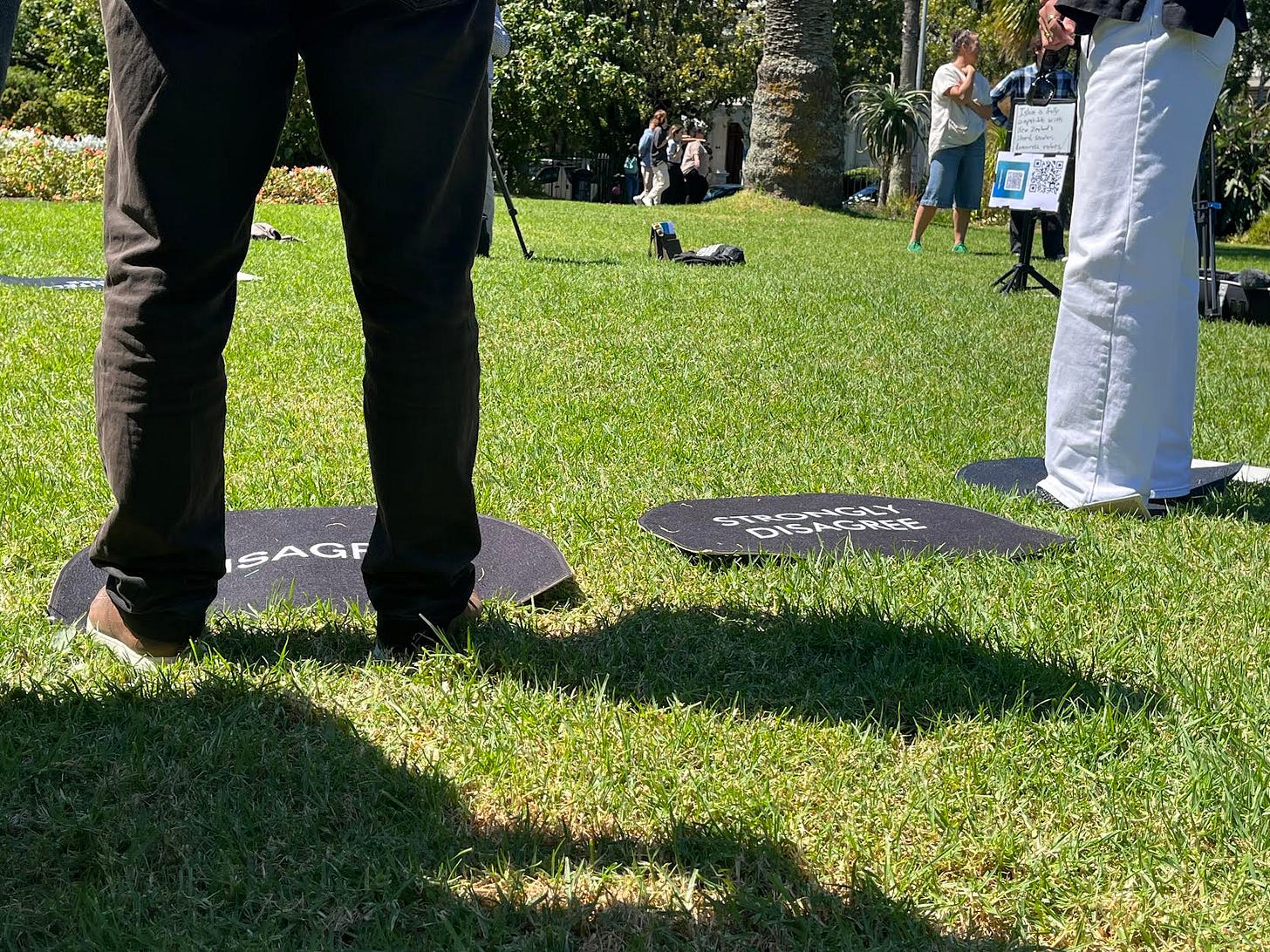
The first day I just watched as two shy young male students and an older man gave their views on questions like Islam is fully compatible with New Zealand’s liberal, secular, democratic values and Mainstream Christianity does not value gay marriage. I couldn’t hear their responses but given that they stepped mostly on the slightly agree or disagree mats, they seemed quite timorous to me.
As I watched them, I was joined by two other young men, second-year students, who turned out to have much more robust views. They talked to me about the challenges of being a straight white male. For instance, they had a mate who wanted to get into drama school at Victoria University but was told there was only one place for a straight white male. All the other places went to different demographics or identities.
Their distinctly non-woke views struck me as unusual until I asked where they had gone to school. One had attended a Christian school outside Auckland and the other had been largely home-schooled, also outside Auckland. Perhaps I’m being unfair but I couldn’t help thinking they might have had more conventional woke opinions had they attended a co-ed state school, simply because that is the water most of the fish swim in. It’s hard to step outside your friendship group, especially during your teen years. Hell, it’s hard at any age.
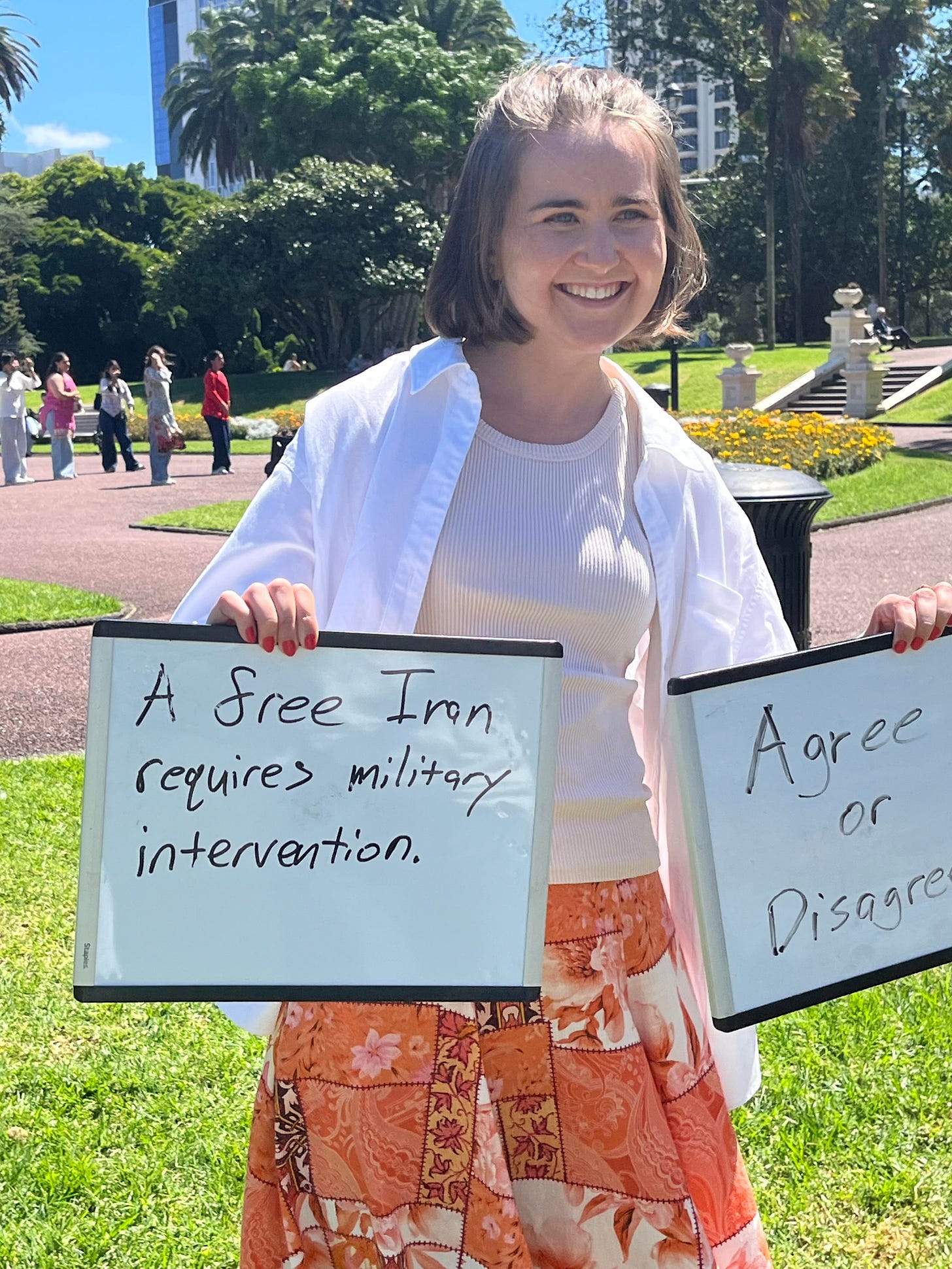
Then I met FSU worker, Lucy Cammock-Elliott, (above) who had been wandering around the campus, also trying to spark conversations. She noticed that the girls often giggled and then eye-flicked their mates to see their reaction before speaking. But she’d had some success and was feeling optimistic about the exercise.
Watching Boghossian try to extract opinions from his sensitive but charming young participants made me want to have a go myself so I turned up the next time he was in the same location.
Before he started, I grabbed him for a sound bite.
“How are you finding the New Zealand participants? Are they more opinionated or more circumspect than other people you’ve done this with?”
Boghossian hesitated momentarily and then replied that it was a hard question that required a long answer. His answer, when it came, wasn’t actually long but it was slow and deliberate as if each word arrived with its own full stop. This is what he said:
“They’re good, decent people who are utterly oblivious to what’s coming.”
“Crikey. So what is coming?” I asked
“Don’t you know?” he shot back immediately. “If you don’t know then you’re part of the problem.”
Then he wandered off to set up something with his team. He returned a minute later.
“Don’t you really know what’s coming?”
I said the only thing I could say after far too much time trawling the net and listening to podcasts and checking data. I said:
“I’m really worried about the rise of Islam around the world. Woke is nothing compared to Islam. Islam is so much stronger than any other ideology.”
Boghossian nodded. Yes exactly. He thought so too. But he’d come to the conclusion that Islam was coming no matter what we did. All we could do was submit to the inevitable and perhaps try and extract the most reasonable jizya (Islamic tax on non-Muslim subjects) that we could.
Naturally I found this enormously depressing which may have unlocked my secret thought box when I played the game with two lovely English tourists. They chose the colonisation question. Was colonisation beneficial for New Zealand?
I’ll leave you to imagine what I said and also what the lovely woman who had been a teacher but was now an ordained minister and her very sweet husband said. At any rate, we had a great chat afterwards, which is the point of the game I guess.
Try it.
Now you can call me names.
This article was originally published on the author’s Substack.


![[The Good Oil] Stuff Up of the Day](/content/images/size/w1304/format/webp/2024/09/Stuff-up-image-1.webp)