John McLean
Citizen typist patriot
On 2 June 2026, changes relating to Diversity, Equity & Inclusion (DEI) were made to New Zealand’s Public Service Act 2020.
The changes, initiated by the New Zealand First political party:
- removed mandatory requirements for public service chief executives to:
- “be guided by the principle that the group comprising all public service employees should reflect the makeup of society”
- “in employment policies and practices, foster a workplace that is inclusive of all groups”
- removed a mandatory requirement that panels appointing chief executives “must undertake those functions having regard to the requirements…relating to diversity and inclusiveness”
The amended Public Service Act retains:
- an express principle, in order for the public service to achieve its purpose, “to make merit-based appointments (unless an exception applies)”
- a requirement for chief executives and boards, when making appointments, to “give preference to the person who is best suited to the position”

DEI is the flawed and failed neo-Marxist philosophy aimed at forcing equal outcomes (not opportunities) on a society’s citizens, regardless of ability and merit. The DEI social engineering experiment hasn’t worked, promotes performative virtue signaling, discriminates against non-preferred categories of people, demeans preferred categories, polarizes and divides societies, harms economic growth and prosperity, and encourages ideological conformity and self-censorship.
At first glance, the changes to the Public Service Act restore merit as the driving criterion for public service appointments. And indisputably, merit and DEI are, and always have been, mutually incompatible and exclusive. An individual is either the best suited for a particular position, based on the position’s objective requirements, or they’re not.

Moreover, the Woke public service has ceased, in the last couple of decades, to even pretended to try to (in the former words of the statute) “reflect the makeup of society”. It has stacked its DEI die-hard managerial ranks with disproportionate numbers of women and gay, gender dysphoric and brown-skinned people, in preference over people who would represent the real composition of New Zealand’s population.

When the de-DEI changes were first proposed, Deputy Prime Minister Winston Peters rightly labelled public service DEIfication as “Woke” and heralded putting “an end to the Woke left-wing social engineering and diversity targets in the public sector”.
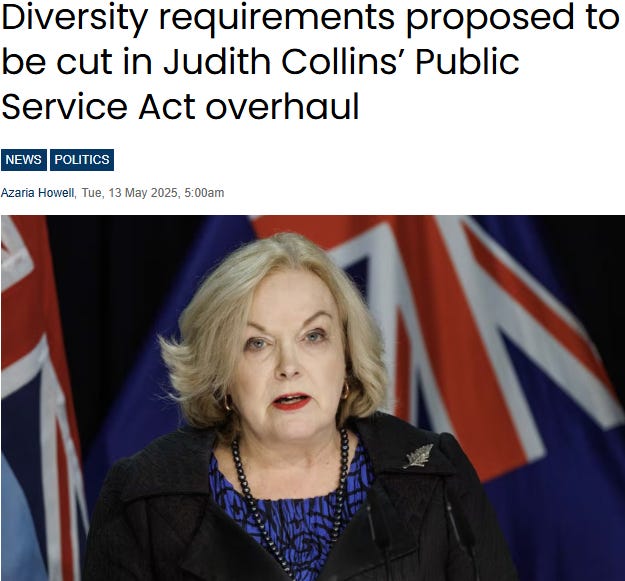
Judith Collins announced, “We’re strengthening the act to make sure that the best person for the job is the one who gets it…the person with the right skills and experience to deliver”. Even Prime Minister Christopher Luxon, himself woefully Woke, conceded that the public service is “pretty Woke”.
The changes were trumpeted on the political right as removing DEI from New Zealand’s public service.
And as predictably as night follows day, the changes have been lambasted by the left as surrendering the public service to neo-Nazis. Labour’s Camilla Belich (who chaired the select committee that considered the Bill) tried to gaslight parliament and the New Zealand public in general that, “Those two things [DEI and merit] can be true alongside each other”.

Labour MP Ayesha “Vaper” Verrall, high as always on her own self-importance, fumed, “I could not think of a more limited, small-minded, managerial, hopeless vision of our democracy than this bill.”
But unfortunately, those who think the changes removed scope for DEI in the public service need to think again. Because the changes did no such thing. They simply removed DEI compulsion, leaving public service leaders free to continue with DEI if they wish (which they all do). It appears that, in the legislative process, NZ First’s bold ambition to remove DEI was watered down.
The contrast with how the current Trump administration dealt to DEI in the United States public service, and in US society in general, is stark.

By presidential executive orders, Mr Trump terminated, dismantled, and prohibited DEI programs, mandates, and offices across the US federal public service, closed DEI offices and roles (e.g., chief diversity officers), criminalized taking DEI factors into account in hiring, promotion and performance reviews, and banned federal contractors from having affirmative‑action programmes.
In addition to leaving it open for government departments and agencies to continue on their merry DEI ways, the Public Service Act still contains active DEI encouragements and permissions, not least for individuals with Māori ancestry or who self-identify as Māori.
The act continues to contain the following:
The role of the public service includes supporting the Crown in its relationships with Māori under the Treaty of Waitangi (te Tiriti o Waitangi).
The public service does so by the commissioner, public service chief executives, interdepartmental executive boards, and boards of interdepartmental ventures having responsibility for–
developing and maintaining the capability of the public service to engage with Māori and to understand Māori perspectives
in the employment area,–
in the case of the commissioner, recognising the aims and aspirations, employment aspirations, and need for greater involvement in the public service [of Māori] in the development and implementation of the Public Service Commissioner’s leadership strategy
in the cases of chief executives and boards, operating an employment policy that meets the requirements of the above Māori considerations
Pollyannas who still have faith in New Zealand’s failed human rights regime and commission may seek comfort that, while the Public Service Act still allows and encourages DEI, discrimination based on race or other privileged DEI characteristics must necessarily breach New Zealand’s Human Rights Act 1993.
But unfortunately, the current government has left an express exception for positive discrimination (“affirmative action”/DEI) in our human rights legislation. Section 73 of the Human Rights Act provides:
Anything done or omitted which would otherwise constitute a breach of any of the [unlawful discrimination provisions of the act] shall not constitute such a breach if–
it is done or omitted in good faith for the purpose of assisting or advancing persons or groups of persons, being in each case persons against whom discrimination is unlawful by virtue of [those provisions]; and
those persons or groups need or may reasonably be supposed to need assistance or advancement in order to achieve an equal place with other members of the community.
The effect of section 73 is to provide carte blanche, across-the-board permission for Wokesters to continue with DEI discrimination, in the public service and throughout New Zealand society.
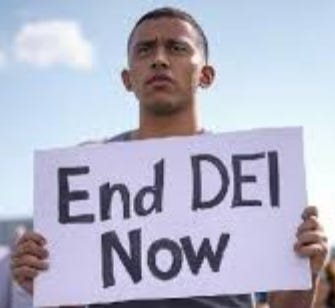
Any government genuinely committed to ending DIE and restoring meritocracy to New Zealand must positively prohibit DEI and repeal section 73 of the Human Rights Act.
This article was originally published on the author’s Substack.