Table of Contents
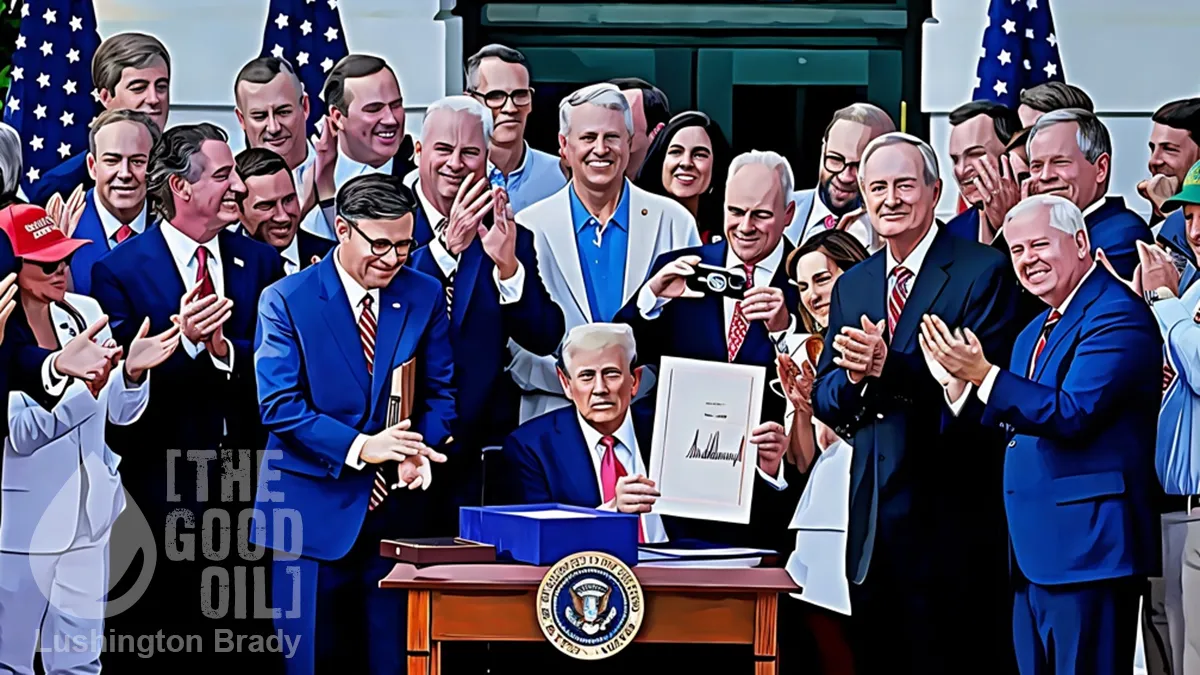
Depending on who you believe, President Donald Trump’s One Big Beautiful Bill Act is either a ‘sweeping legislative triumph’ (the White House, unsurprisingly), ‘awful’ (the Democrats, also unsurprisingly) or a ‘disgusting abomination’ (Elon Musk, make of it what you will).
So, which is it? Don’t ask me – dammit, Jim, I’m a writer not an economist! I also have an instinctive wariness of omnibus bills: too often, they’re an excuse to sneak in stuff that would never pass muster otherwise, or a transparent effort to wedge opponents. For instance, any time you see a claim that, say, ‘Republicans refused to pass a bill doing X Good Thing’, it’s almost certainly because X Good Thing was tacked onto an omnibus bill packed with A-W Very Bad Things.
According to economist Stephen Moore, a senior fellow at the Heritage Foundation, a conservative/libertarian Washington thinktank, the White House is in fact bang on the money. Both literally and metaphorically. Moore argues that the Big Beautiful Bill is not just an economic liberation document for Middle America, but ‘the biggest conservative victory in modern times’.
Everyone knows that the “big, beautiful” tax bill signed into law on the Fourth of July lowers tax burdens for families and businesses. It also averts a $4 trillion tax increase starting next year. That’s enough reason to heartily celebrate.
But, won’t cutting taxes raise the national debt? This is the core of Musk’s objections. Democrats, on the other hand, claim that its slashing of many government programmes is a recipe for disaster. Moore, on the other hand, seems sure that, like Javier Milei in Argentina, Trump’s economic liberation will ultimately unleash a new wave of prosperity.
Expect the economy to grow at over three per cent in the years ahead, which will bend down the burden of our national debt.
But that’s just the start, Moore says.
But what isn’t well known is that this new law doesn’t just change tax policy. It includes dozens of other long-sought policy goals – what I call “hidden gems.” Here is a list of some of the major policy victories:
The law is the most aggressive federal advancement of school choice by allowing low-income parents to direct education dollars to private, charter or Catholic schools that are better for their kids.
Also on the education front, the bill aims to rigorously reform the bloated and unhinged higher education sector.
The law formally ends the absurd Biden student loan forgiveness program, which forced taxpayers to swallow the costs of unpaid college loans […]
The law increases the tax to eight per cent on the near-trillion dollars of bloated university endowments – money that was never taxed. Is there a better way to tax the privileged rich?
The bill also aims to repeat one of the singular achievements of Trump’s first term: unleashing America’s energy resources and breaking away from the globalist wealth-redistribution agenda, laughably dubbed ‘climate action’.
The law increases mining and drilling on federal lands to increase access to America’s natural resource supplies to end our dependence on the Middle East or China or Russia […]
The law ends the electric vehicle mandate and phases out the Green New Deal, thus allowing Americans to buy whatever car they want.
Maybe that’s what’s really got Elon’s knickers in such a twist. Because, otherwise, there’s the sort of techy stuff that ought to make him happy.
The new law authorizes the sale of expanded spectrum to strengthen rural broadband, secure America’s technological dominance and reduce the national debt by nearly $100 billion.
And all that ‘social justice’ stuff the Democrats are screeching about?
The law also expands eligibility for personalized medical savings accounts instead of conventional insurance. This allows workers to control their health care dollars [….]
The law strengthens work requirements for Medicaid and food stamp recipients. History shows that work requirements end welfare dependency […]
The law expands opportunity zones and extends tax benefits for investing in inner cities and economically depressed rural areas. (I thought Democrats cared about poor communities!)
According to Moore, that’s just the start. “There’s much more to shout about, but these are some of the greatest hits” in a “big and beautiful bill that advances America’s freedom and prosperity”.
Is he right? Well, let’s hope so. A prosperous, free America is just the tonic the West needs against an increasingly aggressive China, just for a start.