Table of Contents
The Cargo Cults sprang up across the Pacific in the wake of WWII, where islanders became convinced that the ‘ancestors’ would send ships loaded with Western goods (‘magic cargo’). Consequently, they gave up working for themselves and sat around, waiting to be showered with ‘cargo’.
In many ways, the mentality persists, especially among the political elite. As we’re seeing with the spread of Chinese influence in the Pacific, whoever promises the most cargo gets the loudest song and dance.
Papua New Guinea Prime Minister James Marape will give China a high-level opportunity to scuttle PNG’s stalled “mutual defence” treaty with Australia, dispatching his Defence Minister to Beijing to explain the deal after he and Anthony Albanese failed to sign it on Wednesday as planned.
China is waving billions at PNG via its debt-diplomacy gambit, the ‘Belt and Road Initiative’. As it has with many tinpot kleptocracies across the Third World, the flash of cash is working a treat.
Mr Marape urged “respect” for China’s role as one of PNG’s key partners, and said he was upfront with Beijing that his country’s key security relationship was with Australia.
“In no way, shape or form (did the) Chinese have any hand in saying ‘don’t do this’,” he said.
Is that so?
Responding to the events in Port Moresby, Chinese foreign ministry spokesman Lin Jian declared Canberra’s relationships with Pacific Island states should not “target third countries”.
The rebuke followed a warning in the state-run China Daily that Australia’s “two-faced policy towards China” was unsustainable, amid growing frustration in Beijing at the Albanese government’s moves to court closer Chinese ties while deepening security ties with the US and other partners […]
Paul Barker, executive director of PNG’s Institute of National Affairs, said China exercised “very extensive” influence within PNG, where its firms dominated the construction sector and financed major infrastructure across the country.
It’s yet another foreign policy embarrassment and shocking failure of diplomacy by the Albanese government. For all Labor’s bragging about its diplomatic acumen, all they’ve managed to achieve to date is to alienate our biggest allies and toady to our worst enemies. Albanese has scurried to bend the knee to the communist dictator in Beijing four times, but has yet to even talk to the president of the world’s most powerful democracy even once.
And while he and his foreign minister have prattled obsessively like student politicians about ‘Palestine’, China has spread its tentacles across the Pacific.
If the Albanese government would spend less time on Palestine and more time on the Pacific, it might avoid serial humiliations like its failure to land long-announced security agreements first with Vanuatu, and now, much more seriously, with Papua New Guinea.
The refusal of the PNG cabinet to endorse the military alliance treaty Canberra had negotiated with Port Moresby is another Albanese government failure in the Pacific, a serious setback for Australia and a big win for Beijing.
Albanese says the treaty will be signed within a couple of weeks. Well, who knows? His government’s Pacific policy resembles its defence policy – lots of self-congratulatory announcements of things that don’t end up happening.
The failure in Port Moresby is an indictment of Australia’s poor practice and poor policy in the Pacific […]
In the next week or two Albanese will make high-blown speeches about Palestine and climate change. The difference between Palestine and climate change on one hand and PNG on the other is that nothing of consequence will be affected by whatever silly attitudes Australia takes on the former, but our policy on PNG matters like hell.
And Albanese and Penny Wong have been missing in action all the way. While the ‘gibsmedat’ grasping of Pacific leaders is one thing, Albanese’s high-handed attitude to the Pacific is even worse.
Labor is leaving itself open to being “surprised” by China’s growing influence in Solomon Islands by declining to meet with its former premier, Daniel Suidani, an anti-Beijing politician wishing to warn the Australian government over China’s grip on the region.
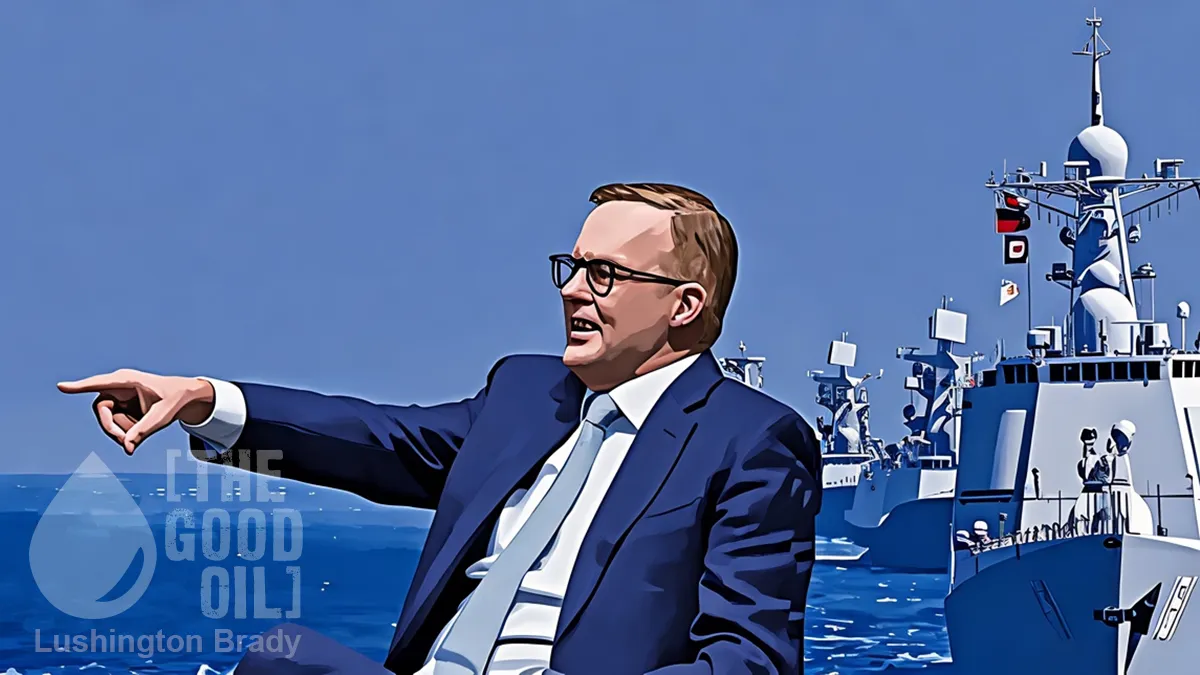
What does he expect? Labor was surprised even when China sailed a fleet right outside our front door. Neither the PM nor the defence department had the foggiest clue the Chinese navy was firing missiles and torpedoes in the Tasman Sea until a commercial airline pilot happened to notice.
Despite efforts by Mr Suidani to meet with Australia’s high commissioner in Honiara in recent weeks, the former premier revealed in the Australian that his appointments with officials have been cancelled and never rescheduled. Foreign Affairs Minister Penny Wong has declined to comment on the matter.
That’s because they’ve been too busy fawning over the anti-Semitic troglodytes of the ‘pro-Palestine’ mob.
When even Kevin Rudd is calling out your dangerous cluelessness, you know you’ve screwed up.
Kevin Rudd has accused China of being the principal architect of disruption across the Indo-Pacific, using much tougher language than the prime minister has used recently in calling out Beijing’s regional ambitions.
In a hawkish statement ahead of an expected meeting between Anthony Albanese and Donald Trump in New York this month, in which China will be a key focus, Mr Rudd said he believed that Australia and the US, working together as close allies, could combat China’s disruptive behaviour.
“On the nature of the disruption we’re facing in the Indo-Pacific, let’s be very clear that in the Indo-Pacific, a principal driving factor in the pan-regional disruption that we are facing is the rise and rise of China, strategically, militarily and economically,” Mr Rudd told a United States Studies Centre conference in Sydney via video from Washington.
Don’t waste your breath trying to tell Albanese that. He’s got his tongue too firmly wedged between Xi’s cheeks to even respond.