Table of Contents
Is Labor pollster Kos Samaras a liar, a fool or just a braggart whose mouth ran away from him?
It was Samaras, after all, who boasted that 85 per cent of diaspora Indians in Australia voted for Labor. But when coalition MP Jacinta Nampijinpa Price repeated Samaras’ boast in an ABC interview, political hell broke loose – and suddenly, Samaras is hurriedly backtracking.
Senior Liberal Alex Hawke has privately urged the coalition’s shadow cabinet to challenge the polling Senator Jacinta Nampijinpa Price used to claim that Indian Australians overwhelmingly favoured Labor and warned about the “ongoing public demonisation” of the community.
What “demonisation”? Price didn’t say anything derogatory about the Indian community. All she did was state what Labor’s own strategist had stated as fact.
“A recent Redbridge poll told us that 85 per cent of those who have Indian ancestry… 85 per cent voted for Labor,” Price said last Thursday, as she clarified her earlier suggestion that Labor was bringing in Indian migrants to win votes. “So, these were the facts that I was pointing out.”
What, exactly, did Price say wrong? All she did was take Samaras at his word, which is enough to send everyone scrambling for cover.
Samaras has been forced to clarify those figures. He told this masthead a more appropriate characterisation of the Indian diaspora’s vote for Labor across Australia in the May election was in the “mid-60s” on a two-party preferred basis, according to his research.
That’s not what he was saying a few days ago.
“Eighty-five per cent of the Indian diaspora voted for the Labor Party at the last election, or thereabouts. It varies across the country,” Samaras said. “In our polling, whenever we poll them, they’re about that, two-party preferred.” [Emphasis added]
So, Samaras unequivocally stated that the two-party preferred vote was 85 per cent. Now, he says it’s in the “mid-60s”.
Which is it? Was he bullshitting then, or is he bullshitting now?
He did not give specific examples, but said that RedBridge would publish a report on its election findings soon. Samaras said the data was based on interviewing people from a range of communities, tracking them over a period of time, and combining the information with polling booth results.
Samaras said the more accurate reading of his findings from the most recent election was an Indian diaspora vote for Labor in the mid-60s, on a two-party-preferred basis. That refers to which major party receives a vote after preferences are distributed. The national two-party-preferred vote at the May election was 55 per cent to Labor.
What kind of pollster gives such wildly disparate figures that vary by as much as 25 per cent?
Veteran polling analyst Peter Brent on X described Samaras’ initial claim as “preposterous” and “bullshit”. He cited data from former YouGov pollster Shaun Ratcliff, who collaborates with Samaras, showing about 45 per cent of Australians with South Asian heritage gave their first preference vote to Labor at the last election, and 34 per cent to the Coalition.
Another data set from the Australian Election Study shows that, between 1987 and 2022, 45.7 per cent of the Indian diaspora voted Liberal and 42.4 per cent voted Labor.
In the meantime, it’s hard to see that Price did anything more wrong than take Samaras at his word.
Even that, though, is apparently too much for the Liberal party ‘Wets’. Weak, woke, lettuce-leaves like Alex Hawke (whose last significant contribution to the immigration debate was bragging that the Morrison government had still imported 100,000 foreigners even in the midst of Covid lockdowns).
Hawke may well have an agenda of his own.
About 10 per cent of voters in Hawke’s north-west Sydney electorate of Mitchell have an Indian background. The Liberal MP suffered a 6.7 per cent swing at the May election, making his seat marginal. Hawke’s office declined to comment.
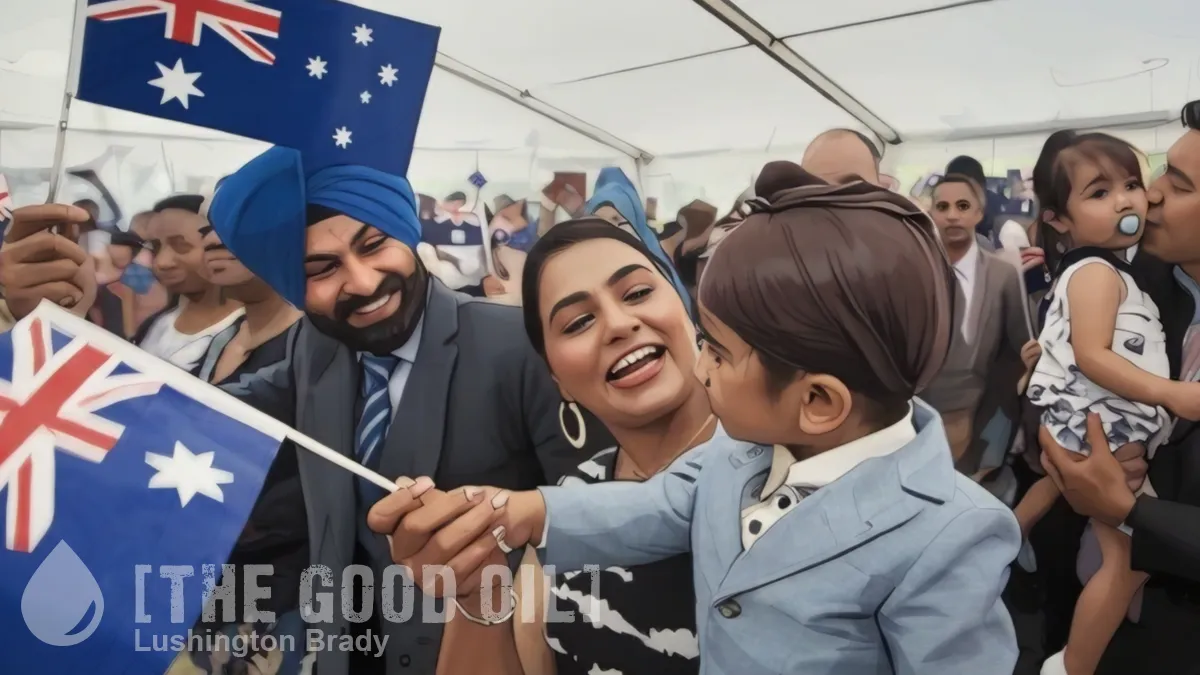
This, along with Labor’s two years of desperately pandering to Muslim anti-Semitism, highlights the real problem with this scandal, which is that our democracy is becoming increasingly tribalised along racial lines, with immigrant voting blocs wielding disparate influence focused more on identity politics than the national interest.
Pollsters, politicians and media regularly single out this or that voting bloc for commentary – over-60s, under-30s, white-collar, blue-collar, wealthy, poor, Muslims – and no one bats an eye. During the Voice referendum campaign, the media and the left continually cited supposed poll numbers among Aboriginal Australians.
What makes Indian-Australians so different?