

Penny Marie
I am a New Zealand-based independent journalist and podcaster.
This week, on People in Politics, I sat down with Maurice Williamson: National MP for 30 years from 1987, holder of 18 ministerial portfolios, front-bench cabinet minister, and later New Zealand’s Consul General in the United States. In his own words, he is still “at heart a right-wing free market Tory”, and he is “frightened as hell” about what happens if the other side forms the next government.
That is why he is urging National supporters to think hard about their party vote on 7 November. He is not telling you to abandon National. He wants you to use both your votes so they actually do something.
This has never happened before
The central point of our chat is simple. Under MMP, the 2026 election puts National voters in a position no one has been in before.
“There has never been an MMP election before where any of the major parties’ number of electorates they’re going to win is higher than what their party vote entitles them to.”
The sign in MMP is minus
Most voters assume MMP works like this: you win your electorates, then list seats are added on top. Maurice says – like it or not, that’s not how it works.
Your party vote sets the total number of seats a party gets. Every electorate the party wins is then subtracted from that total, and whatever is left comes from the list. If two parties each earn 30 seats on the party vote, and one of them also wins 20 electorates, that party doesn’t end up with 50. It still has 30: the 20 electorate MPs plus 10 from the list.
Why a National party vote may be wasted this time
The numbers tell the story. National is polling about 28–30 per cent. Thirty per cent of 120 seats is 36. National currently holds 44 electorates* (43 won at the 2023 general election, plus Port Waikato at the by-election a few weeks later). Maurice expects it to win at least 38 electorates this time, “possibly 40 and on a good day maybe more”.
In MMP terms, National is ‘underwater’. It is likely to win more electorates than its party vote entitles it to. Those extra electorate seats become overhang seats. National keeps them whatever happens, so extra party votes for National don’t add any seats.
“Your party vote for the National Party doesn’t add to anything.”
He compares it to National’s worst-ever result in 2002, when it polled just 20.9 per cent. Even then, its party vote still brought six list MPs into parliament, including Don Brash and Katherine Rich. Every party vote counted that year, as it has at every MMP election so far – 2026 is the first exception.
To change that, Maurice says National would either have to lift its party vote by 20–25 per cent from where it sits now, or give up about 12 electorates. He doesn’t expect either. The budget and the pre-election fiscal update (PREFU) were both meant to give National a bump in the polls, and neither did.
Same voters, different government
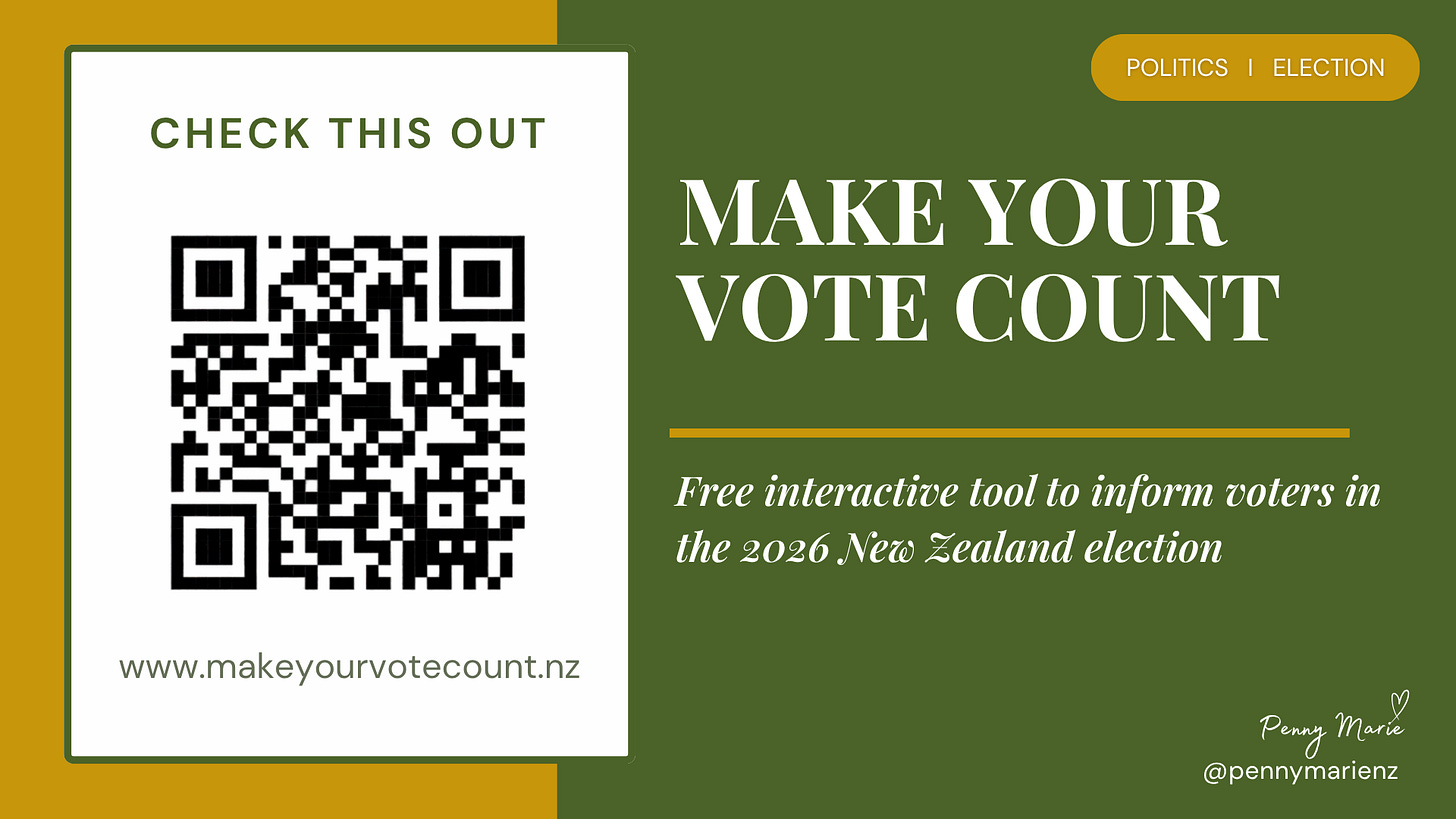
During the episode we tested this on makeyourvotecount.nz, the free MMP simulator we built from the NZ Herald poll of polls. When you drag the slider, the votes National gives up are split evenly between ACT and NZ First, so the centre-right’s total share stays the same in every scenario.
The results surprised even us:
- National at 30.2% – a centre-left government.
- National at 28.2% – a hung Parliament.
- National at 26.2% – a centre-right government with a four-seat majority, and 128 MPs in the House.
The same voters on the same side produce a different government. As Maurice puts it, a higher National party vote “is not adding anything, but it’s subtracting from the other two.”
The rugby analogy
Maurice’s favourite way to explain it:
“If you were watching the All Blacks playing South Africa, you don’t care if the props in the front row of the scrum score the tries or the wingers out on the side with their speedsters score the tries... What you care about is that your total points are more than South Africa’s.”
Give your candidate vote to your local National candidate and your party vote to ACT or NZ First, and the whole team ends up with more points at full time.
‘Isn’t this disloyal?’
Many of the people Maurice talks to feel that splitting their vote would betray the party. His answer:
“You would have been disloyal and you would have been evil if you’d thought these thoughts on any of the previous MMP elections, because your party vote mattered. And this time, party voting for the National Party makes no turn of the dial.”
He also pushes back on commentators who call vote-splitting corrupt or a “Tory plot”:
- MMP was designed for it. If we were meant to vote the same way twice, he says, the ballot would have one column.
- The left already does it. Green voters split about 60 per cent of their party vote in 2023 and 80 per cent in 2020. NZ First voters split 72 per cent and ACT voters 71 per cent. National voters split just 18.2 percent, which he calls “the old guard”.
- National has done it before. In 1996 Jim Bolger asked National supporters in Wellington Central to give their candidate vote to ACT’s Richard Prebble, and Prebble won the seat.
- The Labour/Greens have done it before: In 1999 Helen Clark asked Labour voters in Coromandel to give their candidate vote to Jeanette Fitzsimons, which got the Greens into parliament.
On John Key’s line that splitting your vote is “the opposite of clever”, Maurice says Key was right at every one of the previous 10 MMP elections, but “he’s not right for the coming election”.
Your electorate vote still matters
Maurice is clear that National voters should keep their candidate vote for their local National candidate, identifying in particular the six to eight electorates he thinks are close. His one to watch is Wigram. Labour’s Megan Woods isn’t standing there again, boundary changes have brought in more National-leaning voters from Selwyn, and Tracy Summerfield came within 1,179 votes in 2023. (Read story on Otago Daily Times).
“The narrative keeps talking about splitting your vote. I prefer the narrative to be make both your votes count.”
Watch, share
There is plenty more in the full interview, including what caused the switch to MMP, why Maurice thinks the government should have kept its 2023 promises from day one, and his warning about how busy Auckland Airport might be on 8 November.
WATCH THE FULL EPISODE HERE…
Actions to take
- Share with a two-tick National voter. As Maurice says, most voters are smart once they understand what’s on offer. The problem is that too many have relied on “I’ve always done this.”
- Show them our MMP simulator on your phone, screenshot the QR code, and let them move the slider themselves. It takes about thirty seconds to see what’s happening.
We’re not telling anyone who to vote for. We’re making sure that when you put your two ticks on the ballot, both of them count.

“For the first time ever, what you’ve always done doesn’t work this time.”
Voting opens on 26 October and election day is Saturday 7 November. If you’re not enrolled yet, you need to be by midnight on Sunday 25 October.
*There have been a number of electorate boundary changes since the last election.
This article was originally published by Penny Marie NZ.