“Marshall, Will and Holly. On a routine expedition. They met the greaaaaatest earthquake ever known…”
If you’re of a certain age, you’re likely already singing along, which is exactly as it was intended. But the catchy theme of Land of the Lost is just the surface of a show that captivated after-school audiences in the ’70s. Although it often looked cheesy, even then (bearing out the lament of the creators of Red Dwarf that SF television was expensive to make but always looked cheap), underneath the wonky sets, dry ice and rubber suits, was an often surprisingly deep and thoughtful kid’s show.
That shouldn’t be that surprising, as we’ll see.
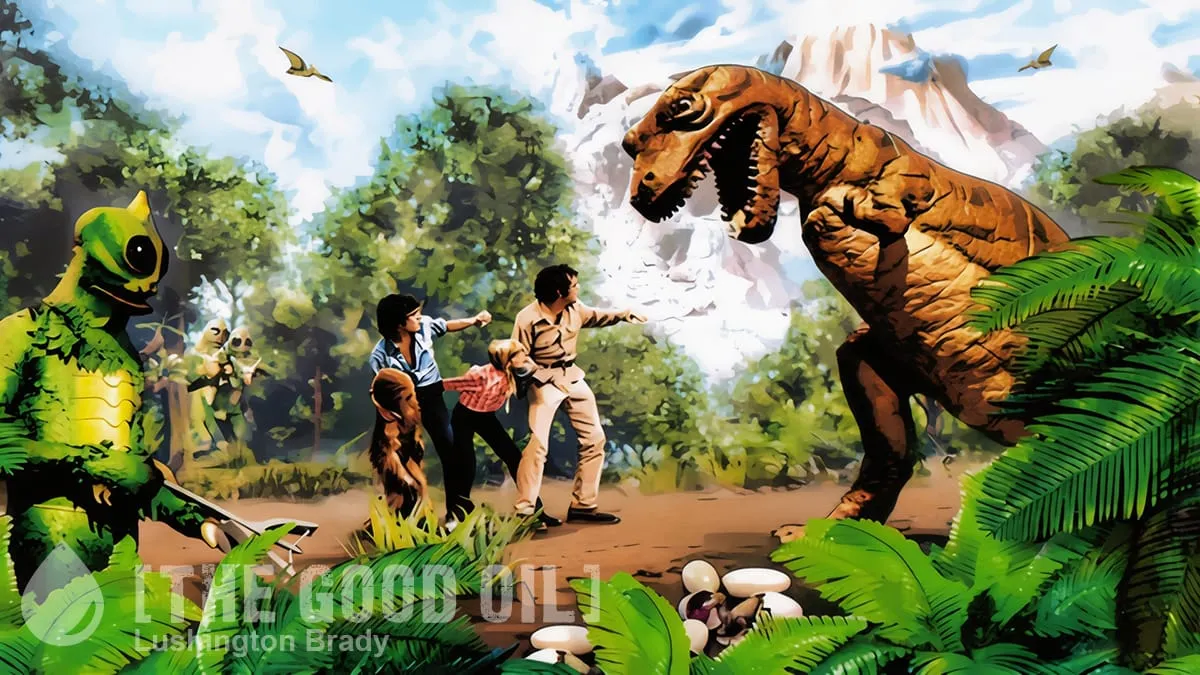
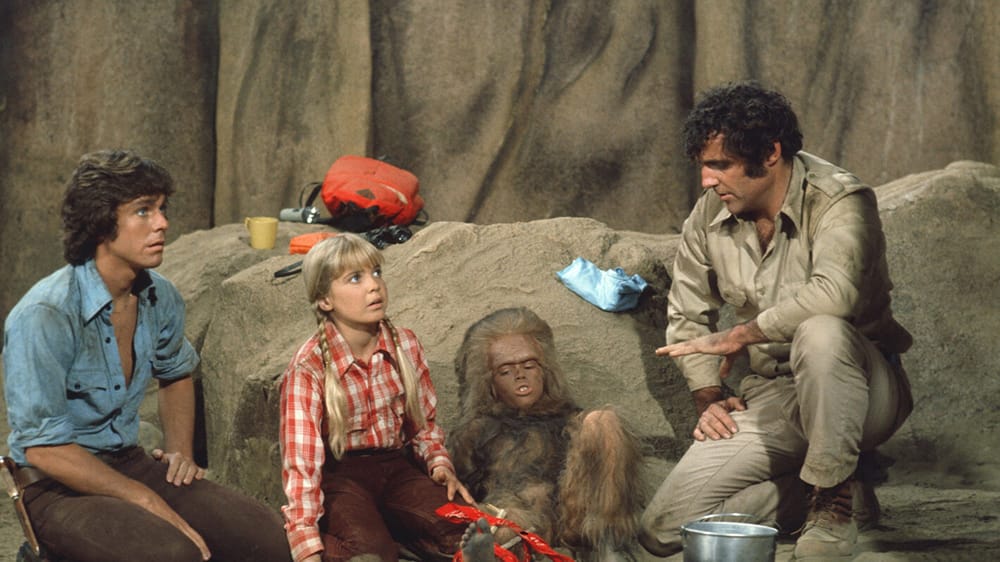
Land of the Lost was the brainchild of Sid and Marty Krofft, who were the undisputed kings of live-action children’s TV in the ’70s, just as William Hanna and Joseph Barbera ruled the animated airwaves. Following a similar premise to Arthur Conan Doyle’s The Lost World, but with multi-dimensions, time-travel and aliens. The story follows the adventures of the Marshall family – father Rick (Spencer Milligan), teenage son Will (Wesley Eure) and pre-teen daughter Holly (Kathy Coleman) – plunged through an inter-dimensional portal into a mysterious world full of danger, dinosaurs and Sleestaks.
The show was a radical departure from the Krofft’s previous stable of lighter shows like H R Pufnstuf (not to mention their long-forgotten ‘adult’ puppet revue, Le Poupées de Paris, a burlesque show with topless puppets: Meet the Feebles, eat your heart out!). But, while on the surface it might seem cheap’n’cheesy, there was a lot of brain-fodder at work underneath the rubber outfits.
Though the Kroffts conceived of Land of the Lost, they left the development of its surprisingly complex lore to a veteran of the celebrated ‘mature’ SF TV series, Star Trek, David Gerrold, though they did provide some unusual guidance for creating the show’s lore. “[Writer] Allan Foshko, who I only met once or twice, and Sid Krofft had put together a book of pictures cut out from the covers of various science fiction magazines,” Gerrold later recalled. “They had a waterfall, a jungle, a giant bee, Tarzan, dinosaurs, monkey people and maybe a couple other things. They asked if I could make it work as a TV series. They had a title and a book – that was pretty much it.”
After some head-scratching, Gerrold wrote a script that included it all except Tarzan, who they decided was an intellectual property issue.
Unlike most children’s shows of its time, ‘Land of the Lost’ didn’t simplify its language. The creators intentionally used vocabulary that challenged viewers, encouraging young audiences to expand their understanding. This decision was made in hopes that children would engage more deeply, learning through context and questioning. By respecting their audience’s intelligence, the show fostered a unique educational experience wrapped in adventure and imagination, setting a high standard for children’s programming […]
‘Land of the Lost’ surprised viewers with its intricate time travel mythology. Unlike typical children’s programming, the show explored complex themes like multiple timelines, paradoxes, and pocket dimensions. These elements added a layer of sophistication, inviting the audience to ponder the possibilities of time and space.
Indeed, risking spoilers, a later episode featured an ingenious bootstrap paradox, where it is revealed that the Marshalls themselves opened the original dimensional portal, in their efforts to get home.
The mysterious pylons scattered throughout the ‘Land of the Lost’ were more than mere structures; they were depicted as advanced alien technology. These enigmatic constructs served as gateways and control centers, adding a layer of intrigue and wonder to the show’s narrative.
The dedication to language didn’t stop with the show’s English vocabulary. Land of the Lost included the first full language created for a TV show. While Star Trek famously included the Klingon language, the actual Klingon language spoken by legions of nerds today wasn’t developed until the ’80s. Pakuni was the language of the ape-like semi-human natives of the Land of the Lost. The Kroffts decided including an alien language would make the show more intellectually stimulating, so they hired UCLA linguistics professor Victoria Fromkin to invent one. Frompkin based Pakuni on Akan, a language spoken in Ghana, and created a 200-word vocabulary. Like ‘Nadsat’, in A Clockwork Orange, the idea was that immersing the viewer in its language would allow children to learn it over the course of the show.
Cha-Ka, the young Pakuni who befriends the Marshalls, was played by 10-year-old Phillip Paley, the youngest karate black belt at the time. Paley appeared on The Tonight Show Starring Johnny Carson, where he and Chuck Norris joined forces to flip Johnny. The Kroffts saw the show and hired him.
They also hired a bunch of basketballers from nearby Palos Verde High School to play the tall, skinny Sleestaks. One of the Sleestaks later become more famous as a player for the Detroit Pistons: Bill Laimbeer. “It was easy money. People on TV only work 20 minutes out of a whole day,” Laimbeer said in 2019. “It was a lot of fun and a good experience, especially when you were 18 years old.” Not entirely fun, it must be said: Kathy Coleman recalls that, the Sleestak actors “would walk like surfers who wear their wetsuits halfway pulled down. That’s how they were on the set. Those costumes were so hot that we could only shoot them for about 60 seconds at a time, and then they had to unmask.”
Although it often looks cheap, Land of the Lost incorporated some groundbreaking special effects. While the stop-motion dinosaur scenes might date back to King Kong (1933), the series used a rare example of matting filmed stop-motion sequences with videotape live action, so as to avoid the telltale blue ‘fringe’ produced in matting with less exacting processes.
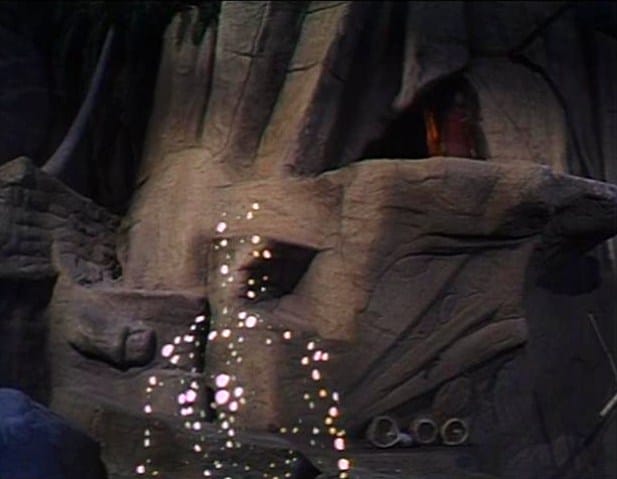
The Zarn, an intriguing antagonist in ‘Land of the Lost,’ was among television’s first attempts at depicting an anti-gravity character. Created using reflective materials and inventive camera work, Zarn’s floating, glowing appearance captivated audiences. This innovative portrayal predated CGI, showcasing the show’s commitment to pushing creative boundaries. The Zarn’s unique representation added to the show’s allure, offering a glimpse into the possibilities of visual effects before the digital age took hold […]
Despite its expansive settings, ‘Land of the Lost’ was filmed entirely indoors using soundstages. Through the clever use of fog machines, painted backdrops, and forced perspective, the production team created convincing landscapes. These techniques allowed for a diverse array of environments, from jungles to mountains, all within the confines of a studio. Such ingenuity was necessary to bring the fantastical elements of the show to life, showcasing the creativity and resourcefulness of the crew.
Echoing the fate of the original Star Trek series, Land of the Lost was almost cancelled after the first season, due to low ratings. But a fan-letter campaign saw two further seasons green-lit.
The enduring popularity of the show, long after its cancellation, led to a big-budget cinema adaptation in 2009, starring then wunderkind Will Ferrell. It sucked. It not only failed to make back its production cost, it drew a rare, unanimous response from audiences and critics alike on Rotten Tomatoes, where it has a 26 per cent rating.
Audiences and critics weren’t the only people who hated it.
The Kroffts have repeatedly disowned the film – in a 2016 interview with Forbes, Sid said, “It didn’t have a heart … they changed all of the characters,” while Marty claimed that “at the time they were shooting it, I knew we were in trouble. This was not the movie I thought we were making.” But at a 2015 Comic-Con panel, the Kroffts went even farther, apologizing to the audience and fans for the film.
Thankfully, the original series is easily available on streaming and DVD, where it continues to be among the most rewatched shows of its time. Not unlike the first seasons of Lost in Space, once modern viewers look past the sets, rubber costumes and wonky dinosaurs, the standard of the writing shines through. Land of the Lost has well earned its enduring place in the pantheon of children’s TV entertainment.