John McLean
Citizen typist patriot
Allegations are flying that New Zealand’s imminent 7 November general election is being rigged.

Ex-Labour Party Minister and Speaker of the House Trevor Mallard has alleged that the current coalition government – comprising of course the National, ACT and NZ First political parties – has tried to rig the election. Mallard’s strong on allegations. He’s previously falsely accused a perfectly innocent man of being a rapist, an allegation that cost New Zealand taxpayers hundreds of thousands of dollars in compensation.
Mallard’s rigging allegation is that the coalition government has changed electoral laws in ways deliberately designed to stop people voting for the Labour, Greens, Māori and Opportunity political parties.
On 25 October, Mallard announced publicly:
Along with the early roll closing it is looking like the voter suppression you expect from Trump or in India or Hungary not here in Aotearoa. The government is determined to make it harder to vote.
Mallard added that, if he were an Electoral Commissioner, he would have resigned because, in his crazy eyes, the current government has not adequately resourced the commission to deliver a fair election.
The current coalition government has indeed changed some voting rules. One such change means that potential voters now cannot enrol to vote during the voting period, which began on Sunday 25 October (previously, voters could enrol up to the close of voting on election day).
At the heart of Mallard’s allegation is his apparent belief that unenroled prospective L/G/M/O voters were disproportionately incapable of enrolling before 25 October. In short, he thinks left supporters are especially lazy and useless when it comes to getting themselves on New Zealand’s electoral role. But even if that’s true, so what? The no-enrolment-during-voting-period change was justifiably made to accelerate voting counting. Nothing wrong with that.
Mallard has also alleged, without any sound ground, that the current government has underfunded the Electoral Commission to prevent the commission from providing enough options for voting before election day (e.g., open polling stations).
Mallard, already an honorary inductee into New Zealand’s Hall of Political Disgrace, has bolstered his gallery of disgraceful behavior. But he’s far from alone.
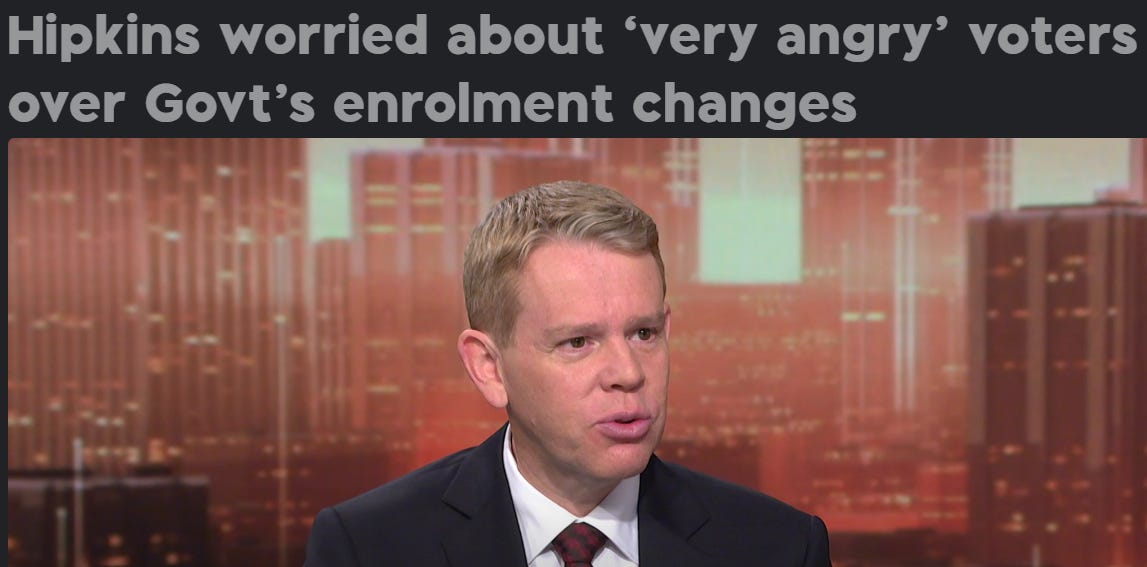
Ex-prime minister and current Labour leader Chris Hipkins claims the government has “deliberately tried to disenfranchise people, particularly those who are less likely to vote for them”, describing the new enrolment rule (no enrolment after voting has started) as “the most draconian restriction to people’s right to enroll to vote that we have ever seen”.
Former Labour adviser and political journalist Vernon Small has written that he has a “disturbing sense that the outcome might be illegitimate”.

Pseudo-academic lefties are wading in. University of Otago professor of law Andrew Geddis has warned that any lower youth enrolments resulting from the earlier cut-off for enrolment could be a “looming disaster”.

Geddis further loud hails that strategic attempts to create an “overhang” could produce “real legitimacy questions about the resulting government”. Andrew was referring to the tactic of voting for one’s National Party candidate in one’s electorate seat, and party voting for NZ First or ACT. If widely adopted, this vote splitting tactic would significantly increase the likelihood of a repeat of the current National/NZ First/ACT coalition government after the next election.
What are the leftists trying to achieve, with all these claims that the election is being rigged? I’ll tell ya straight. They’re preparing the ground for leftist strife if the election doesn’t result in a Labour-led government. The neo-Marxists are trying to pre-legitimize unlawful protest action, including violence, if a conservative government is elected – on the spurious basis that election of a government of, and by, a group of predominantly normal people would be illegitimate.
‘Overhang’ tactics are legal and legitimate and certainly not the exclusive domain of conservatives. The Māori Party is fielding candidates in all seven Māori electorates but is not competing for party votes. On current polling, the Māori Party is expected to win five (perhaps even six) of the seven Māori electorates. In that case, Māori Party MPs would hold about five per cent of the seats in parliament, despite attracting only about 1.5 per cent of New Zealanders’ (and less than 10 per cent of Māori) votes. Without the Māori electorates, the Māori Party would of course not be represented in parliament at all.

Unfortunately, but unsurprisingly, there’s no state-owned or mainstream media coverage of just how far the Māori electorates and the Māori Party’s ‘overhang’ tactics will distort the outcome of the next election. Such coverage would be HARD-RIGHT RACIST!
Assuming no Māori electorates and if the Opportunity Party (TOP) attracts more than five per cent of the party vote, then – on current polling – it would be neck-and-neck as to whether a Nats/NZFirst/ACT coalition or the Lab/Greens/TOP block would form the next government. With the inevitable Māori Party seats in parliament and with TOP getting over five per cent, a Lab/Greens/TOP/Māori coalition government would, for all intents and purposes, be a sure bet.
In my humble opinion, there’s next to no chance of TOP joining a Nats-led coalition. TOP, aided and abetted by state and mainstream media channels, are simply lying that TOP could go either way, in order to garner more overall TOP votes. TOP is a tissue of lies, including – most recently – Dear Leader Wong’s wrong bib bollocks ‘race’:

Whether it’s a Nat or Lab-led government after the next election therefore depends, IMHO, almost entirely – but with one intriguing alternative – on whether TOP gets over the five per cent threshold for representation in parliament. If TOP tops five per cent, then it’s a Labour-led government under Hipkins, except perhaps if… (read on).
The National Party’s No-Brains Trust has been behaving increasingly oddly. The Naterti’s mandated official line is that New Zealanders wanting a National-led government after the next election must give both their electorate and party votes to the Nats. But indisputably, by negating a right-block ‘overhang’ advantage from voting Nat-electorate and NZFirst/ACT party vote, Nat-Nat voting would significantly increase the likelihood of a Labour-led government.
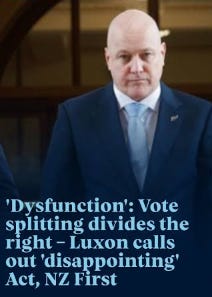
Shockingly, the National Party has complained to the Electoral Commission about Harry Mowbray’s splityourvote website, alleging that the website breaches electoral laws.
And the commission has come to the pernicious party and asked the police to investigate. Now get this – the Mowbrays are THE NATIONAL PARTY’S BIGGEST DONORS. Yes, you read that right. The batty Nats are biting the hand that feeds them.
What’s going on? Why is the National Party apparently, by its own mantra, increasingly the likelihood of a leftist bloc taking hold of New Zealand. What on earth are Luxon (the prime offender and enforcer), Nat campaign manager Simeon Brown and ex-National prime minister ShonKey John thinking?

Some have attributed The Nats’ nuttiness to arrogant delusions that a repeat of the current coalition is a given and that Nat-Nat voting will increase the Nats’ ‘share’ of a Xerox’ed coalition. The Nats’ delusion of eternal, God-given grandeur is certainly a thing. But has the focus of the Nats’ grand delusion shifted?
Here’s my pick. The Nat King Rats are endeavoring to bias the election against the prospect of a National/NZ First/ACT coalition AND IN FAVOUR OF A NATIONAL/LABOUR COALITION. In other words, National may well be slyly angling for a UNIPARTY coalition with Labour, free from those pesky NZ First and ACT people.
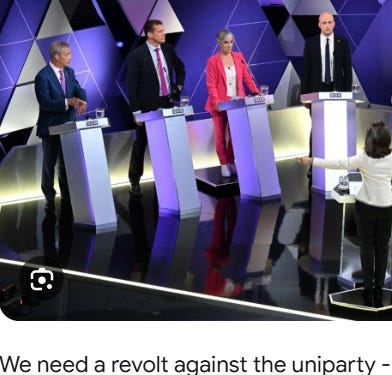
A uniparty coalition would result in another inept one term government, incapable of addressing New Zealand’s chronic political, economic and cultural problems. Plus, stifling free-speech restrictions, antisemitism, racialization, mass immigration, de-industrialization, attacks on productive economic effort, public ‘service’ expansion, state-controlled media, exorbitant energy prices and ballooning national debt. All exacerbating the general malaise, division and discontent.
Does all this mean that the impending election will be able to be considered ‘rigged’? Probably not, in my view. A rigged election is one that has been deliberately manipulated or predetermined by grossly improper means, so that the official outcome does not genuinely reflect the lawful electoral process.
Typical examples of election rigging include:
- falsifying or altering vote totals
- stuffing ballot boxes or introducing fraudulent votes
- destroying or excluding valid votes to change the result
- manipulating vote-counting systems
- election officials secretly favouring a candidate or party in administering or counting votes
- coercion or bribery of voters on a scale capable of corrupting the electoral result.
If the election will not be rigged, will it have been free and fair? Probably not. But that’s another debate.
(P.S. Is it riggish, do you think, for the Electoral Commission to have unleashed the police onto Mowbray?)
This article was originally published on the author’s Substack.