Table of Contents
For my money, the Beats were the last great literary movement in America. There have been important movements in general and genre fiction, including new genres being evolved, but ‘literary’ fiction for the last 70 years has been a diminishing return of middlebrow college snobs writing for other middlebrow college snobs.
The Beats’ literary greatness is often obscured by what came after them, as they became famous, and millions of normies glommed on to media fantasies of ‘beatniks’, which ultimately led to the hippy era and everything horrible that fell out of that. But none of that detracts from the magnificent, terse poetry of Gary Snyder, the drug-fuelled delirium of William S Burroughs or the freestyle jazz stream-of-consciousness of Jack Kerouac.
It was Kerouac’s On the Road that, more than any other Beat work, set the template for the ‘beatnik’ craze. Not least for the legend of its creation.
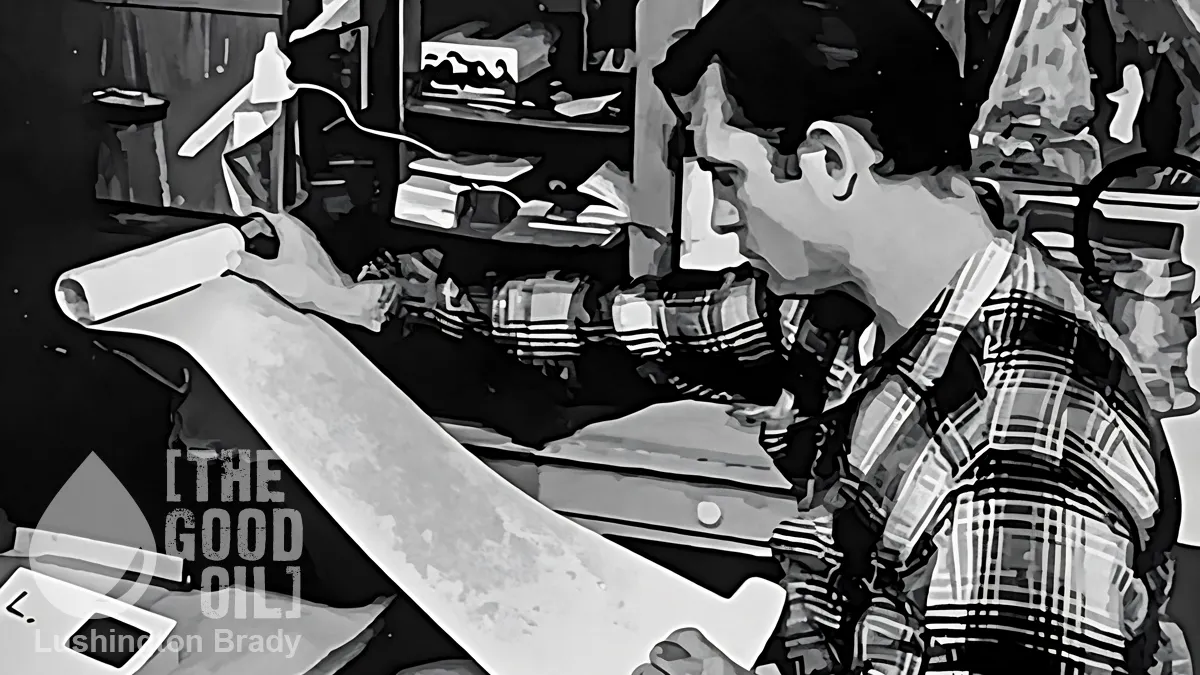
In April 1951, Jack Kerouac feverishly typed out the first complete draft of his masterpiece On the Road over just a three-week period. He famously taped sheets of paper together into a makeshift scroll so that he didn’t have to stop writing in order to switch out the pages in his typewriter. Now, this original manuscript of the novel that defined the Beat Generation is heading to auction.
The scroll is expected to fetch up to $4 million at an upcoming sale of music, literature, and sports memorabilia once owned by Jim Irsay, the former owner of the Indianapolis Colts who died in 2025.
While it’s true that the scroll was typed in a near non-stop coffee- and benzedrine-fuelled frenzy, which prompted Truman Capote to sniff that “That’s not writing, it’s typing,” its composition was in fact a far more drawn-out affair. Kerouac famously alluded that he ‘spent seven years on the road, three weeks typing’. What this laconic remark conceals is that, over those seven years, Kerouac compiled copious diaries and notes and began at least six different drafts that he eventually discarded.
So, when he sat down to type out the scroll, there were already years of experience, thought and composition behind him.
In the late 1940s, Kerouac began jotting down passages in his journal that would eventually become On the Road, a semi-autobiographical novel that follows the restless cross-country road trips of Sal Paradise (representing Kerouac) and his friend Dean Moriarty (based on Neal Cassady). The men travel the United States searching for freedom and meaning against a backdrop of jazz, drugs, and rebellion against American cultural norms.
Then, over three frenetic weeks in April 1951, Kerouac sat down to type out the entire book. He taped together sheets of tracing paper before he began so that he wouldn’t have to pause to change out pages in his typewriter. The final result was a 121-foot-long scroll.
Even then, the work still wasn’t in its final form, though close to it. There were no paragraph breaks, let alone chapters. Kerouac had used the names of the real people the characters were based on and terrified publishers demanded they be replaced with pseudonyms. Sex scenes were either cut completely or heavily edited, leaving the reader to guess at, say, the implied mobile front-seat three-way.
As a result, there were another six years between the frenzied outburst of the scroll and the final publication of the book. In 1957, the book hit the shelves. As Kerouac’s then-girlfriend recalled, they went out late that night to pick up the early papers and read the reviews. ‘Then Jack went to bed unknown for the last time in his life. Next morning, the phone started ringing, and it never stopped.’
Once the book finally hit shelves, it achieved immediate success despite its mixed critical reviews. And today, it remains a cultural phenomenon – which makes it unsurprising that Kerouac’s original scroll is expected to sell for up to $4 million when it goes to auction next month […]
Heather Weintraub, a books and manuscripts specialist at Christie’s, told the Guardian, “This is the original and only scroll for the first draft of Kerouac’s masterpiece. It’s widely considered to be the most iconic artifact of the Beat Generation, [and] one of the most celebrated artifacts in American literature… When you roll it out it actually looks like a road.”
The scroll is just part of the late Jim Irsay’s astonishing collection of Americana and popular culture artefacts that will be sold across four auctions.
Kerouac’s scroll will be sold alongside instruments played by the Beatles, Eric Clapton, Kurt Cobain, Elton John, Prince, Johnny Cash, and several other world-famous musicians. The auction also includes an Apple II manual signed by Steve Jobs, Paul McCartney’s handwritten “Hey Jude” lyrics, Secretariat’s saddle, the jersey Wayne Gretzky was wearing when he scored his 500th NHL goal, a bat used by Jackie Robinson, the volleyball from the film Castaway, and dozens of other artifacts from modern history.
While alive, Irsay often loaned the scroll out for exhibitions. Surviving friends of Kerouac hope the scroll will be bought by a public institution.