Table of Contents
Penny Marie
Mum, Woman, Female. NZ based independent investigative reporter, researcher, writer, coach, truth seeker. Founder of Let Kids Be Kids NZ.
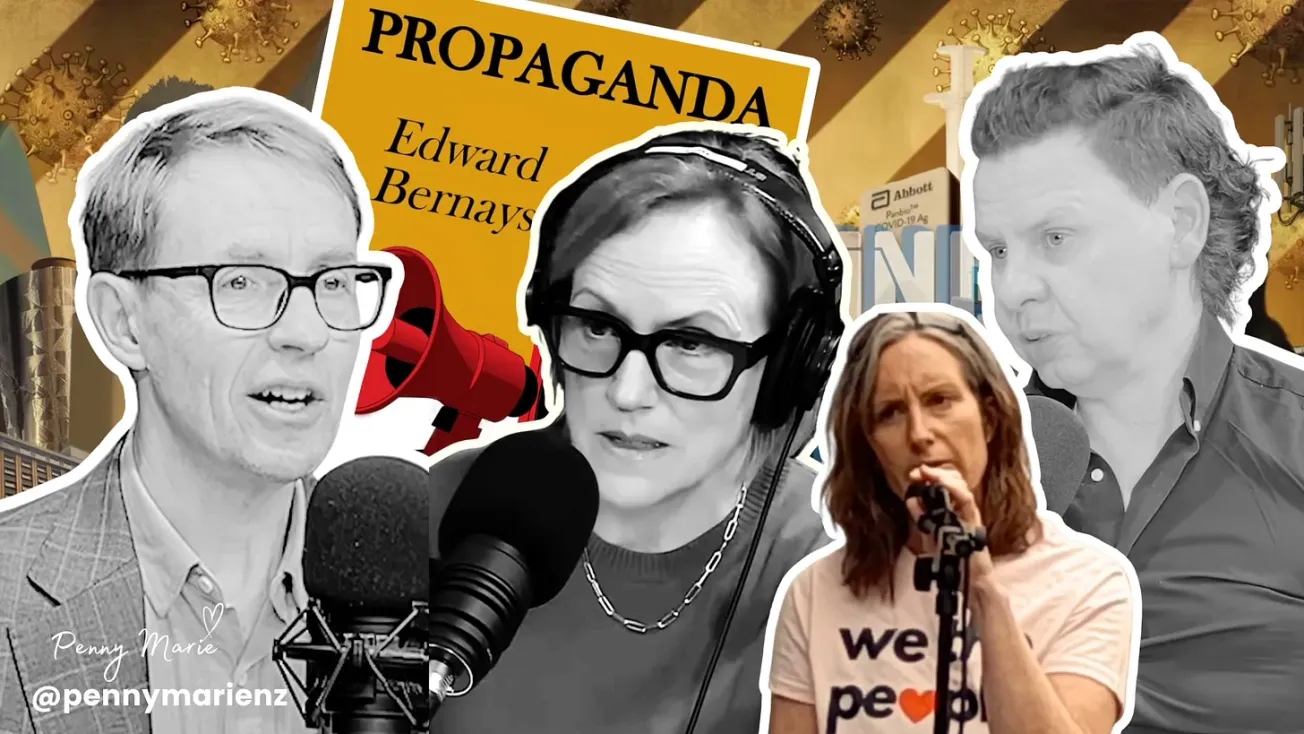
Stuff’s Quarantine Nation podcast sells itself as sober reflection on the Covid years. Read through the lens of Edward Bernays, it looks more like a second wave of propaganda: regret without reversal, fear and heroism without accountability, and a tightly controlled story about what we’re allowed to question.
‘Quarantine Nation’ trailer
Quarantine Nation presents itself as a reflective oral history of New Zealand’s Covid years. It’s marketed as “a mostly serious history,” a chance to look back with the benefit of hindsight, to hear key players admit what they got wrong and what the pandemic did to them.
Underneath that layer, though, the series does something else. It functions as a second round of messaging: a carefully curated set of confessionals in which the central communicators of the Covid era admit limited mistakes, reaffirm that ‘we’d do it again’, and re‑sell the official response as necessary, heroic and beyond fundamental question.
Read through Edward Bernays’ 1928 book ‘Propaganda’, that pattern stops looking like a coincidence and starts looking like a textbook. Bernays describes propaganda as the “conscious and intelligent manipulation of the organized habits and opinions of the masses,” carried out by an “invisible government which is the true ruling power of our country.” “Propaganda is the executive arm of the invisible government.”
In his frame, propagandists don’t primarily lie. They sift and ‘high‑spot’ certain facts, suppress others, wrap it all in emotion and identity, and present the result as common sense. Quarantine Nation’s Covid confessions fit that pattern almost perfectly.
‘We’d do it again’: The safe apology
One of the most striking shared moves in the three episodes I’m focussing on here is what you might call ‘regret without reversal’. Each guest acknowledges something they wish they had done differently. None of them question the core project they fronted.
Ashley Bloomfield, NZ Director General of Health during Covid era
Ashley Bloomfield’s main regret is internal. Late in his interview he says that if he could change one thing, he would, from the start, have appointed a senior executive “responsible for pastoral care” and rotating people out, because he “did see colleagues burn out” and “feel[s] bad about that”. He admits getting “close” to burnout himself and describes the physical and psychological weight he carried, including his wife telling him he looked five years younger a week after he left the job.
When it comes to the use of extraordinary legal powers, however, the tone hardens. Orders to stay home, mask and vaccinate were, in his telling, based on “meticulously assembled advice” and good data: he emphasises that he always felt confident signing them. The counterfactual he offers is graphic: without those measures he imagines “dozens, potentially even hundreds of deaths every day” in the first wave. The implied conclusion is clear: given the same information, he would do it again.
Hilary Barry, influential media personality
Hilary Barry does not dwell on specific regrets so much as on the emotional toll and downstream division. She describes Covid as “traumatic”, “unprecedented” and “like something out of a dystopian movie”, and says the country has become “a lot more divided”, with people “quick to anger” and less open to other views. Yet she insists she “did the right thing” in backing the vaccine rollout and frames her on‑air role – “I was the vibe-check person… cheering people up” – as unambiguously positive.
The harm sits in “social media” and a small set of vitriolic online abusers, not in the broadcast tone of the response itself.
Paddy Gower, influential media personality
Paddy Gower is the most explicit. He opens by saying, “I was too entrenched in a pro‑vaccine view and I crossed a journalistic line… I’m sorry about it looking back now.” He admits fronting the Vaxathon and running a sting on a Canterbury doctor giving exemptions, and he acknowledges that “the media were very pro‑vaccine” and that people who were sceptical were treated “harshly”.
Later he says bluntly, “we got it wrong… we were too harsh on them and that included me.” Then comes the pivot: “If I went back, I’d do it again because it was important that we got vaccinated… I’d probably do it again.” Ethical breach and harm are admitted, but morally overwritten by the “greater good” of the campaign.
In Bernays’ terms, this is exactly what you would expect from people who see themselves as participants in a justified propaganda project. Tactical excesses can be conceded; feelings of guilt can be aired. But the mission itself – the idea that mass persuasion was necessary, that the fundamental strategy was right, that they were on the right side of history – is never up for renegotiation.
Emotional grammar: Fear, sacrifice, heroism, unity
The emotional grammar of these interviews also lines up neatly with Bernays’ description of how propaganda works: vivid fear, heroic self‑sacrifice, and a simple unity story.
Fear is everywhere, mostly framed through counterfactuals. Bloomfield describes waking at 3am in a “cold sweat”, imagining what would happen if the virus got loose, and says he would not have “enjoyed talking about… hundreds of deaths every day”. He treats the first death as a symbolic moment and constantly gestures to the alternative: the horror he believes New Zealand avoided. Gower recounts intensive care staff telling him they would be “crushed” if vaccination rates stayed low, and presents his activism as an attempt to stop the health system collapsing. Barry’s version is more atmospheric – empty motorways, essential‑worker letters in the glovebox, the sense that normal life could vanish overnight – but the emotional effect is the same. The listener is reminded that the stakes were life and death.
Layered over this is a heavy dose of heroism. Bloomfield gives a guided tour of his days: waking in the early hours, data work, line‑by‑line preparation for the 1pm stand‑ups, long meetings into the evening, and six‑and‑a‑half‑day weeks for months on end. He speaks openly about the “roller coaster ride no one had bought a ticket for”, the “enormous weight” he carried, and the physical relief when it finally ended. Barry describes herself, only half‑jokingly, as an “essential worker” whose job during lockdown was to be the “vibe-check person” on air while others were stuck at home.
Gower talks about being broken by lockdown – chewing through craft beer and red wine, “massively depressed”, frustrated with his work – but also about wanting to play his part in “getting us out of this hole”. All three position themselves as people who suffered for the cause.
Then comes unity. Bloomfield’s preferred phrase is “invitation to collective action”, which he says New Zealanders “absolutely accepted”. He recalls that “no one ever said no” when he called, that people “stepped up” without being asked, and that the system was held together by shared purpose. Barry praises how “we all signed up for that and did what we were told” in those early days, recalling meticulous self‑isolation and general compliance with the rules. Gower repeatedly contrasts those who “played by the rules” with the doctor who issued exemptions and the people who sought them.
Bernays argued that modern campaigns succeed when they can anchor extraordinary measures in emotionally satisfying pictures: disaster averted, leaders who suffer alongside you, a “team” that pulls together.
The details of the science matter less than the narrative frame in which people place them. He stated “the manipulation of news, the inflation of personality, and the general ballyhoo by which politicians and commercial products and social ideas are brought to the consciousness of the masses,” and noted that “the instruments by which public opinion is organized and focused may be misused. But such organization and focusing are necessary to orderly life.” Quarantine Nation leans hard into that frame.
The vanishing of dissent
If propaganda high‑spots some facts, it also shadows others. Here the shading mostly falls on dissent and harm.
Dissent, when it appears, is either marginal or pathologised. In Bloomfield’s recollection, the main tension is speed: sometimes people found out what they would be doing next day by watching the 1pm stand‑up, and he would “occasionally” have to phone and apologise. The positive spin is that “no one was privileged with information” and that the pace was so fast everyone understood. The possibility that this information regime disempowered professionals and created a culture of announcing first and managing consequences later is not explored.
Barry’s critics are almost entirely online. She talks about “a hell of a lot of abuse”, including death threats, and about TVNZ offering security at her house. The key point, though, is that “not one person” has ever challenged her in person at an event. From this she concludes that the abusive cohort is small and cowardly – a loud minority with “a big megaphone”. That may be true of the worst abusers. It does not tell us much about the wider population who lost jobs under mandates, were barred from visiting dying relatives, or experienced adverse events, and who might simply have avoided engaging with a celebrity broadcaster they saw as hostile to them.
Gower gets closest to acknowledging harm. He describes being confronted in cafes and on the street by people furious about his Vaxathon role and his coverage of the Canterbury doctor, and says, “I can understand why people would hate me over it.” He recounts interviewing a man with vaccine‑induced heart inflammation whose own family struggled to believe him, and admits that “journalists should be helping and fighting for these people sometimes and we weren’t… it was more convenient for us to ignore them or push down on them”. Even here, though, the narrative circle closes around his personal learning: he is “allowed to regret that”, he says, but remains “still pro‑vaccine”. Structural questions – how newsroom incentives, government funding and campaign messaging shaped that harshness – are outside the frame.
The cumulative effect is to assign most moral injury to the communicators themselves. They suffered burnout, abuse and regret. They misjudged tone or failed to look after staff. The public’s pain appears in glimpses, mainly to illustrate how hard the job was. That is an inversion worth noticing.
A second round of messaging – and a different kind of media
None of this means the series is scripted by cabinet. Quarantine Nation is clearly produced with craft and genuine feeling. The guests are not robots. They cry, stumble, admit fault, reveal stress fractures in their own lives. That human texture is part of its power – and part of why, through Bernays’ lens, it looks like effective modern propaganda.
What the series ultimately offers listeners is closure on particular terms. The terms are roughly these: the threat was as bad as, or worse than, we were told; the basic strategy was right; the people fronting it were sincere, hard‑working and sometimes broken by it; and although some things went too far, those excesses were understandable under the circumstances and do not call the project itself into question.
The repeated “I’d do it again” motif is not accidental. It’s the moral that ties all three early episodes together.
Seen that way, Quarantine Nation is not just telling us what happened. It is helping to fix in place which parts of the Covid response are available for debate, and which are to be treated as settled. Bernays put it bluntly: there is “a vast and continuous effort going on to capture our minds in the interest of some policy or commodity or idea”, and “propaganda is the executive arm of the invisible government”.
What I started doing
That top‑down closure sits in stark contrast to the media I and others began to build outside the mainstream system. In 2022, standing outside TVNZ, I said: “We’ve been programmed to a place where we are order‑followers, where we have been legislated the common sense out of us… but we’re coming back to our authority – we know that we have the right to speak in honour.” You told the crowd, “Everybody has their own entry point into the truth… we are hypnotised us en masse and we wake up individually when we’re ready,” and I suggested to “always be in love and in honour” even towards media workers who might later realise “what they have been a part of”.
My words came from a very different reality of the public who didn’t agree with the narrative being promoted by mainstream media. We are NOT a mass to be managed by a ‘single source of truth’, but a collection of individuals with their own timing, pain and questions.
Watch my speech outside TVNZ in 2022…
Thank you for reading… Part 2 is coming soon
- Part 1 of this series has focussed on the official attempt to close the Covid story.
- Part 2 will look at the star the system built – “Saint Ashley,” the bureaucrat turned sex symbol – and at how politicians, universities and media together turned a “single source of truth” into someone the country was encouraged not just to trust, but to adore.
This article was originally published by Penny Marie NZ.