Tom Armstrong
Just an old fashioned romantic libertarian conservative at heart. Or maybe a romantic conservative libertarian, depending on the stages of the moon.
You have almost certainly been told about Bristol’s involvement in the African slave trade of the 17th and 18th centuries. It is most unlikely, however, that you’ve been told about its much earlier involvement in the slave trade, that of the export of English slaves in the tenth and eleventh centuries.
Long before Bristol became a centre of the transatlantic trade, it was an important port in the export of English slaves. During the 10th and 11th centuries, men, women and children were bought in different parts of England, brought to Bristol and shipped across the Irish Sea to be sold in Ireland, where Viking trading centres, above all Dublin, had become major markets for enslaved people.
This earlier history is less familiar, but it matters. It reminds us that slavery was not an institution invented by the modern Atlantic world. It was one of the recurring features of human societies, including medieval Europe.
In Anglo-Saxon England, the population was divided broadly between the free and the unfree. Slavery had existed for centuries, and people could enter it in several ways. Prisoners captured in war might be enslaved. Others were kidnapped. Parents facing starvation could sell their children. Debt, punishment and dependence could also result in the loss of freedom. Some people entered servitude voluntarily, believing that life under a master might offer greater security than what they had.
The boundaries between slavery and other forms of unfree labour were not always clear. Medieval England contained a spectrum of dependent statuses, from people with relatively limited obligations to those who could be treated as property. Serfs, for example, were generally tied to a manor rather than bought and sold as individual commodities, but they were still denied the freedom to leave without permission. That distinction mattered legally, even if it offered little comfort to those living under coercion.
The outright buying and selling of people, however, was fairly common and Bristol was particularly well placed to profit from it. Known to the Anglo-Saxons as Brycgstow, ‘the settlement by the bridge’, the town stood on the River Avon, with direct access to the Bristol Channel and the Irish Sea. Its position made it a natural port for trade with Ireland. By the turn of the second millennium, Bristol was an important commercial centre with its own mint and an increasingly active maritime economy. Its merchants could collect people from across England and transport them by sea to Irish markets.
Ireland was an obvious destination. Scandinavian settlers had established powerful trading centres there, including Dublin, one of the great slave markets of northern Europe. From Ireland, enslaved people could be sent onwards to Scandinavia, Iceland and other parts of the Viking world. The trade was sustained by demand, geography and profit.
The evidence is not sufficiently detailed to tell us how many people passed through Bristol, nor can every story repeated about the trade be treated as certain. But the broad picture is clear. Bristol was an outlet for the export of English slaves, and the trade was established enough to be described in the early twelfth century as an ‘ancient custom’ of the town.
Our most vivid account comes from William of Malmesbury, writing about the campaign of Wulfstan, Bishop of Worcester. William describes ‘long rows of young men and maidens’ bound together and brought to market. He also refers to women who had been deliberately made pregnant before being sold. The passage is a moral denunciation, not a statistical report, and it should be read as such. Even so, it provides an unusually powerful glimpse of the human beings behind an otherwise abstract commercial system.
They were not merely prisoners captured in battle. Men, women and children were being acquired specifically for resale. Some may have been sold by relatives; others were kidnapped or coerced. The market turned people into commodities, and the existence of profit made the practice appear ordinary to those who participated in it.
That is perhaps the most important point. The people of 10th- and 11th-century England did not live in a society where slavery was universally regarded as an obvious moral outrage. Kings knew about it. Landowners possessed slaves. Merchants traded in them. Religious institutions could own them. The institution was embedded in the social and economic order.
This did not mean that medieval Christians had no moral objections to enslavement. They did. But those objections were often selective. One of the strongest prohibitions concerned the sale of Christians to pagans. The issue was not necessarily that a Christian could never be enslaved; it was that a Christian might be sold to people of another faith and thereby removed from Christendom.
That distinction helps explain the apparent contradiction at the heart of medieval Christian society. A Christian landowner might possess slaves without believing that he had violated Christian teaching. A church might own slaves. Yet the sale of Christians to pagan buyers could be condemned as an intolerable offence. To modern eyes this seems inconsistent. To many medieval people it was a coherent distinction between permissible and impermissible forms of enslavement.
Bristol’s trade was especially objectionable for that reason. Its cargo was being sent to markets controlled by pagan or recently converted Scandinavian rulers and merchants. The people being sold were not simply losing their liberty; they were being exported beyond the religious and political community to which medieval Christians believed they belonged.
Nor was England unique. Slavery and other forms of unfree labour existed across Christian Europe, the Byzantine Empire, the Islamic world, Africa and Asia. Slave routes crossed the Mediterranean, the Black Sea, the Eurasian steppe, the Sahara and the Indian Ocean. Eastern Europeans were traded through Black Sea ports into Byzantine and Islamic markets. African societies participated in regional systems of enslavement and trade, while various forms of slavery and bonded labour existed across Asia.
This is not an argument for a league table of guilt. It is an attempt to understand the world in which Bristol’s trade existed. Slavery was a widely recognised institution, and medieval people in many societies accepted that some human beings could legitimately own others. Bristol’s story was not an isolated aberration, but one local expression of a much broader system.
It was nevertheless challenged – and eventually abandoned.
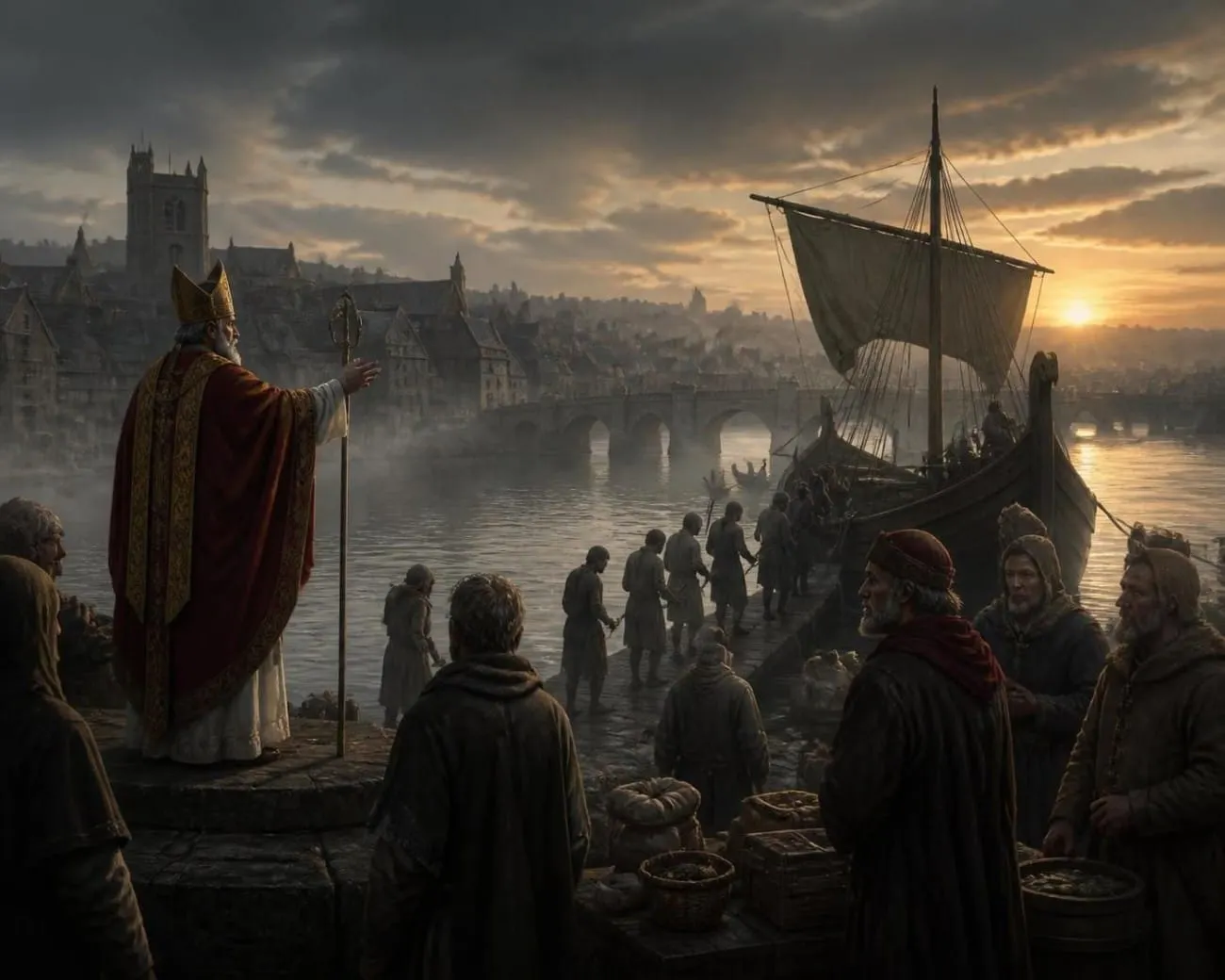
The central figure was Wulfstan, Bishop of Worcester. Born around 1008, Wulfstan became bishop in 1062 and remained in office through the Norman Conquest until his death in 1095. His career crossed the divide between Anglo-Saxon and Norman England, but his opposition to the Bristol trade was persistent. According to William of Malmesbury, Wulfstan repeatedly visited Bristol and preached against the merchants. A single sermon was not enough. He returned again and again, sometimes remaining in the area for weeks or months. Each Sunday he preached against the buying and selling of human beings.
William says that neither the love of God nor the fear of King William had been sufficient to destroy the trade. The merchants continued to buy people from across England and send them to Ireland in search of profit. Eventually, however, Wulfstan’s persistence helped change the attitude of the town. Bristol’s merchants abandoned the trade, and the practice began to lose its local legitimacy.
This matters because the end of the Bristol trade was not simply the result of an order issued from London. It required a sustained campaign against the people actually involved: merchants, shipowners and customers. Wulfstan confronted a profitable custom that had become, in William’s words, hardened in the hearts of those who practised it.
Royal and ecclesiastical authority also played a part. William the Conqueror restricted the export of slaves from England, particularly the sale of Christians to foreigners and heathens. But legislation alone did not immediately eliminate the trade. The Council of London, held under Archbishop Anselm in 1102, issued a church canon condemning the buying and selling of people in England, especially the export of English slaves. It was an important ecclesiastical prohibition, though not the equivalent of a modern Act of Parliament and not an instant abolition of every form of unfree labour.
The trade seems to have continued in some form for a time. Medieval sources and later accounts suggest that Scandinavian merchants still attempted to lure unsuspecting people aboard ships and carry them away. The 1102 prohibition therefore marked a decisive change in moral and institutional attitudes, but not an overnight transformation of society.
Nor did freedom arrive for everyone. Serfdom and other forms of dependency continued for centuries. People could remain tied to the land, obliged to provide labour and unable to leave without permission. The disappearance of chattel slavery in England was gradual, uneven and incomplete. Yet by the 12th century the open buying and selling of English Christians had become increasingly difficult to defend, and outright slavery had largely declined by around 1200.
Bristol’s early history therefore reveals something uncomfortable about both the city and the medieval world. Slavery did not require participants to think of themselves as villains. A merchant could buy a person, transport that person to Ireland and sell them at a profit while regarding the transaction as a legitimate branch of commerce. Social custom, economic interest and religious assumptions could combine to make cruelty appear respectable.
There is something striking about William of Malmesbury’s description of those “long rows of young men and maidens” bound together for sale. These were not abstractions. They were individuals who had families, homes and lives of their own, but who had become commodities in a profitable business. But perhaps because they were not Africans, modern society seems to be uninterested.
This article was originally published by the Free Speech Backlash.



![[The Good Oil] Stuff Up of the Day](https://storage.ghost.io/c/31/f4/31f4e20a-0315-499e-83ff-139e8eab53bf/content/images/size/w1304/format/webp/2024/09/Stuff-up-image-1.webp)