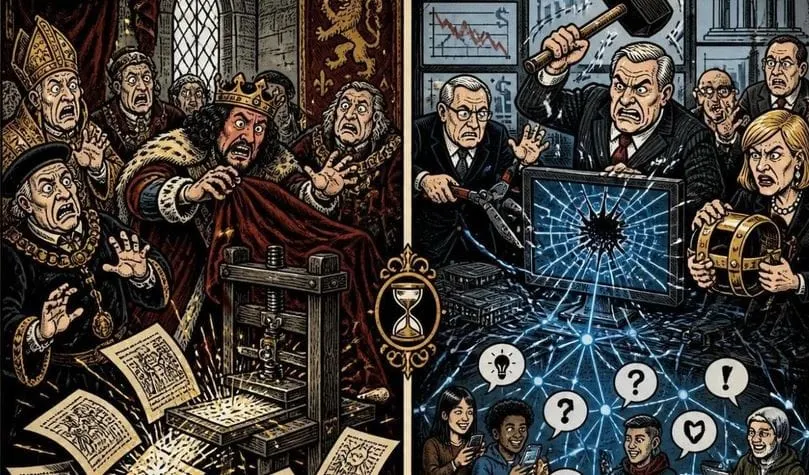
It’s important to remember that ‘fake news’ doesn’t just mean ‘outright lies’. Fake news also includes truthful information used selectively or framed in a false context. This is probably the most damaging fake news of all. As poet William Blake famously wrote: A truth that’s told with bad intent beats all the lies you can invent.
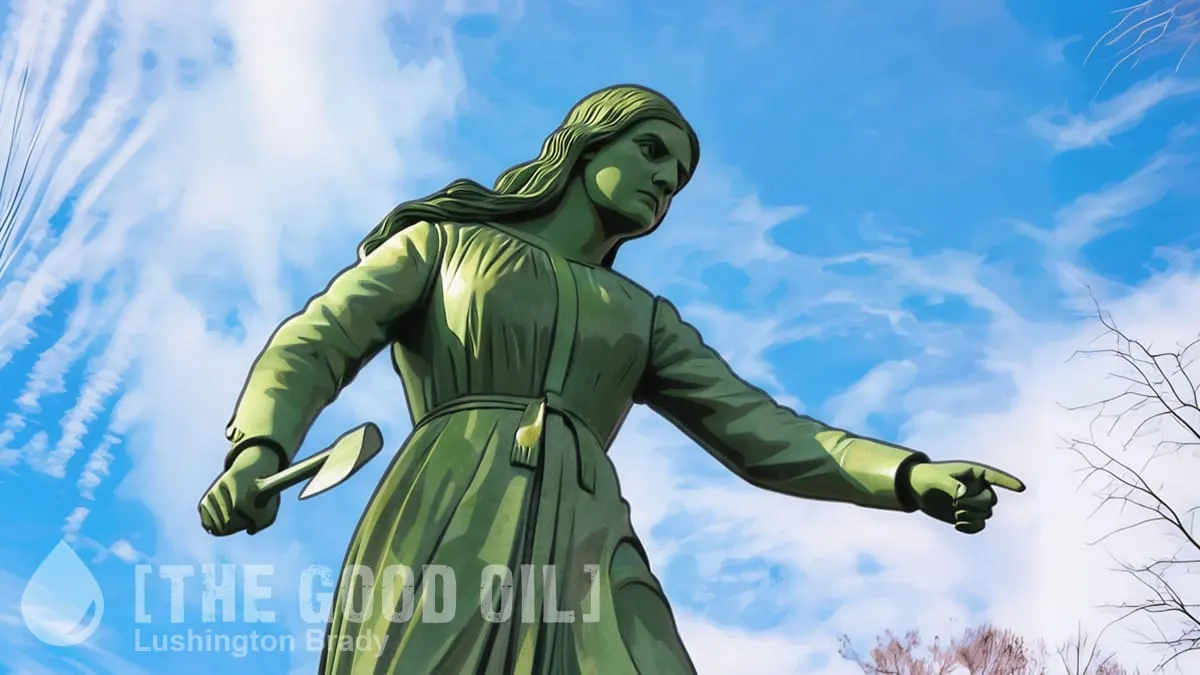
The legacy media are going full fake news to try and justify the left’s latest attempt at statue toppling.
Though she’s all but forgotten today, Hannah Duston was probably the first American woman to be memorialized in a public monument, and this statue is one of three built in her honor between 1861 and 1879. The mystery of why Americans came to see patriotic “heroism” in Duston’s extreme – even gruesome – violence, and why she became popular more than 100 years after her death, helps explain how the United States sees itself in world conflicts today.
Ignoring the bizarre non sequitur of the last sentence, notice how the Smithsonian have skewed their story? “Heroism” in scare quotes, accusing Duston of “extreme – even gruesome – violence”. The last is true – but by presenting it with no context, Smithsonian all but defame Duston.
Other legacy media outlets are no better. NPR blithers about “racist monuments”. History News Network shrieks,“The statues were made to send a message to the indigenous community that they are inferior, that their land would be seized and they would be removed and put on reservations.”
If the racial roles were reversed, the legacy media and the rest of the left would be lionising Duston as a 17th century girlboss. Multiple movies would portray her as a lioness-like wronged woman wreaking justified revenge on the brutal, racist men who so abused her.
And for once, they’d be telling the truth.
In March 1697, Abenaki raiders burned Haverhill, Massachusetts, killed 27 colonists and marched off with captives. Hannah Duston was among them. She had given birth six days earlier. On the trail north, her infant daughter was savagely killed against a tree.
Weeks later, on an island in the Merrimack, she and two other captives took hatchets while their captors slept. They killed 10 of them. They scalped the dead, stole a canoe and paddled home at night.
Well, that changes things a bit, doesn’t it?
A bit too much for the legacy media.
Cue Smithsonian to the rescue of the narrative.
Born in 1657, Hannah Emerson Duston lived in Haverhill, Massachusetts, at a time when disputes among English colonists, the French in Canada, and various Native American nations resulted in a series of wars in the region. King Philip’s War (1675–1676), for example, decimated southern New England Indian nations, which lost between 60 and 80 per cent of their population as well as their political independence. Many were sold into slavery. By the late 1680s and the start of King William’s War, fragments of those southern tribes had joined the Abenaki and other northern New England Indian nations allied with the French to fight the continuing expansion of the English colonists to the north and west. Native men conducted raids on frontier English settlements, burning property, killing or injuring some colonists, and taking others captive, either to ransom them back to their families, or to adopt them as replacements for their own lost family members.
Such was the context in which one group, most of whom were likely Abenaki, attacked the town of Haverhill on March 15, 1697.
Smithsonian also hides the brutality of the Indians behind the anodyne, “The captors are said to have killed her child early in the journey.”
See what they’re doing? It’s not the poor ickle Indians’ fault: it was all the big, meany white people who made them do it.
And that is a big, fat load of bollocks.
As S C Gwynne makes clear in his excellent book Empire of the Summer Moon, such unalloyed brutality and constant warfare was part and parcel of Indian society long before Europeans ever encountered them. Gwynne’s book mainly concentrates on the Comanche, who were the most powerful tribe in North American history – and they were a byword for cruelty long before they ever sighted a white man.
But, even into the early 19th century, Comancheria was as unknown as Darkest Africa. Through all the previous 200 years, the Comanche wars were with other Indians. The Spanish in the late 1600s had noticed that attacks by Apaches had all but stopped. What they didn’t know was why: the Apaches were being systematically exterminated by the encroaching Comanche. Like all Indian violence, they were wars of incredible savagery.
As Gwynne writes, “Not only did they inflict horrific suffering, but from all evidence they enjoyed it” (emphasis in the original). This doesn’t just apply to the Comanche: “Such behaviour was common to all Indians in the Americas.” It was just a fact of life, explaining why Indians would regularly fight to the death: capture only meant a long, slow, cruel death.
“It was what everyone had always done, what the Sioux did to the Assiniboine, what the Crow did to the Blackfeet. A Comanche captured by a Ute would expect to receive exactly the same treatment (thus making him weirdly consistent with the idea of the Golden Rule).”
– S C Gwynne, Empire of the Summer Moon
Rachel Parker Plummer, captured by Comanche in 1836, provides a chilling first-hand account of what the Smithsonian conceals behind “the captors are said to have killed her child”.
Pregnant at the time, Parker Plummer was repeatedly raped, along with her aunt, by the Comanche men, in front of her nine-year-old cousin. When her baby was seven weeks old, a group of men held her down while another strangled the baby. “When he showed signs of life, they took him again, this time tying a rope around his neck and dragging him through prickly pear cactus, and eventually dragged him behind a horse around a hundred yard circuit.”
This was the sort of savagery Hannah Duston and her baby would have been subjected to.
Who can blame her for taking “extreme – even gruesome” revenge?