

Table of Contents
Auroras – the Northern and Southern lights – are one of the most awe-inspiring sights planet Earth has to offer. The night sky lit up with shimmering, dancing curtains and beams of light. As it turns out, though, Earth is not the only planet to have auroras. Venus, Jupiter, Saturn, Uranus and Neptune have all been observed displaying their own northern and southern lights. Except, on Uranus, they’re ‘western’ and ‘eastern’ lights: due to the planet’s 98-degree axial tilt, its magnetic poles are roughly 45 degrees off-kilter to its geographical north and south.
Given that auroras occur when the solar wind collide with particles in the upper atmostphere, and are channelled along the lines of the planet’s magnetic fields, it might be thought that Mars would be a low candidate for the effect. After all, Mars’ magnetic field is weak and its atmosphere thin. Yet, cameras on NASA’s Perseverance rover have finally photographed auroras on the Red Planet.
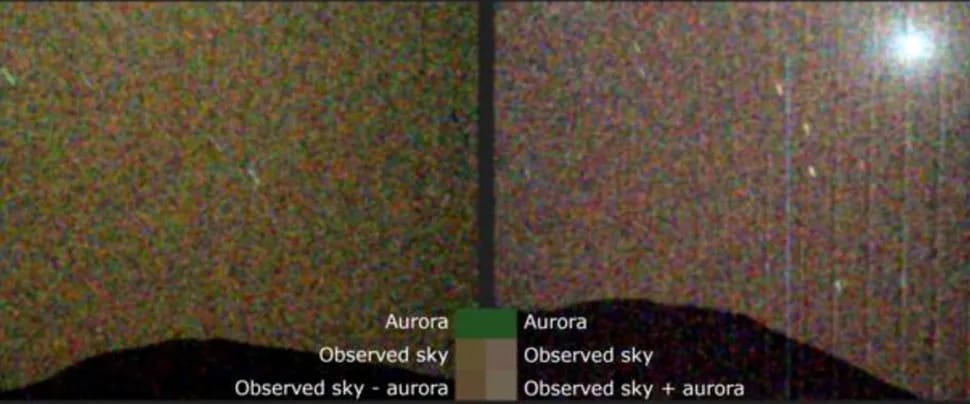
The wandering robot snapped the newly released image on March 18, 2024, roughly three days after a sizable cloud of charged particles, known as a coronal mass ejection (CME), erupted from the sun. In a new study, published May 14 in the journal Science Advances, researchers revealed that the CME collided with Mars’ patchy magnetic field, exciting the gas within the planet’s wispy atmosphere to emit light, similar to how the most vibrant northern lights displays are created on Earth.
It was previously known that Mars indeed had auroras, sometimes extending around the entire planet due to the lack of a magnetic field to ‘channel’ them. But these were only in invisible wavelengths of light, mostly ultraviolet. Perseverance for the first time spotted visible-light auroras. If only just visible.
In addition to being the first visible auroras on Mars, the faint green lights are believed to be the first auroras anywhere in the solar system to be captured using only visible wavelengths of light […]
The auroras were so weak that the light was apparent only after the glare from Mars’ largest moon, Phobos, was edited out of the photo, which is why the image above is split in half.
It is unlikely that humans could have seen such weak auroras. However, the researchers think a higher dose of solar particles, coupled with reduced atmospheric dust, could allow the phenomenon to be visible to the naked eye in the future.
In fact, Perseverance only captured the Martian lights because its operators were looking for them.
Researchers realized that the CME would likely hit Mars, so they positioned Perseverance’s Mastcam-Z camera toward the Martian night sky in anticipation of catching a glimpse. However, even then, they were not confident they would see a visible aurora.
This also marks the first time a Martian aurora has been detected from the planet’s surface. Until now, all observations have been captured by orbiting spacecraft, such as NASA’s Mars Atmosphere and Volatile Evolution (MAVEN) probe and the UAE’s Emirates Mars Mission orbiter.
Jupiter, by far the biggest and most active planet in the solar system, not unsurprisingly has a dazzling light show to match, as scientists using the James Webb Space Telescope (JWST) discovered on Christmas Day 2023.
“What a Christmas present it was – it just blew me away!” study coauthor Jonathan Nichols, a researcher studying auroras at the University of Leicester in the UK, said in a statement. “We wanted to see how quickly the auroras change, expecting them to fade in and out ponderously, perhaps over a quarter of an hour or so. Instead, we observed the whole auroral region fizzing and popping with light, sometimes varying by the second” […]
They also found some puzzling data when they turned the Hubble Space Telescope toward Jupiter at the same time. Hubble captured the ultraviolet light coming from the auroras, while JWST captured infrared light.
“Bizarrely, the brightest light observed by Webb had no real counterpart in Hubble’s pictures,” Nichols said in the statement. “This has left us scratching our heads. In order to cause the combination of brightness seen by both Webb and Hubble, we need to have a combination of high quantities of very low-energy particles hitting the atmosphere, which was previously thought to be impossible. We still don’t understand how this happens.”
As Isaac Asimov said, the most exciting words in science are, ‘That’s funny…’
Neptune is so far away that it wasn’t even seen by astronomers until 1846. Unsurprisingly, then, its auroras have only just been observed for the first time. Again, thanks to the JWST.
Like Mars, though, Neptune’s auroras are hard to see – in fact, invisible to the naked eye. But where Mars’ are mostly in the ultraviolet end of the spectrum, Neptune’s are in the infrared. JWST spotted the infrared auroras thanks to the fact that they create a type of molecule called a ‘trihydrogen cation’ (pronounced ‘cat-ion’): a hydrogen molecule with three protons and two electrons.
“Turns out, actually imaging the auroral activity on Neptune was only possible with Webb’s near-infrared sensitivity,” Henrik Melin, a planetary scientist at Northumbria University in the UK, said in a statement. “It was so stunning to not just see the auroras, but the detail and clarity of the signature really shocked me.”
In June 2023, researchers used JWST’s Near-Infrared Spectrograph to look for the trihydrogen cation (H3+), a hallmark of auroral activity in the hydrogen-rich atmospheres of the solar system’s gas giants. NASA’s Voyager 2 probe flew by Neptune in 1989, but it didn’t have the right equipment to detect the cation […]
This time, JWST detected H3+, but researchers also noted unexpected changes in Neptune’s atmosphere. “I was astonished – Neptune’s upper atmosphere has cooled by several hundreds of degrees [since the Voyager flyby],” Melin said in the statement. “In fact, the temperature in 2023 was just over half of that in 1989.”
Oh, no! Global cooling! Somebody send some coal-fired power stations to Neptune, stat!







%20Every%20Planet)