Table of Contents
Carl Cannon
Carl M Cannon is the Washington bureau chief for RealClearPolitics and executive editor of RealClearMedia Group.
Editor’s note: As part of our special coverage of America’s 250th birthday, RealClearPolitics is excerpting some of the most evocative oratory in our nation’s history. These addresses will appear throughout the year, not in chronological order, but, rather on the anniversary of the date they were delivered – or close to it.
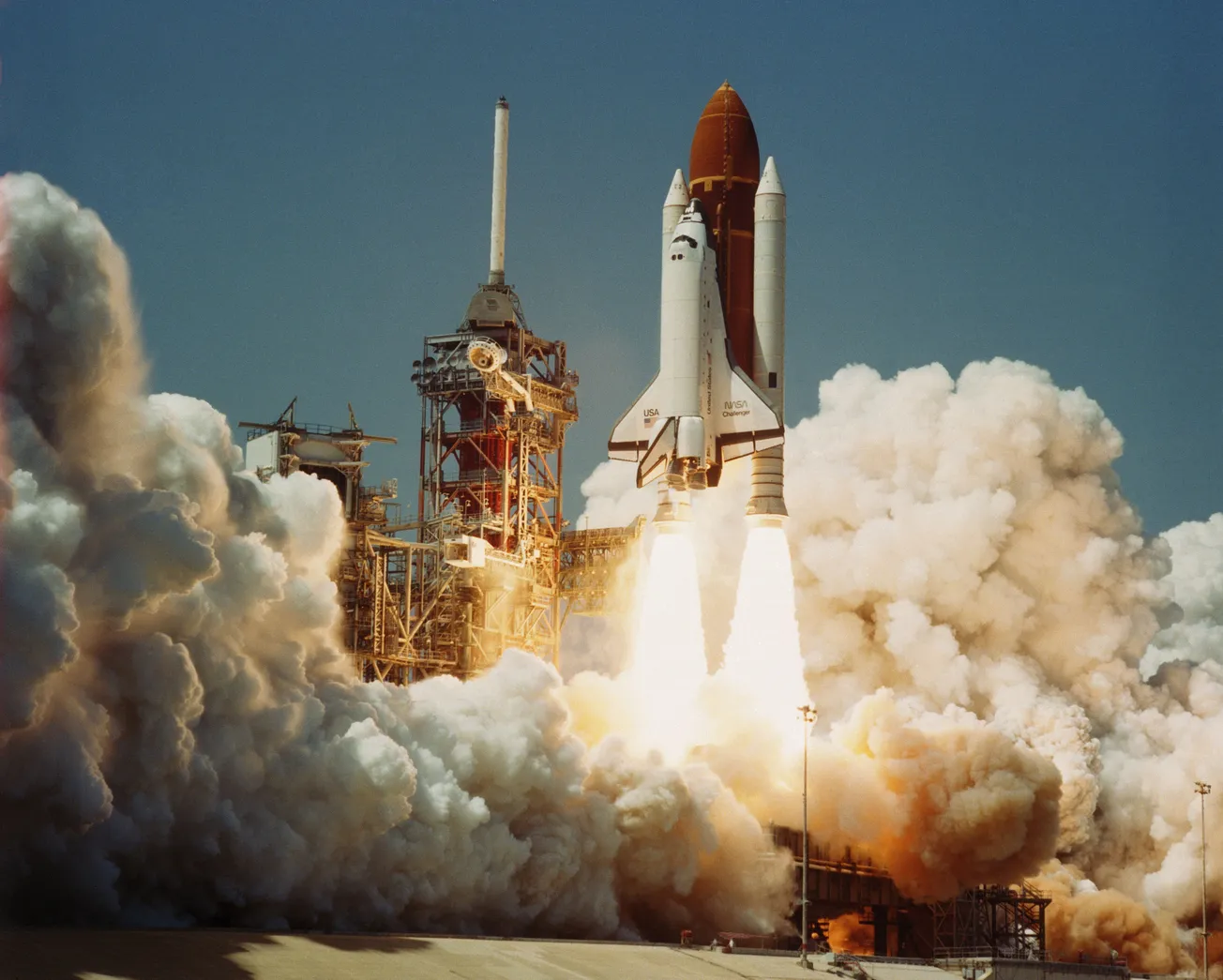
Our initial entry is President Reagan’s speech 40 years ago – on Jan 28, 1986 – in response to the explosion of the space shuttle Challenger.
Prelude: It was bitterly cold in Washington for Reagan’s scheduled State of the Union address. But it wasn’t the weather that intervened. Instead, the annual event was postponed by a tragedy that unfolded on national television and left adults explaining to children why a beloved public school teacher would never set foot in a classroom again.
Americans had become so complacent about the dangers of space travel that when Congressman Bill Nelson spent six days orbiting the earth in the shuttle two weeks earlier, few people outside his state of Florida even noticed. But Challenger’s voyage on this date, the 25th launch in the program, was a whole different story.
Among the crew was Sharon Christa McAuliffe, a beloved high school social studies teacher from Concord, NH, whose mantra to her students was: “Reach for the stars.” Unaffected and likeable, Christa McAuliffe had beaten out 11,000 other applicants to become the first schoolteacher in space. The 1985 ceremony to announce the winner – all 10 finalists were present – was broadcast live from the White House, with Vice President George HW Bush announcing the winner.
“She was just so excited,” her mother, Grace Corrigan, recalled later. “She was thrilled to be going on the trip of a lifetime.”
In an interview with journalist Annie Groer, her mother added: “She made everybody feel kind of good about themselves. She made the schoolchildren learn as much as they could and she taught them how important they were. That was what she was striving to do.”
Instead, America’s children, along with their parents and loved ones, learned a more painful lesson. “It was a televised event that involved the entire country,” recalled Sally Karioth, a nursing professor at Florida State University who specializes in grief counseling.
“We had this cute little curly-headed teacher in that blue astronaut outfit, and we had dragged in every kid in America to write her letters before the launch, so it was like Christmas Eve,” she added. “Then it blows up in the sky – and that’s the Grinch.”
That very morning, House Speaker Tip O’Neill had decided that the Grinch in Washington was Ronald Reagan. O’Neill had emerged from an Oval Office meeting fuming over what he considered Reagan’s high-handed attitude toward Americans who couldn’t find employment.
Then the unthinkable happened, and the two men quickly joined forces. White House officials wanted to know: Could the State of the Union address be postponed? Of course, came the answer from the speaker’s office.
Reagan himself learned of the tragedy just before the traditional State of the Union lunch with television network anchors. Acting Press Secretary Larry Speakes was giving Reagan some last-minute briefing points when White House aides rushed in with news of the Challenger disaster. They turned the television on and watched with horror, just like the rest of the country.
The president would later describe Jan 28, 1986, as “one of the hardest days I ever spent in the Oval Office.” Meanwhile, his speechwriting staff drafted an alternate presidential address. Delivered at 5pm, it is widely considered a rhetorical highlight of Reagan’s presidency.
“The future doesn’t belong to the faint-hearted, it belongs to the brave,” the president said that evening. “The Challenger crew was pulling us into the future, and we’ll continue to follow them.”
Reagan ended his 648-word homily by borrowing a passage from a World War II era sonnet:
“We will never forget them, nor the last time we saw them, this morning, as they prepared for their journey and waved goodbye and slipped the surly bonds of earth to touch the face of God.”
Three days later, the president and Nancy Reagan traveled to Houston for a memorial service for the fallen astronauts. On the plane, the first couple sat between the widowed wives of Challenger commander Francis Scobee and crew member Michael Smith. “I found it difficult to say anything,” Reagan recalled in his autobiography. “All we could do was hug the families and try to hold back tears.”
Reagan could do more, however, and he did when it was his turn at the lectern. Eulogizing each of the seven members of the crew by name, the president gave them their proper place in history: “America itself was built by men and women such as our seven star voyagers.”
“Sometimes when we reach for the stars, we fall short,” Reagan added. “But we must pick ourselves up again and press on despite the pain. Our nation is indeed fortunate that we can still draw on immense reservoirs of courage, character, and fortitude; that we’re still blessed with heroes like those of the space shuttle Challenger.”
Looking back on that ordeal, Tip O’Neill would later write that he had seen the worst of Ronald Reagan, and the best, in just a few hours’ time. “It was a trying day for all Americans,” O’Neill wrote, “and Ronald Reagan spoke to our highest ideals.”
YOU CAN WATCH THE VIDEO OF THE SPEECH HERE:
TEXT OF THE SPEECH:
Address to the Nation on the Explosion of the Space Shuttle Challenger
January 28, 1986
Ladies and gentlemen, I’d planned to speak to you tonight to report on the State of the Union, but the events of earlier today have led me to change those plans. Today is a day for mourning and remembering. Nancy and I are pained to the core by the tragedy of the shuttle Challenger. We know we share this pain with all of the people of our country. This is truly a national loss.
Nineteen years ago, almost to the day, we lost three astronauts in a terrible accident on the ground. But we’ve never lost an astronaut in flight; we’ve never had a tragedy like this. And perhaps we’ve forgotten the courage it took for the crew of the shuttle. But they, the Challenger Seven, were aware of the dangers, but overcame them and did their jobs brilliantly. We mourn seven heroes: Michael Smith, Dick Scobee, Judith Resnik, Ronald McNair, Ellison Onizuka, Gregory Jarvis, and Christa McAuliffe. We mourn their loss as a nation together.
For the families of the seven, we cannot bear, as you do, the full impact of this tragedy. But we feel the loss, and we’re thinking about you so very much. Your loved ones were daring and brave, and they had that special grace, that special spirit that says, “Give me a challenge, and I’ll meet it with joy.’’ They had a hunger to explore the universe and discover its truths. They wished to serve, and they did. They served all of us. We’ve grown used to wonders in this century. It’s hard to dazzle us. But for 25 years the United States space program has been doing just that. We’ve grown used to the idea of space, and perhaps we forget that we’ve only just begun. We’re still pioneers. They, the members of the Challenger crew, were pioneers.
And I want to say something to the schoolchildren of America who were watching the live coverage of the shuttle’s takeoff. I know it is hard to understand, but sometimes painful things like this happen. It’s all part of the process of exploration and discovery. It’s all part of taking a chance and expanding man’s horizons. The future doesn’t belong to the fainthearted; it belongs to the brave. The Challenger crew was pulling us into the future, and we’ll continue to follow them.
I’ve always had great faith in and respect for our space program, and what happened today does nothing to diminish it. We don’t hide our space program. We don’t keep secrets and cover things up. We do it all up front and in public. That’s the way freedom is, and we wouldn’t change it for a minute. We’ll continue our quest in space. There will be more shuttle flights and more shuttle crews and, yes, more volunteers, more civilians, more teachers in space. Nothing ends here; our hopes and our journeys continue. I want to add that I wish I could talk to every man and woman who works for NASA or who worked on this mission and tell them: “Your dedication and professionalism have moved and impressed us for decades. And we know of your anguish. We share it.’’
There’s a coincidence today. On this day 390 years ago, the great explorer Sir Francis Drake died aboard ship off the coast of Panama. In his lifetime the great frontiers were the oceans, and an historian later said, “He lived by the sea, died on it, and was buried in it.’’ Well, today we can say of the Challenger crew: Their dedication was, like Drake’s, complete.
The crew of the space shuttle Challenger honored us by the manner in which they lived their lives. We will never forget them, nor the last time we saw them, this morning, as they prepared for their journey and waved goodbye and “slipped the surly bonds of earth’’ to “touch the face of God.’’
This article was originally published by RealClearPolitics and made available via RealClearWire.