Ani O’Brien
Like good faith disagreements and principled people. Dislike disingenuousness and Foucault. Care especially about women’s rights, justice, and democracy.
In the days since I published my piece on Maiki Sherman and the “faggot” incident, the story has moved on. The incident itself is no longer really the point and in this second part I am focused on the lengths media went to in order to prevent the incident being reported on and how legal threats appear to be creating a state of paralysis in the industry.
We now have the extraordinary situation where media outlets are reporting on each other for using legal threats to suppress stories. Newstalk ZB broadcaster Mike Hosking has confirmed on air that TVNZ did send a letter to Newstalk ZB after a producer asked too many questions about the incident (told you). Hosking says the letter was “wide-ranging” in its scope and it certainly had the desired effect. ZB did not run the story.
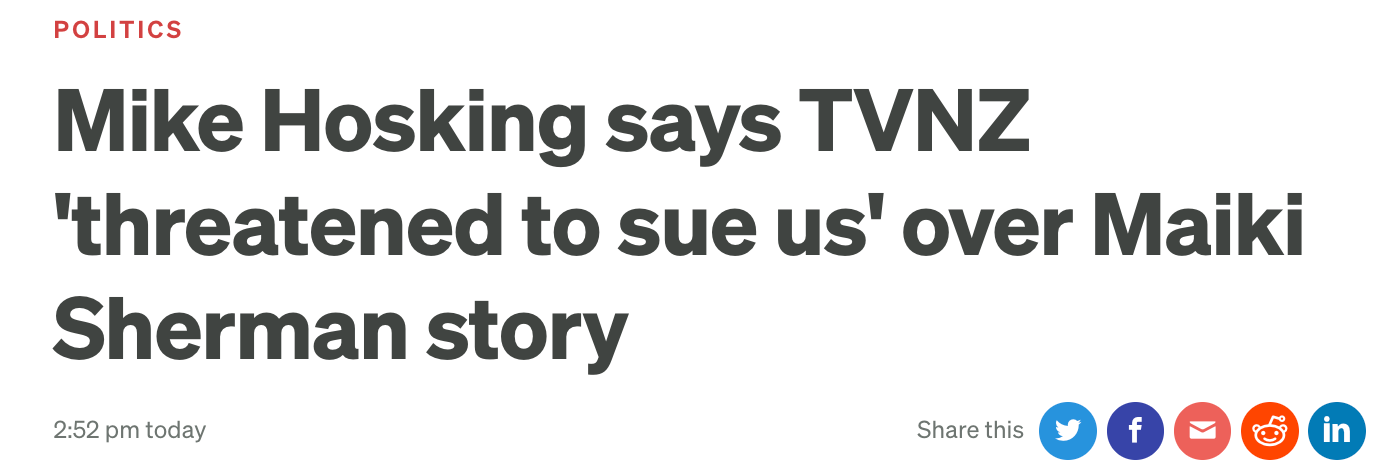
Naturally the NZ Herald, owned by the same parent company as ZB, wrote an article about this. And then Radio NZ published one. And then, to my astonishment, Stuff published an article about how TVNZ used a legal threat to silence another newsroom.
Stuff said:
Hosking also questioned whether it was appropriate for a state-owned broadcaster to take a legal approach toward another media organisation pursuing the issue.
Newstalk ZB is among the brands owned by NZME. Stuff has approached NZME for comment.
Why did this astonish me? Well, dear reader, I too received a letter threatening defamation action this week. I received it from Stuff.
After seeking advice from lawyers, I have decided to publish my correspondence with the chief legal officer from Stuff. I am doing so because it is such egregious hypocrisy for Stuff to question the appropriateness of taking “a legal approach toward another media organisation” while they are attempting to use the same tactics on me.
In the initial letter to me, Stuff’s chief legal officer begins by saying: “Please note that this message is confidential and not for publication.” There is no legal basis under which she can force me to be silent about this. Asserting confidentiality doesn’t make it so. And if this saga has made one thing clear, it should be that I am not afraid of the bullying tactics of establishment media.
Allison Whitney wrote:
Dear Ms O’Brien,
Please note that this message is confidential and not for publication.
We refer to your article published on Substack dated 28 April 2026, “Unreported for nearly a year: media misconduct in Parliament” (the Article). The Article contains the allegation that Stuff employee, Mr Burr, used a racial slur. This allegation is false, categorically denied by Mr Burr, and highly defamatory. There is no credible evidence nor any genuine witnesses to support the claim. Including a denial by Mr Burr does not provide a defence.
Further, you published these allegations without seeking a right of reply from Mr Burr or Stuff. In doing so, you have failed to meet the basic standards of responsible journalism and there is no legal defence available to you, including that of responsible communication on a matter of public interest.
Stuff Group stands by, and has complete faith in, Lloyd Burr’s account of the events and his conduct in Minister Willis’ office last May.
We require the immediate removal of all references to the defamatory allegation.
Mr Burr and Stuff reserve all rights.
Regards,
Allison Whitney
Chief Legal Officer
Historically, the chilling effect has been something journalists have invoked when talking about external threats. When governments threaten them with regulation and corporations threaten lawsuits, the media positions itself as the last line of defence for the public’s right to know. It is a hero’s narrative, and in some contexts, a justified one. But it rests on an assumption that the pressure always comes from outside.
Not so. Now the chilling effect is coming from inside the house. We already know that media organisations in New Zealand are not just reporting the news but are actively shaping what does and does not get reported on. But until now it appeared that this was largely through ideological decision making and the fact that our media class is overwhelmingly left-wing. This incident and its fall out add another dynamic to the situation in that not only are media companies internally gatekeeping stories, but they are creating barriers to reporting for other media companies through legal intimidation of each other.
TVNZ threatens Newstalk ZB. Stuff threatens me. I would be very interested to know if anyone else received a similar letter from Stuff this week, given I am far from the only one to report on this. In fact, Stuff themselves reported on it, which I mention in my response to the legal letter:
Dear Ms Whitney,
I acknowledge receipt of your correspondence regarding my article published on 28 April 2026.
I note your assertion that the allegation concerning Lloyd Burr is false, denied, and defamatory, as well as your concerns regarding the process followed prior to publication.
Since publication, Stuff has reported on the incident in question (“TVNZ political editor Maiki Sherman allegedly directed slur at reporter”), confirming that an event took place in the Finance Minister’s office at which offensive language was used, and attributing the allegations to my reporting. That coverage treats the matter as one of public interest and relies on the substance of the reporting, notwithstanding that it characterises my platform as a “blog”.
The article also contains comments from the Finance Minister confirming the incident took place.
In light of that reporting, it is difficult to reconcile the position set out in your letter that there is “no credible evidence nor any genuine witnesses” to support the existence of the incident. While I accept that there is a factual dispute regarding aspects of what occurred, the underlying event and its seriousness are now clearly matters of public record and discussion. More broadly, the article addresses issues of media conduct and accountability within the parliamentary press gallery, which are plainly matters of public interest.
Turning to your concern regarding right of reply, I accept that it is best practice to seek comment in advance of publication. However, I did note that he disputes the claim:
“Sherman has claimed this occurred in response to an alleged racial slur used by Burr, a claim he disputes.”
I also note that Stuff’s own reporting on this issue did not seek comment from me prior to publication, notwithstanding its reliance on my work and attempts to create a narrative that I was in cahoots with politicians in writing the article. I raise this not as a complaint, but to underscore that questions of process and timing arise on all sides when reporting on developing matters.
I also note that Stuff’s failure “to meet the basic standards of responsible journalism” is more egregious considering it is a news platform and its article reports me as a blogger not a journalist.
I do not consider that removal of the article is warranted. However, I am willing to consider any specific corrections of fact that you believe are required, provided they are substantiated.
Ani O’Brien
Stuff’s own reporting on the incident makes clear that something did happen in Nicola Willis’ office, that “offensive language” was used, that the event was shut down, and that the people involved have given accounts of what occurred. Nicola Willis has confirmed that she intervened to shut the event down.
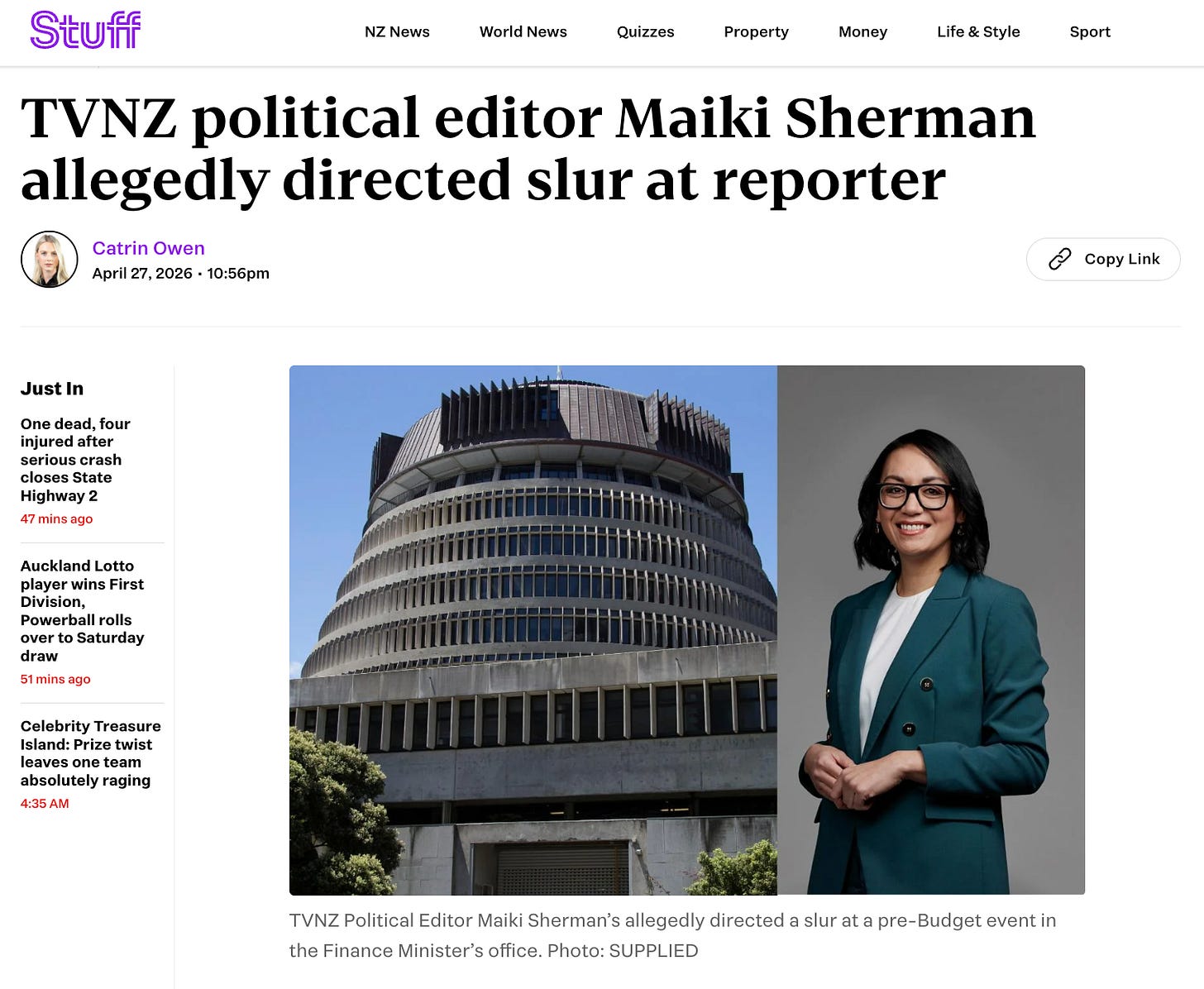
This is significant for two reasons. First, it directly undercuts the claim made in the legal letter I received that there is “no credible evidence nor any genuine witnesses” to support the existence of the incident. The existence of the incident is confirmed at ministerial level. The dispute is about what was said and by whom, not whether anything happened at all.
Second, it places the entire situation well outside the narrow framing of a private workplace issue. This was not an internal HR matter that occurred behind closed doors. It took place at an official ministerial event, in the finance minister’s office, in front of other members of the press gallery. That makes it a matter of legitimate public interest and it raises obvious questions about how it was handled, both at the time and afterwards, which is where we should now be focused.
We should be questioning why our state broadcaster felt it was appropriate to respond in that way it did, rather than providing clarity about what occurred and how it was addressed.
TVNZ is not a private company operating in a vacuum. It is a publicly funded broadcaster with explicit obligations around accountability and public trust. The use of legal pressure to suppress reporting, followed by a refusal to explain what occurred and how it was handled, raises serious questions about editorial judgement at the highest levels of the organisation. Who made the decision to effectively cover up the incident? Who instructed the lawyers? How much did they pay in the course of using lawyers to suppress the story? What is TVNZ’s version of events given Stuff has explicitly backed Lloyd Burr’s account?
At a minimum, there are then some fairly obvious questions that should now be put to Broadcasting Minister Paul Goldsmith as well. Does he consider it appropriate for a publicly funded broadcaster to deploy legal threats against other media organisations in response to legitimate journalistic inquiry? What expectations does he have of TVNZ when it comes to transparency and accountability in incidents involving its senior staff? Has he sought any briefing from TVNZ about the incident that occurred in the finance minister’s office and the organisation’s subsequent handling of it? Is he satisfied that TVNZ’s response, including the use of legal correspondence, is consistent with its role as a public broadcaster? What oversight, if any, exists when TVNZ uses resources to engage external legal firms in matters that may have the effect of suppressing reporting? Does he accept that the use of legal threats in this context risks undermining public trust not just in TVNZ, but in the media more broadly? If the incident has now been acknowledged at ministerial level, what justification remains for TVNZ’s continued refusal to provide clarity about what occurred? At what point does “we do not comment on employment matters” cease to be an adequate response when the matter clearly extends beyond internal employment issues and into the public domain?
I have left this to the real journalists, but, if they aren’t keen to pursue it, I will happily reach out to the minister myself.

As an aside, Stuff also quotes the finance minister saying:
The following day I checked in on the welfare of the reporter at whom the language was directed. He advised me he did not want to take the matter any further. I respected his decision.
This directly refutes another narrative framing of the incident prevalent online that this was about a bit of banter between press gallery colleagues. Willis clearly viewed Burr as the victim in this situation as she checked on him the next day. Additionally, others have reported that Maiki Sherman left the event in tears.
But back to the legal letter from Stuff. Here am I in the bizarre situation of simultaneously receiving aggressive legal correspondence about my Substack article while the sender of that correspondence is quite literally relying on that same piece in order to write and publish its own reports on the matter. They explicitly reference, and consequently draw attention to, the very article that they are alleging is defamatory. Either the reporting is so unreliable that it warrants legal intervention, or it is sufficiently credible to form the basis of your own journalism.
The focus of Stuff’s grievance is the brief reference to Maiki Sherman claiming that the incident was triggered by Lloyd Burr using a racial slur. I made sure to include that Burr disputes this which is pretty standard practice. The New Zealand Herald has done the same and included the comment from Burr that “I can tell you right now that I never used a ... slur to Maiki or anyone”.
I can totally understand Burr’s reaction to this. Being accused of being a racist and a bigot is a terrible thing when you consider yourself to be neither of those things. I can empathise given I have been mischaracterised very unfavourably over the years in similar ways. However, the media never blinked an eye when they called me anti-trans for speaking up about women’s rights, for example. That is why I wrote about that aspect (in a single sentence) as a claim by Sherman that is contested by Burr.
All of this speaks to a seriously concerning trend or collective behaviour in the New Zealand media industry that I hope my writing has put a spotlight on and will cause some self-reflection by media companies. That is that New Zealanders are not getting the full picture of what is going on politically in this country, not only because our media are being selective and gatekeeping, but they are also utilising legal action, or the threat of it, in a way that is frankly antithetical to the journalistic profession as it has functioned historically.
Journalists rely on the ability to report contested allegations. It is fundamental to how the industry operates and, without it, a significant portion of political and investigative reporting would simply not exist. The justification has always been that such reporting is legitimate when it is fair, clearly framed, and includes relevant context, including relevant denials.
The reliance on legal threat as a substitute for editorial decision making is, in my view, a terrible indictment on our media class. It contributes to an environment where, instead of asking whether a story is true, in the public interest, and can be stood up, the question becomes whether it is risk-free legally. Whether someone might complain and get lawyers involved. I have said it many times before, but legal threats against media have always been common place, however, previously this was treated as a kind of cost of business. The more interesting and explosive a story was, the more likely it was to anger someone in power and trigger a reaction.
But once newsrooms indulge or allow themselves to be influenced by litigious parties, the outcome is predictably that their stories get softer, or they are delayed as legal departments wring their hands. Or they disappear altogether.
We have now have a clear example of that process. A story with obvious public interest involving senior journalists, a government office, an official event in the ministerial calendar, and conduct that the finance minister herself described as involving “offensive” was not published by anyone. Not because it lacked substance or evidence, after all journalists witnessed it with their own eyes, but because they covered for their colleague and then a legal letter was sent to those who did look into it.
To me this looks to be part of the reactionary panic that the sector is experiencing currently because, for a long time, legacy outlets controlled not just publication, but legitimacy. If something appeared in a newspaper or on a broadcast, it was real. If it appeared anywhere else, it was not. That narrative control is now gone. Independent writers can publish, reach audiences comparable to or greater than mainstream media, and, occasionally, as I have done with this, force stories into the open that traditional newsrooms have chosen not to pursue.
The response to this shift and lack of control has not been particularly dignified. Instead of competing editorially by doing better reporting, by breaking the story first, and adding value, the instinct appears to be to reach for legal weapons.
Stuff have tied themselves in knots about my article by referring to me as having a “blog”, which is practically a slur in their circles. Other reporting on this has similarly made it clear that I am an outsider, not a journalist, but some renegade with a blog, which is all true, I guess. But it is pretty funny to be framed this way and then receive a legal letter than questions my “journalistic standards”.
They cannot have it both ways. If I am not a journalist, then your professional standards do not apply to me. If I am, then it is worth asking why I appear to be doing work that your newsroom did not.
It is difficult to avoid the conclusion that this is not about principle at all. It is about control. Control over who gets scrutinised, how that scrutiny is framed, and who is permitted to do the scrutinising.
I have received a second letter from Stuff and maybe I am being a sensitive wee flower, but the tone feels very hostile. Stuff has come in hot and combative with what feels like intent to intimidate and put me in my place. The second letter says:
Dear Ms O’Brien,
You have misread my original correspondence which specified that the allegation we take issue with is the allegation that Mr Burr used a racial slur. That is untrue and highly defamatory of Mr Burr. Reporting a denial does not provide a defence.
Your assertion that Stuff should have sought comment from you is misplaced. The only references to you were factual and in no way defamatory, and therefore did not necessitate seeking any comment from you.
We never asked for removal of the entire article. We only required removal of references to the defamatory allegation that Mr Burr used a racial slur. This could be achieved by simply deleting or re-writing the sentence referring to the “alleged racial slur” to remove the racial slur aspect.
I look forward to hearing from you urgently given the defamatory allegation has remained published on your substack for more than 24 hours now.
Regards, Allison Whitney
I haven’t replied to this. I suppose this piece can function as a response. It can function as an emphatic declaration that I will not be intimidated and won’t allow a big corporation to strong arm me into compliance. Maybe I am a fool, but when I think of the great journalists, who movies have been made about, they inevitably were the ones who refused to back down when the powerful flexed their muscles. Now, I am in no way comparing myself to the greats or even claiming to be a journalist, but I am suggesting that if New Zealand’s media were the ones investigating the abuses of the Catholic Church as the Boston Globe did (reflected in the film Spotlight) they would have buried the story the minute the Catholic Church sent in the lawyers.
I am publishing this correspondence not as a stunt, but because it is directly relevant to the matters I am trying to highlight. If legal threats are being used as a routine tool within journalism, then those threats are themselves a matter of public interest. New Zealanders should know that the news they are being offered has had the life squeezed out of it by legal departments and they are being kept in the dark on some issues entirely.
None of this is to suggest that the law should be ignored nor should there be a complete ignoring of risk assessments. Defamation law exists for a very good reason and reputations are important. Accuracy matters too. But so does consistency and intellectual honesty. So does truth and courage.
Legal threats are easy to make in the abstract. Fire off a letter and hope the recipient caves. They are much harder to sustain once they are challenged and even more so when they are publicised. That is why they demand confidentiality they are not entitled to. It is embarrassing for them to be caught out using these tactics. Sunlight, as they say is the best disinfectant.
The public does not see the internal machinations that result in stories being shelved or framed in a particular way. They see the eventual coverage, not the stories that almost ran and didn’t. They do not see the legal letters that the media are sending each other and to solo writers with a Substack and insomnia. Well, until said Substacker publishes them.
If New Zealand’s media wants to have a serious conversation about press freedom, and it clearly does, given the sudden interest in reporting on TVNZ’s behaviour in relation to this story, then it needs to start with an honest assessment of its own conduct. Because the system is under enormous external pressure in terms of shrinking resources and terrible lack of public trust, but it is also a system that is in some ways self-sabotaging and constraining itself. Journalists threatening journalists. Outlets threatening independent writers. Legal tactics not as a last resort, but as a first response: a knee-jerk reaction.
And all the while, the public is told that the press is under threat. And, as I say, it is. But my argument is that the threat is in large part not coming from outside. It is coming from inside the newsrooms.
This article was originally published by Thought Crimes.