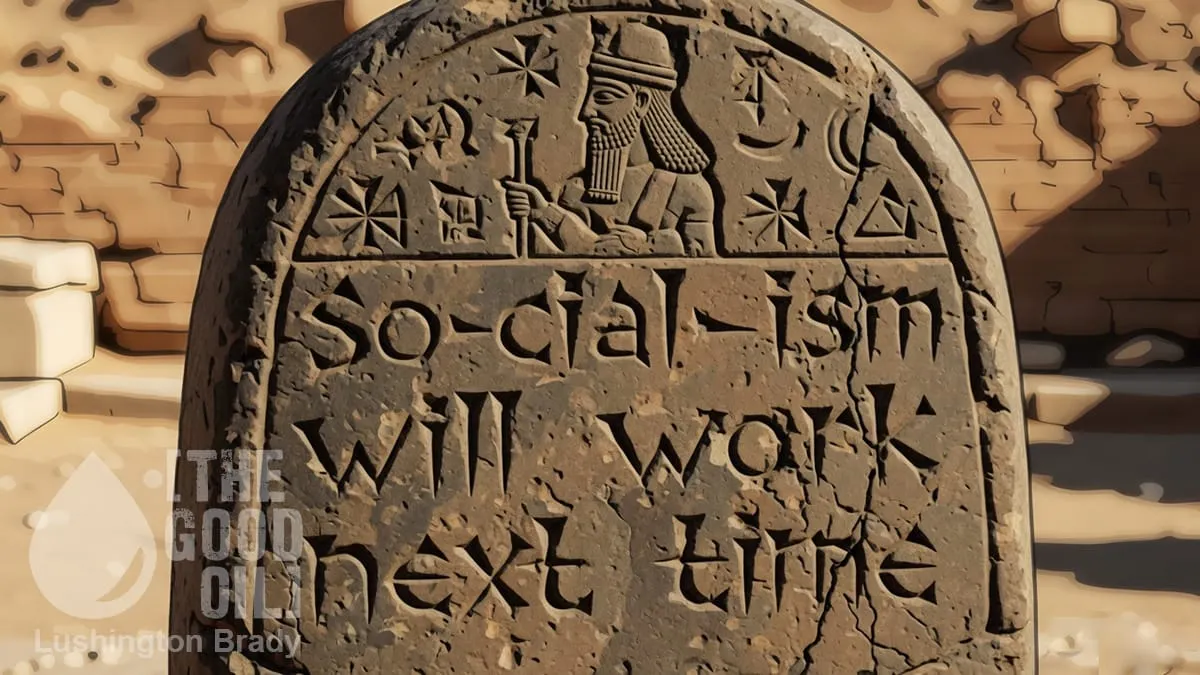
‘Socialism will work next time…’ If I had a dollar for every time I heard that, I’d be rich enough to be a socialist. We’ve been hearing the same excuse parroted ad nauseam since… well, just about forever.
In 1754 BC, the sixth king of Babylon wrote the famous Code of Hammurabi. While most attention focuses on the fact that it is one of the first examples of codified law, what is often ignored is that it is also one of the earliest recorded efforts at imposing a planned economy. As “economic heretic” Handre van Heerden puts it, it shows a king thinking he “can override laws of supply and demand with a chisel and a threat”.
The code set maximum prices on grain, wool, oil, and silver-denominated wages for laborers. A boatman earned a fixed rate. A hired ox cost a fixed rate. Violate the ceiling and you faced death. Hammurabi genuinely believed that price stability came from royal decree, not from the voluntary exchange of millions of individuals acting on real, local knowledge that no palace scribe possessed.
Nearly 4,000 years later, the socialist ‘king’ (or, more accurately, caliph) of New York is still trying to override the laws of supply and demand. Perhaps Zohran Mamdani should pick up a history book.
Here’s what happened. When Babylon fixed grain prices below market-clearing levels, merchants stopped selling grain openly. They held stock, moved it through informal channels, or waited. Shortages followed. This is not speculation: clay tablets from the Old Babylonian period record complaints about goods disappearing from markets and black market exchange at rates far above the official ceiling. Price controls suppress the visible supply of goods, which is considerably worse if you’re a Babylonian trying to feed a household.
This, as historian Frank Dikötter points out, in The Cultural Revolution: A People’s History, 1962–1976, is exactly what happened when Mao tried to enforce a planned economy. Enterprising Chinese were forced to work around the Communists’ dictates, mostly as a matter of survival. The black market thrived as some wily farmers carved off private plots from the communes and sowed forbidden crops that were highly profitable, and returned to condemned ‘capitalist’ enterprises such as animal husbandry and handicrafts. In south China, goods supposedly controlled by government monopoly were openly sold privately, while gangs of entrepreneurs roamed the coastline trading in prohibited goods.
‘Ah,’ your typical socialist airily handwaves. ‘That wasn’t real socialism.’
As I wrote recently, though, even the most thoroughgoing attempt at real socialism, Robert Owen’s model socialist township of New Harmony, Indiana, in 1825, failed just as hard. Despite millions in seed money and a ‘Boatload of Knowledge’ carrying scientists, teachers and intellectuals, the entire project collapsed in just two years.
Yet, here we are again, with yet another in the conga-line of socialist cretinism: the latest, but certainly not the last (if history has taught us anything, it’s that socialists never, ever learn from the past). Who wants to take bets on how long before Mamdani turns the second-richest city in the world into yet another failed socialist hellhole? Already, capital and brainpower is fleeing the Big Apple faster than Bernie Sanders dodging a day’s honest work.
Free market thinkers have pointed this out for centuries, and the mechanism never changes: a price ceiling set below what buyers and sellers would freely negotiate tells producers that the state values their goods less than those goods actually cost to produce. Producers respond rationally. They exit, hide, or redirect. The shortage is the controlled market functioning exactly as incentives dictate.
You are watching the same policy run on loop across 3,800 years of recorded history. Venezuela in 2014. Nixon’s price controls in 1971. Diocletian’s Edict on Maximum Prices in 301 AD, which Romans promptly ignored while Diocletian executed people for ignoring it. The edict collapsed within a decade. The interesting question is never whether price controls work. The interesting question is why each new government that imposes them believes it solved the calculation problem that destroyed every previous attempt.
If an airline persisted in flying a particular design of plane despite it crashing without fail every time it previously taken wing, they’d be jailed. But the defining characteristic of the ‘intelligentsia’ is that they never pay for never learning.