One of the more foolish conceits of the modern world is the fanciful notion that primitive, tribal humans lived in a state of harmony and eco-sensitive ‘caretaking’ with the natural environment. Politically, this Pollyanna delusion is weaponised by ‘indigenous activists’ and the mendacious post-modernist ‘scientists’ who are determined to drag genuine science to the same level as primitive superstitions. Worse, as Jared Diamond points out, this ‘Noble Savage’ mythology is “dangerous” because it implicitly carries the idea that, should tribal humans turn out to not live as Western fantastists believe, it casts them as evil despoilers.
And all the evidence is very much that they did not live in a Rousseau-esque Arcadian hippy commune. Like all humans, they had far more pressing concerns – such as not starving to death – than what their ‘ecological footprint’ might be. Unsurprisingly, then, the fossil evidence shows a clear pattern: as soon as humans showed up in a previously human-free environment, drastic ecological changes took place, including extinctions.
For instance, Aboriginal ‘firestick’ practices meant that vast ranges of formerly dense, wet forest along Australia’s east coast were wiped out, leaving the open grasslands that far better suit human hunters. At the same time, Australia’s megafauna, literally tons of meat with no learned fear of humans, abruptly disappeared. The same pattern repeated in the Americas and when Māori arrived in New Zealand.
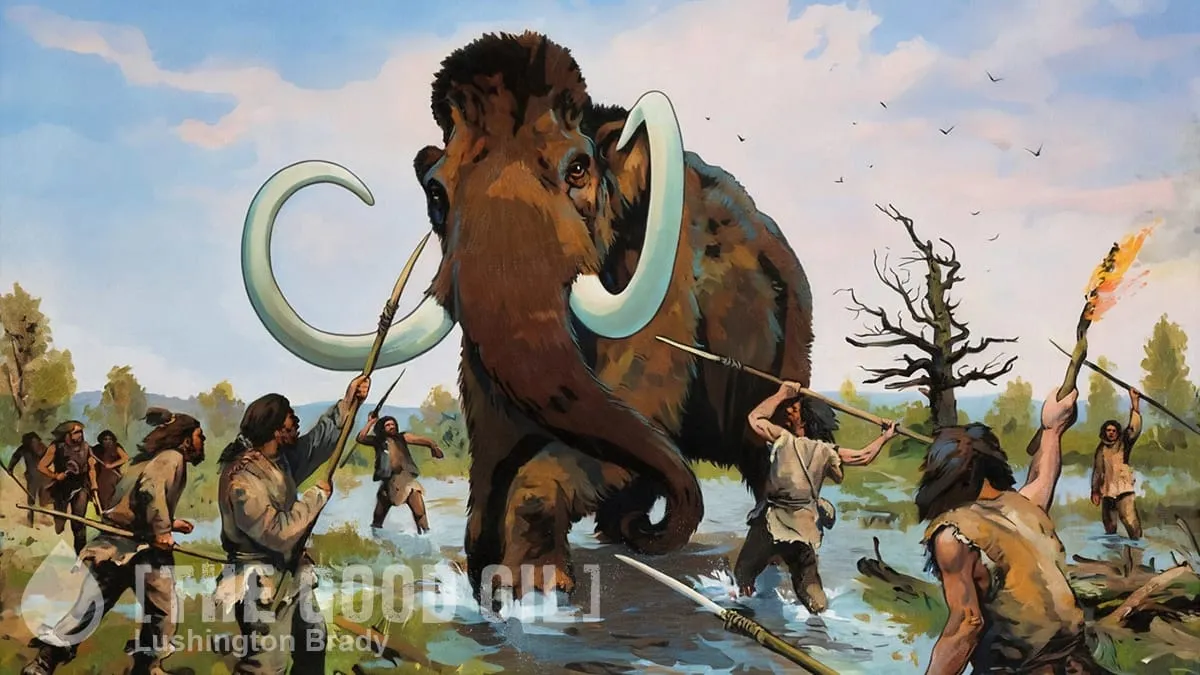
That primitive humans cared less about ‘environmental stewardship’ than they did about filling their bellies is further borne out by a new study that indicates humans hunted almost exclusively female mammoths. As any hunter today will tell you, hunting the female of a species is a very bad idea. Early humans didn’t care: they just wanted all that juicy meat and warm fur lumbering by.
An investigation of mammoth bones suggests that during the last ice age, people mainly hunted female animals. This is reported by an international team of researchers after analyzing the remains of more than 500 woolly mammoths in Europe, Asia and North America.
In clusters of mammoth bones, which are believed to date back to humans and which come exclusively from Eurasia, 70 per cent of the animals were female. Fossils from other sites, on the other hand, were 66.5 per cent from male animals, as the group writes in the journal Current Biology.
Why the discrepancy? The same behaviours we see in elephants today.
It appears that bulls were mostly solitary and possibly prone to the same sort of male recklessness we see in YouTube stunts filmed by human males today. Solitary bulls, it seems, were hard-headed idiots more prone to wandering into deadly terrain, such as natural traps, sinkholes or landslide areas.
Females, by contrast, played it safe: sticking together in large herds and following established, predictable migration routes. Behaviour that made them much more tempting targets when humans showed up.
Woolly mammoths (Mammuthus primigenius) were an important resource for the hunter-gatherers of the younger Paleolithic period. They provided meat, fat and fur; their ivory served, among other things, to make tools and jewelry. Materials from woolly mammoths were also integrated into burials, such as ivory pearls or mammochute leaves.
The team led by Hannah Moots from the University of Stockholm has now examined genetic material from 521 woolly mammoths. 100 of the genomes came from bones found in larger clusters where there was archaeological evidence of human activities – about 20,000 to 30,000-year-old fire pits. The remaining 421 genomes came from mammoths, the remains of which were found individually in many different places.
“By comparing the gender ratio of hundreds of mammoths in natural environments and archaeological contexts,” says David Díez del Molino of Stockholm University. “We can now deduce that mainly human activities are behind these accumulations.”
Whether the hunters deliberately targeted females remains open. Females were smaller, so easier prey in theory. At the same time, Moots says, “the females living in matriarchally organized herds may have had defense strategies that made an encounter with such herds just as risky or even more dangerous”. Yet the routes of those matriarchal herds may simply have been more predictable than the aimless wandering of lone bulls, outweighing the dangers of hunting a herd. Predictable food is good food when your next meal is never guaranteed.
None of this fits the soothing bedtime story of gentle earth-stewards living lightly upon the land. Early humans looked at a female mammoth the same way a modern farmer looks at a fat ewe: as dinner. They hunted what was available, what was predictable and what filled the belly fastest. Conservation biology was not high on the list of priorities. But beating starvation was.
The same ruthless pragmatism that emptied Australia of its giant marsupials and New Zealand of its moa operated on the mammoth steppe. When the opportunity arose to turn walking mountains of protein into steaks and spear-points, our ancestors took it. Even if targeting the females of the species accelerated the path to extinction in a world emerging from a glacial cycle.