Table of Contents
Nigel
Nigel is the founder, editor-in-chief, and lead writer at Pavlova Post, a New Zealand satire publication covering national news, local chaos, weather drama, politics, transport mishaps, and everyday Kiwi life – usually with a generous layer of exaggeration.
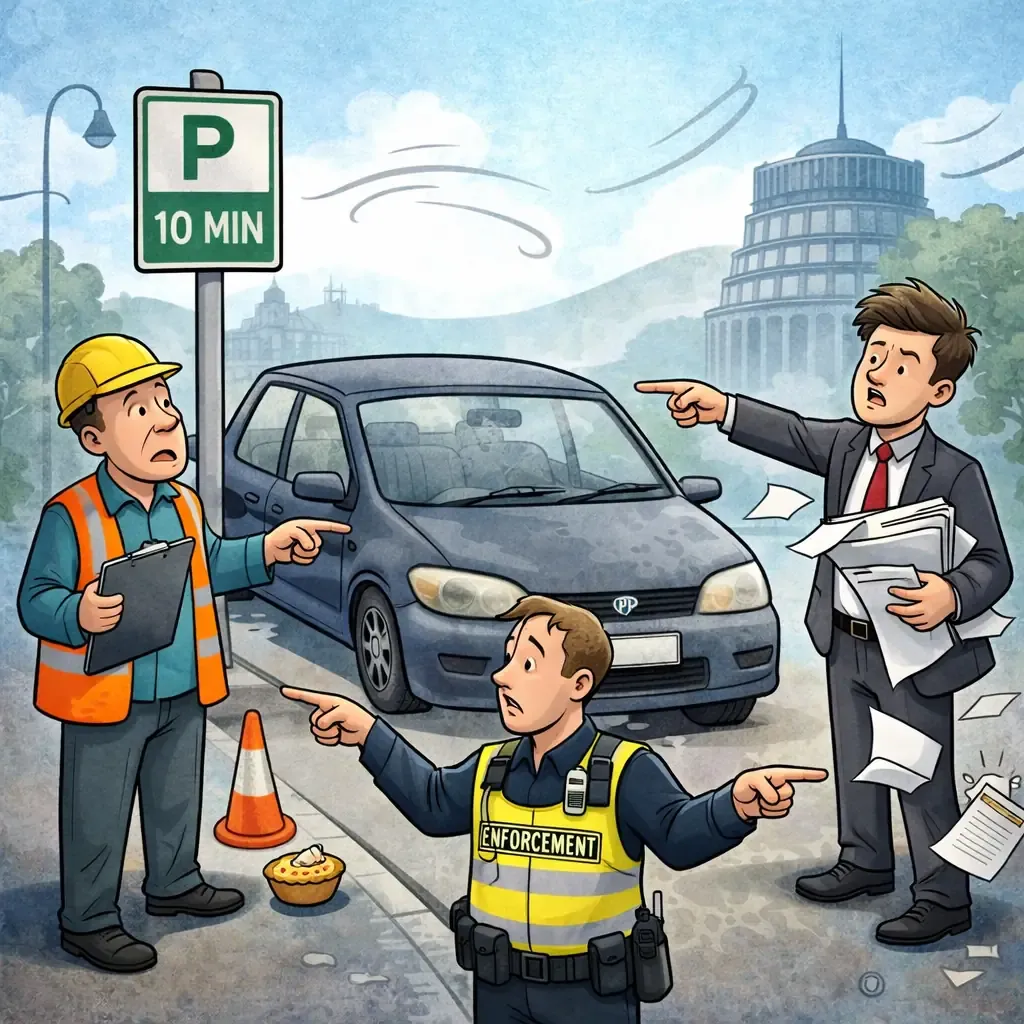
If you’re looking for a clean, modern example of how government agencies coordinate in 2026, I have fantastic news: the Wellington illegally parked car on Tory Street has become a living museum exhibit titled “Responsibility: An Interactive Experience.”
It’s been sitting there long enough to develop a fan base. People don’t even ask “why is it still there?” any more. They ask, “Has anyone tried calling the correct department, or are we still doing the Wellington classic where everyone politely explains why it’s somebody else’s job?”
According to reporting, a Wellington business owner says the car has been parked illegally in time-restricted spaces for about a year and has basically become semi-permanent – like the wind, like damp carpet, like a council consultation period that ends when the sun burns out.
How one car became the city’s newest permanent installation
Wellington is already famous for:
- wind that slaps you emotionally
- coffee that costs more than your first car
- and a civic vibe that screams “we’re progressive” while your bus disappears into the astral plane
So it makes perfect sense the city has now pioneered a new tourism product: Stationary Vehicle Watching.
You can picture it now: a couple from Hamilton standing outside the car with a Cuba Street tote bag like, ‘Wow. It really is… still there.’
Meanwhile a local walks past, doesn’t even blink, and mutters, “Yeah nah. That’s been there since the last time I believed in customer service.”
Local vibe check: taking the piss (because what else can you do?)
Down here in South Canterbury we have our own classics – roadworks that feel like generational curses, SH1 detours that rewire your personality, and council signage that reads like a poem written by a stressed-out printer. But Wellington’s special talent is different.
Wellington doesn’t solve problems.
Wellington processes them.
Wellington turns a simple towing job into a multi-agency relay where the baton is ‘not my department’ and the finish line is ‘we’ll circle back’.
The Official Statement That Makes It Worse
Somewhere in a fluorescent-lit office on Lambton Quay, a person has definitely said something like:
‘We take concerns seriously and are working with relevant stakeholders to explore an appropriate pathway forward.’
Yeah, nah.
That sentence is just Wellington for: “We have placed the issue in a folder labelled ‘Later’ and we’re hoping it develops legs and walks away.”
The problem isn’t that nobody can tow it. The problem is that towing requires someone to admit, out loud, “This is ours.”
And in Wellington, admitting ownership is basically the emotional equivalent of volunteering to run the next school sausage sizzle: suddenly you’re responsible for everything and everyone has opinions.
Fictional Interview #1: Brendon from Accounts, amateur policy translator
We spoke to Brendon (39), who works “in accounts” but speaks the language of bureaucracy fluently because he once tried to get a refund for a Snapper top-up.
“Look,” he said, adjusting his lanyard like it contained the secrets of the universe. “This isn’t a parked-car issue. This is a jurisdictional complexity event.”
He then explained the Wellington Blame Triangle:
- Council says it’s enforcement
- Enforcement says it’s legal
- Legal says it’s safety
…and safety says “please email us and allow 10–15 business years”.
Brendon believes the car has achieved a rare status: Too Annoying To Touch.
“Once something reaches that level,” he said, “it becomes part of the city’s identity. Like the Bucket Fountain. Like Courtney Place on a Saturday night. Like the feeling you get when a meeting ends with ‘no next steps’.”
Fictional Interview #2: Moana from a café, watching society collapse one latte at a time
Moana runs a little café near the action, and she’s seen the whole saga unfold the way a bartender watches a fight start: with tired certainty.
“Customers keep asking if it’s a prank,” she said. “But Wellington doesn’t do pranks. Wellington does permanent inconvenience.”
Moana claims the illegally parked car has become a moral lesson for the city:
“If you do something wrong confidently enough, people assume you’re allowed. It’s the same energy as someone cutting the queue at New World and saying ‘sweet as’ like it’s a legal document.”
When asked what should happen, she didn’t hesitate:
“Tow it. Or at least put a little plaque next to it that says ‘Wellington’s First Self-Sustaining Problem.’”
Fictional Interview #3: Gareth from Auckland, accidentally proving the point
We also spoke to Gareth from Auckland, who was visiting Wellington and immediately offered a solution with peak Auckland logic:
“Why don’t they just put parking rates up to like… forty dollars a minute?” he said, smugly, as if he’d invented enforcement.
We gently reminded him that Wellington doesn’t use money to solve problems.
Wellington uses emails.
Gareth nodded slowly, like someone learning about a culture that communicates through smoke signals.
The Sub-Plot: the passive-aggressive sign economy
As this car continues its reign, a secondary issue has emerged: Wellington’s passive-aggressive sign arms race.
At some point, someone will absolutely tape a laminated note to a nearby pole that says:
“PLEASE BE CONSIDERATE OF OTHER ROAD USERS ☺️”
Which in New Zealand translates to:
“I hope your next pie is lukewarm and your flat white tastes like printer ink.”
If you think this is minor, you don’t understand the Kiwi psyche.
We won’t confront someone directly, but we’ll create signage so emotionally loaded it could start a small war.
And once signage appears, the council has to respond, because signs are basically New Zealand’s unofficial constitution.
The Deep Dive: Consultant Glossary of Doing Nothing (Wellington Edition)
To help readers decode the next inevitable update, we’ve translated key Wellington phrases into English:
“We are aware of the issue.”
= We noticed, but we’d like it to stop being our problem.
“We are liaising with stakeholders.”
= We have forwarded an email to someone who will forward it again.
“A solution is being explored.”
= Someone suggested towing it and got told to “keep it constructive”.
“This falls outside our remit.”
= We would rather eat sand than touch this.
“We encourage the public to report concerns.”
= Please fill out the form so the system can auto-reply “thank you”.
This is the real genius of Wellington bureaucracy: it doesn’t deny reality. It simply reclassifies reality as “not currently actionable”.
So what happens next?
Realistically, this ends one of three ways:
- A tow truck finally arrives and everyone pretends it was always the plan
- The car becomes an official landmark and gets a tiny Wellington City Council logo
- The car is still there in 2046, and school kids take field trips to learn about “early administrative civilisation”
From the Temuka newsroom, we’ve seen enough council logic to know the safest bet is option three. Not even close, bro.
Because in New Zealand, a problem isn’t real until it inconveniences someone important – and even then, the response is usually: “She’ll be right.”
Until it isn’t.
And then we’ll hold a consultation.
GROWN-UP LINKS (Real Story)
- RNZ — Authorities under fire for failure to deal with illegally parked car
- 1News — Authorities under fire for failure to deal with illegally parked car
This article was originally published by Pavlova Post.