Penny Marie
NZ based independent investigative reporter, researcher, writer, coach, truth seeker. Founder of Let Kids Be Kids NZ.
New Zealanders have a long-standing allergic reaction to the thought of their vote being a ‘wasted vote’ come election day.
This has its historic roots in some of the rationale for kicking First-Past-the-Post to touch and adopting Mixed Member Proportional (MMP) as our electoral system in the first place. There were several elections under the First-Past-the-Post system where voters could rightfully feel aggrieved that their vote seemed to count for nothing.
Back in 1981, when Social Credit captured over 20 per cent of the national vote, it yielded just two seats in parliament. In the 1978 and 1981 elections, Labour won the nationwide vote but National won more electorates and became the government. That democratic mismatch – compounded by the radical economic overhauls rammed through by the Muldoon and Lange governments without a mandate – shattered the public’s trust and, eventually, sealed the argument for MMP.
Yet, three decades into proportional representation, the ghost of the wasted vote conundrum still haunts many voters as they enter the ballot box. Every election cycle, as polling day nears, minor parties hovering around the five per cent threshold trigger a wave of voter anxiety.
Kiwi voters want to back their true beliefs, but they dread watching their support vanish into thin air, potentially altering the balance of power in favour of their least favourite bloc.
This creates a self-fulfilling loop. Safe voting takes over, panic shifts support toward the safe major players at the last minute. This has left potentially viable minor parties such as The Conservative Party (2014), NZ First (2008) and Christian Coalition (1996) squeezed out at the wire. Each of these parties polled above the five per cent threshold in some pre-election polls. MMP was designed to ensure every vote counts – yet the psychological shadow of the threshold seems to keep New Zealanders playing it safe.
The ‘overhang’ election
The 2026 election cycle is serving up another rendition of wasted-vote watch. This time it is the The Opportunities Party (TOP) walking the five per cent tightrope. Early momentum made them look like a potential kingmaker, but as voters started to look past the Tinder-profile approach to campaigning into actual policy detail, support started cooling. If TOP makes it into parliament, the left-bloc may well be able to cobble together a four-party coalition and form the next government. If the threshold curse hits, hundreds of thousands of party votes will be distributed across all the other parties and TOP will disappear into obscurity for another three years.
There is an equally significant wasted-vote dynamic looming on the right that is flying under the radar...
The 2026 election is exposing a rare quirk of MMP mechanics, the potential for a major-party overhang. That comes with the potential that many party votes for the National Party won’t yield a single extra MP, despite them sticking to the standard two-ticks blue campaign.
The three right bloc parties will cross the five per cent threshold comfortably but the real challenge this election for the right is bad vote efficiency.
The National Party overhang explained
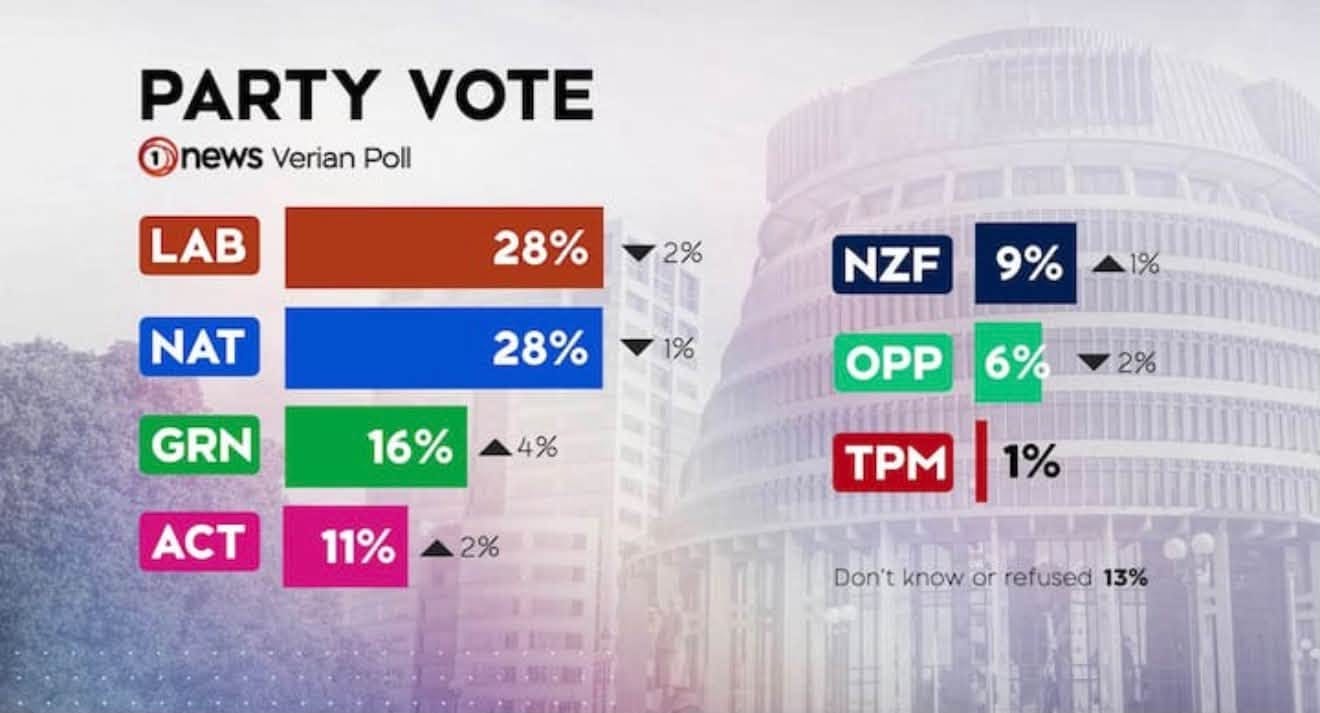
- The National Party is currently polling around 30 per cent just a couple of weeks before voting begins.
- If the polls are accurate, and in New Zealand they have been typically, the expected party vote would yield for National roughly 36 parliamentary seats.
- However, National currently holds 44 electorate seats and it seems likely to retain the vast majority of those local strongholds.
- Some commentators are predicting National will win 38–40 electorate seats this time around. It could win more given boundary changes and high profile Labour MPs like Megan Woods (list only) and Duncan Webb (retired) not contesting the electorates they currently represent.
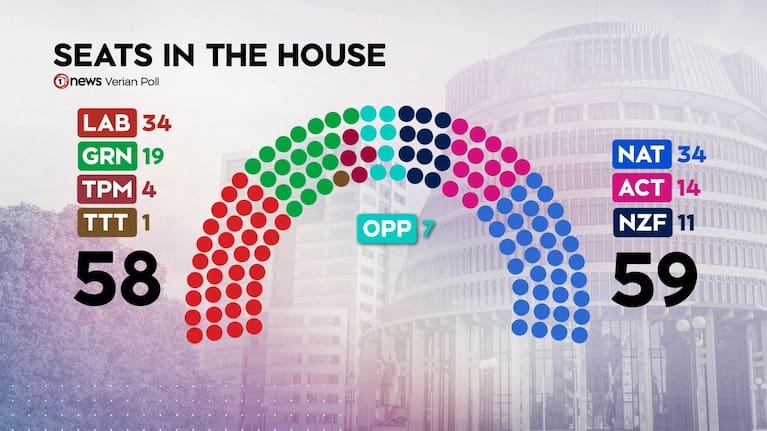
Under MMP rules, a party never loses an electorate seat it wins even if their proportion of the party vote is low. So, if National wins 38 electorates but are entitled to just 36 seats courtesy of a 30 per cent party vote, parliament won’t shrink National’s footprint to match its proportional share. Instead, the House expands to absorb the extra MPs. In this scenario, a very realistic one, there would be an overhang of two additional seats for National in a parliament of 122. Given Te Pāti Māori will likewise have an overhang, the parliament may well consist of 124 or more seats.
The resulting overhang for National could be more dramatic. It is not unrealistic to envision as many as eight extra seats via the overhang.
This could happen if the party vote drops below 30 per cent, a distinct possibility, and National wins contests in the likes of Nelson, Wigram or the new West Auckland electorates. This inflates the overall size of parliament by eight seats. However, rather than being penalised for a softer party vote, National keeps every single extra electorate MP.
The right-bloc gains a significant advantage courtesy of this overhang. The parliamentary majority target required to form a majority government is lifted when an overhang arises. In a standard 120 seat parliament 61 seats is the magic number. If the combined Te Pāti Māori and National Party overhang demands, for instance, a 130-seat parliament, the target is 66 seats. Nationals overhang of eight seats makes that number much easier to reach.
The triple threat
As a result of the pending National Party overhang, the 2026 election presents three ways for centre-right voters to accidentally waste their vote. Worse still, a well meaning right-bloc voter could inadvertently cast an electorate vote that damages the prospects of a right-bloc forming the government.
1. The party vote trap
We have been conditioned to believe that the party vote is the most important vote come election day. That has been the case until this election. The traditional “Two Ticks National” logic falls apart under current polling. This is because if the overhang results, a party vote for National yields zero additional MPs.
Remember, National will not bring in anyone off their list. Party votes for National won’t expand the right bloc’s footprint.
Let me say this again so you can get your head around it…
Under current polling, a party vote for National is a wasted vote if you wish to return a coalition government consisting of National, ACT and New Zealand First, which is the only viable centre-right combination. Sensible right-bloc voters will give their party vote to their preference of ACT or NZ First.
2. The electorate illusion
Casting candidate votes for ACT or NZ First in local electorate races is almost always a wasted vote because the National candidate is typically the only right-bloc candidate with a chance of succeeding.
There are exceptions such as Epsom and, maybe, Tāmaki where ACT candidates won three years ago. However, even here, this election provides a fascinating paradox. Epsom’s strategic voting strategy, conjured up over famous cups of tea, has saved the right-bloc previously. If it continues it will harm its chances this time around. David Seymour winning Epsom doesn’t add an extra seat to the right bloc – ACT will simply claim its proportional share of its party vote.
Whereas, electing National’s Paul Goldsmith in Epsom would actually trigger an additional overhang seat, handing the right bloc an extra seat. It would also again give Epsom two MPs. If Seymour wins that seat, Goldsmith will depart parliament because his high list ranking will not save him. Sensible right-bloc voters in Epsom and Tāmaki will vote for the National Party candidate even if they prefer ACT.
3. The vote-split hazard
In tight swing seats, splitting the candidate vote hands Labour a path through the middle. Look no further than Nelson, where Labour won by a razor-thin 29 votes in 2023 while ACT and NZ First candidate votes totalled over 4,300.
In previous elections, losing an electorate seat in this manner did not matter much to National. The party-vote allocations simply delivered one more list MP. With an overhang in play, however, every lost electorate shrinks the right’s total seat count. Sensible right-bloc voters will vote for the National Party candidate in all but the safest of National Party electorates.
The 2026 version of ‘strategic voting’
There have been a few enlightened commentators promoting the obvious strategic overhang strategy for right-bloc voters unique to this election. The best result for the right-bloc will stem from split voting:
The candidate vote to the National candidate in each electorate and the party vote to either ACT or NZ First.
This will mean National will maximise its electorate seats. And in so doing maximise its overhang. It is also likely to give a bump in party vote to the ACT and NZ First as people who, according to the polls, were National voters who realise they are free to vote elsewhere. Therefore, the party vote for ACT and NZ First is maximised at the cost of National’s party vote, remembering that the party vote for National will not result in more seats for National.
The stakes are high. If TOP gets to the five per cent threshold, a significant National overhang may be the only way for the right-bloc to form a majority government.
Why aren’t we seeing National encouraging their supporters to split their vote?
Why are they persisting with a “two ticks blue” campaign? Why are they acting as if the party vote is the most important?
Ex PM John Key made a speech at the National Party campaign launch this week, disagreeing with the commentators suggesting strategic voting, and analysed by Winston Peters here.
Could principled motives be driving this, ensuring an election strictly via the popular vote? That seems doubtful. Perhaps it stems from a desire to avoid appearing to manipulate election outcomes. Far more plausible, however, is plain self-interest.
National appears to favour the prospect of a slim victory with greater leverage in post-election coalition talks over a decisive right-bloc win bolstered by empowered coalition partners who have benefited from a split vote strategy. Additionally, key individuals within National face a direct disincentive toward an overhang. For high-ranking list figures like Nicola Willis (ranked second) and Chris Bishop (ranked third), an overhang scenario would force them out of parliament entirely – a devastating loss of prominent sitting MPs and key ministers.
Rumours suggest that National campaign managers are advising candidates in tight electorates to focus exclusively on securing the party vote. If these rumours are true, National is effectively intentionally underperforming in electorate races to ensure figures like Willis and Bishop enter parliament via the party list, a strategy that dangerously opens the door for a left-bloc victory.
Value Your Vote
Family First’s Value Your Vote guide is out now, make use of it to assist in your choices this election. Your vote matters.
What are your thoughts?
This analysis has been co-written with a passionate political analyst. Together we want what is best for New Zealand, and this election is not only exceedingly important given the situation in both within New Zealand but also globally.
This article was originally published by pennymarie.com.