Table of Contents
In his novel State of Fear, Michael Crichton used America’s Yellowstone National Park as a cautionary tale in ‘environmental management’.
Yellowstone was America’s first national park and, after visiting in 1903, Theodore Roosevelt created a new federal bureaucracy whose sole job was to maintain the park in its original condition.
Yet within 10 years, the teeming landscape that Roosevelt saw was gone forever. And the reason for this was the park managers – charged with keeping the park in pristine condition – had taken a series of steps that they thought were in the best interest of preserving the park and its animals. But they were wrong.
– Michael Crichton, “State of Fear”.
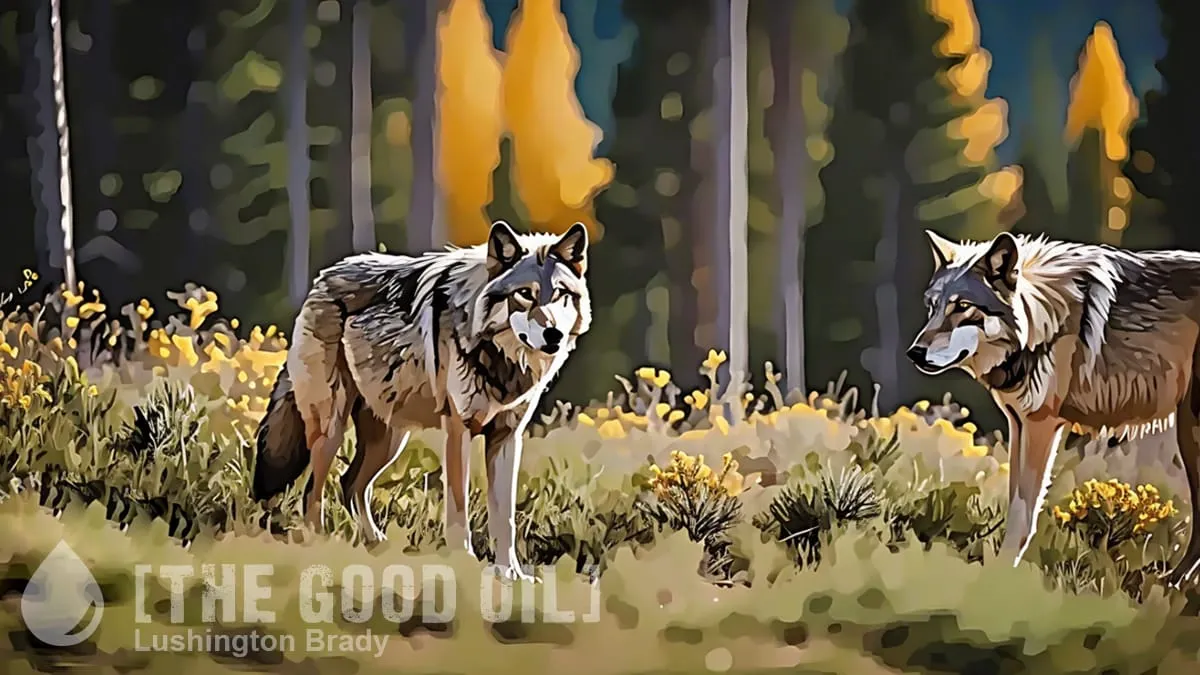
One of their first missteps was to eradicate the wolves, which they assumed were about to make the elk extinct.
Protected, the elk herds exploded, and ate so much of certain trees and grasses that the ecology of the area began to change. The elk ate the trees that the beavers used to make dams, so the beavers vanished. That was when the managers discovered beavers were vital to the overall water management of the region.
When the beavers disappeared, the meadows dried up; the trout and otter vanished; soil erosion increased; and the park ecology changed even further.
– Michael Crichton, “State of Fear”.
After more than 60 years, wolves were re-introduced. Now, for the first time in nearly a century, a new generation of aspen trees is flourishing for the first time.
As wolf numbers rose, the elk population in the park dropped sharply, and it is now down to about 2,000.
In the new study, published Tuesday (July 22) in the journal Forest Ecology and Management, [Luke Painter, an ecologist at Oregon State University] and his colleagues surveyed aspen stands – specific areas of the forest where these trees grow.
The team returned to three areas surveyed in 2012 to examine changes to aspen sapling numbers. Of the 87 aspen stands studied, a third had a large number of tall aspen saplings throughout, indicating the trees are healthy and growing. Another third of the stands had patches of tall saplings.
But Crichton’s essential point was that no action – or even inaction – in an environment is without consequence.
The world is alive, Ted. Things are constantly in flux. Species are winning, losing, rising, falling, taking over, being pushed back… Ours is a changing world, and if you want to preserve a piece of land in a particular state, you have to decide what that state is, and then actively, even aggressively, manage it… Because any action you take causes change in the environment, Ted. And any change hurts some plant or animal. It’s inevitable.
– Michael Crichton, “State of Fear”.
However, while Yellowstone’s quaking aspen are recovering, they aren’t out of the woods just yet. The elk population has declined, but bison (Bison bison) numbers have increased in some areas in recent years.
Bison are a lot harder for wolves to take down, said Painter, so increasing numbers of bison may be emerging as a new constraint on aspen in some areas.
Which means that the bison may well be on the hit-list for park rangers, and this will have its inevitable knock-on effects (not to say, inevitably outraged animal activists). “Any change hurts some plant or animal.”
And benefits others: “Species are winning, losing, rising, falling, taking over, being pushed back.”
The re-emergence of aspen has widespread effects, he told Live Science. “Aspen are a key species for biodiversity. The canopy is more open than it is with conifers and you get filtering light that creates a habitat that supports a lot of diversity of plants.”
This means a boost to berry-producing shrubs, insects and birds and also species like beavers, because the trees are a preferred food and building material for the semi-aquatic rodents, along with the willows and cottonwoods that grow near to water in the region.
There are also hints that the number of bears and cougars in the region have increased since wolves were introduced, Painter said, but it’s not clear why.
Anyone who studied high-school biology just a generation ago will be familiar with the term, ‘the web of life’. Grasping in full what that really means, though, is something few of us ever understand or are willing to admit.