Former US General Norman Schwarzkopf famously said that he was “just an instrument of policy”. That may sound like a cop-out, but it’s a fundamental truth. If war is, as Clausewitz said, a continuation of politics by other means, then the ultimate responsibility for acts committed in wartime rests with the politicians. The war buck stops at a president or prime minister’s desk.
US President Harry Truman brutally reminded Robert Oppenheimer of that fact during their Oval Office meeting after the nuclear bombings ended WWII. Suffice to say, Truman didn’t take Oppenheimer’s weepy contrition too well. “Blood on his hands, dammit, he hasn’t half as much blood on his hands as I have. You just don’t go around bellyaching about it,” Truman said to Secretary of State Dean Acheson.
Reiterating the sentiment, Truman stated in 1948 that, “The president cannot duck hard problems; he cannot pass the buck”. Australian politicians and the Australian Defence Force’s brass never got that memo. For them, it’s buck-passing all the way down. When, without a single court-martial, the ADF proposed summarily stripping all enlisted ranks from the Afghanistan war of their combat decorations, over so-called ‘war crimes’, the brass specifically excluded themselves.
For one former senior commander, that’s just not good enough.
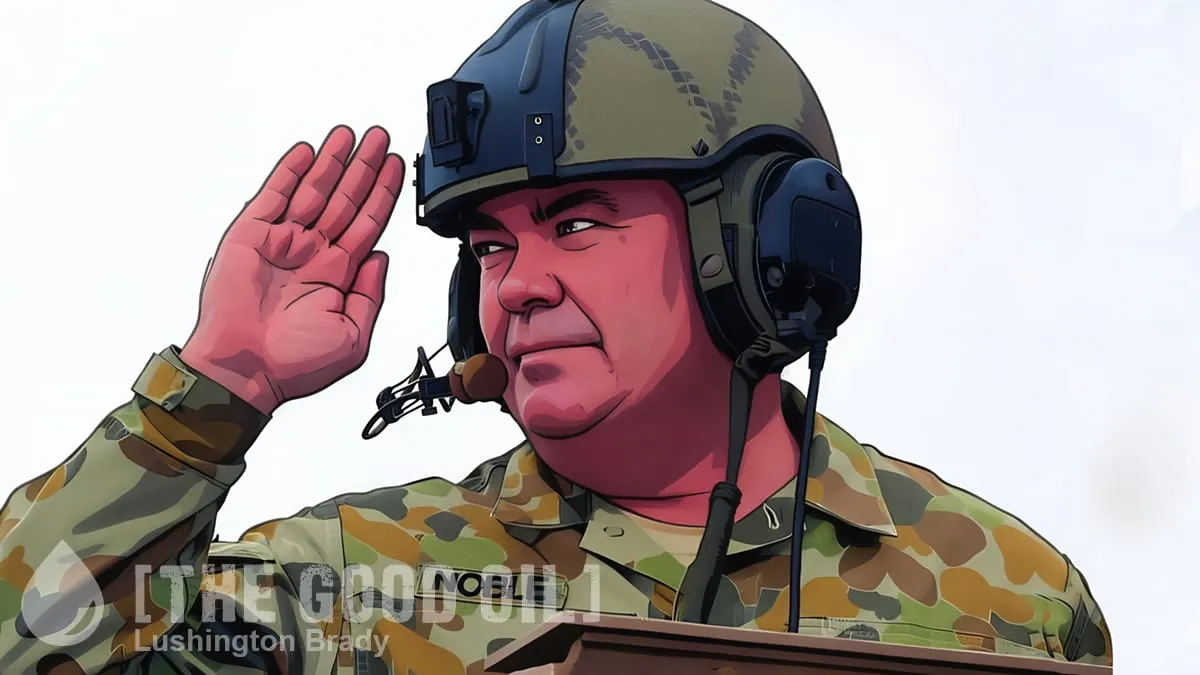
Roger Noble ordered the deaths of countless people during his 26-year army career. “I was a strike authority in Iraq, so I gave lots of orders to shoot people,” the retired major-general says.
Sometimes mistakes were made and the wrong people died. But Noble – one of Australia’s most operationally deployed commanders – is untroubled by the life-and-death decisions he made wearing the nation’s uniform.
“It’s very disciplined and considered,” Noble tells Inquirer. “The laws of war guided what we did. If ever there was an allegation, we got investigated. But I found it was a moral defence, so you can reconcile with having to kill people.”
But where Noble says, ‘we’, the ADF desk-jockeys and careerists say, ‘anyone but us’.
He is scathing of the selective moral theatre that followed the Brereton report. The inquiry found 39 Afghan civilians and prisoners murdered by Australian soldiers, yet Brereton ruled that “responsibility and accountability does not extend to higher headquarters”. In particular, it excused the joint taskforce commander of 2011, then Major-General Angus Campbell, later chief of the Defence Force.
Noble rejects that convenient break in the chain.
Says Noble: “I don’t agree with the premise that (the chain of command) breaks in the middle.
“(Campbell) was in the chain of command. I think if you’re in the chain of command, you hold responsibility for those (actions by subordinates).”
Harry Truman never personally dropped a bomb on a city, but he unflinchingly admitted to the blood on his hands. He certainly wasn’t about to dodge responsibility.
In his turn, Noble acknowledges the difference between the sterile calculus of a strike authority and the close-quarters chaos faced by a Victoria Cross winner like Ben Roberts-Smith. The transition from combatant to non-combatant is rarely clean when the enemy is metres away and one of the villagers surrounding you.
More importantly, justice delayed is justice denied. Allegations must still be tested, and tested quickly, not left to fester for 20 years. But the idea that only the men at the sharp end carry the stain, while the men who sent them and the politicians who ordered the war wash their hands, is pure institutional cowardice.
The ADF’s attempt to strip medals from the ranks while shielding the brass was the purest expression of that cowardice. Noble is simply stating the obvious that the brass refused to face: if the private is accountable, so is every link above him, all the way to the prime minister’s desk.